 Mekong Monitor
Young Robot Builders Aim to Tackle Everyday Problems
Students from Happy Chandara school showcased their robots at FrancoTech in Phnom Penh, after months of building, testing and troubleshooting. Their goal is to use robotics to solve real problems, such as safer school crossings.
Grade 11 student Tharn Chandy has already helped build a sumo robot, a machine designed to shove rivals out of the competition ring. Her next ambition is closer to home: making streets safer for children crossing outside their schools.
A student at Happy Chandara, she hopes to design a smart traffic device for school crossings. It would apply the engineering skills she has sharpened through robotics to a problem that matters to her community.
“Later on, I want to take part in problem-solving contests and build robots that serve the community,” she said. “Specifically, I'd like to make a smart traffic system that helps students get across the road safely in front of their schools.”
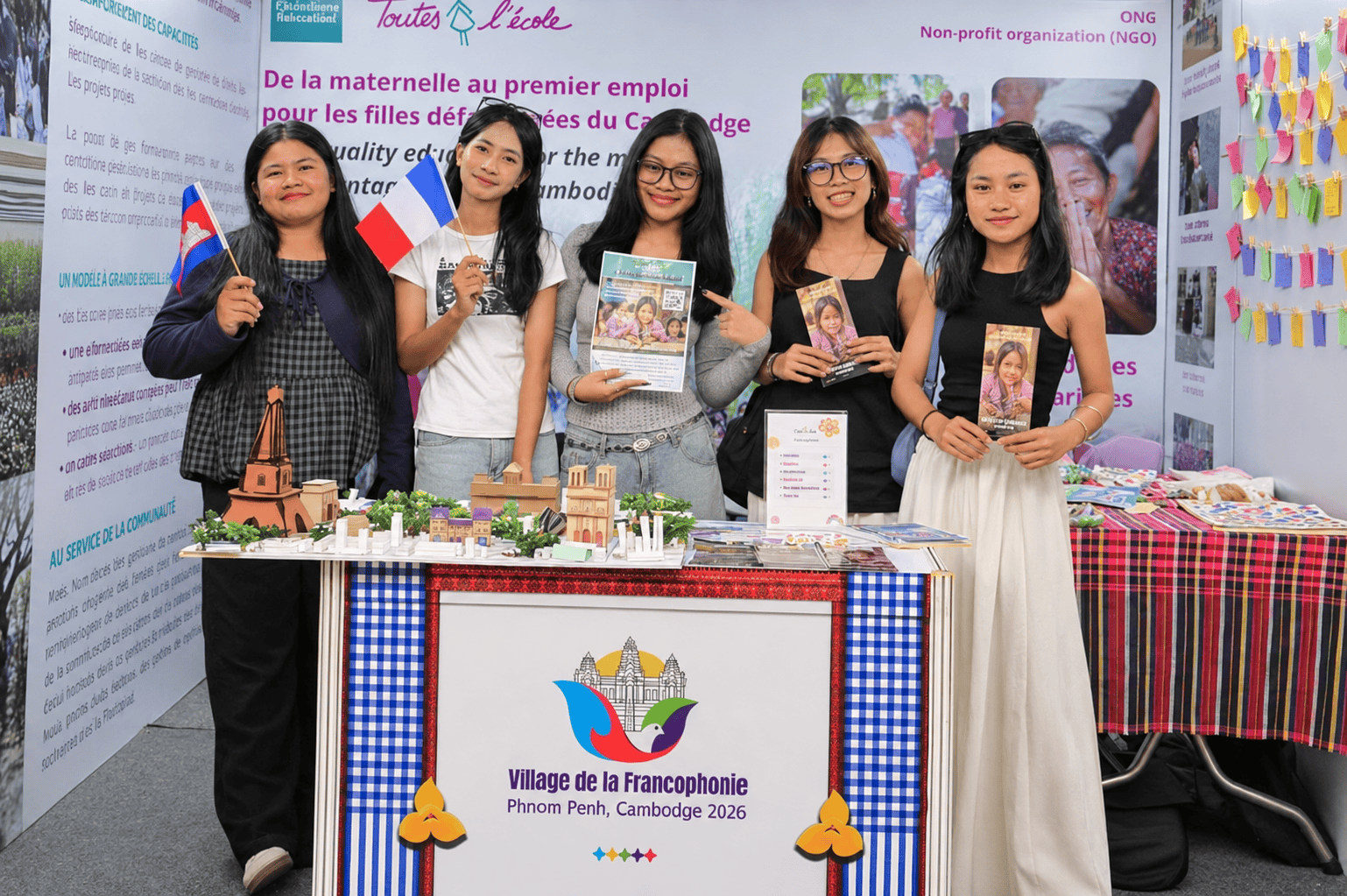
Chandy, fellow Grade 11 student Chuon Zana and Grade 10 student Son Socheata presented their robotics projects at FrancoTech, an event held alongside the 20th Summit of La Francophonie in Phnom Penh.
Behind those demonstrations lies months of work: designing, building and testing machines, tracking down faulty wiring and learning to keep going when a program refuses to cooperate.
Chandy and Zana won second and third place in the Senior Sumo category at the Cambodia Robotics Olympiad. At FrancoTech, the pair explained how their robot worked and shared the pride of that result.
Zana took part in nearly every stage, from the first design and assembly to testing, splitting the workload with her teammate. In one trial, the robot failed to move as it should. Instead of redesigning it on the spot, the pair inspected the connections and found that several parts had not been wired properly. “We figured out the issue together, repaired the connections and tested it again to confirm it worked,” she said.
The episode taught her how mechanical design works and how individual parts depend on one another. It also showed her why critical thinking and quick responses matter when technical faults appear mid-competition. She hopes to get better at diagnosing and fixing faults under pressure, and eventually to build robots with real-world uses.
Chandy faced a similar lesson while working on her robot's frame and electronics. During testing, she and her team found that the left and right motors were wired in reverse, so the machine drove the wrong way. “We had to take the chassis apart, solder the connections again properly and reassemble everything,” she explained.
The project showed her how hard it is to build a frame that is both sturdy and balanced enough to compete.
Months of Preparation
Supervising teachers said the students spent roughly three months on the work, covering design, assembly, remote-control setup, testing and refinements. The sumo and tug-of-war events demanded attention to strength, weight, size, movement, stability and control. Chandy and Zana first developed their interest and hands-on skills in the school's Technology Club.
Alongside the sumo robots, the FrancoTech display also featured a tug-of-war robot and a LEGO machine built for RoboMission.
Socheata focused mainly on the LEGO robot, learning to program it with block-based coding. “I liked working with my team and seeing how code lets a robot carry out different tasks,” she said.
Her first encounter with LEGO robotics came in Grade 9, and she later picked up basic 3D modelling at a school summer camp.
Her first competition was a tougher test. Nervous while running her robot on the competition board, she lost track of her code. A teacher later helped her put the programming blocks back in the right order.
Her team did not win, but she was not too discouraged. “It was our first time, so we gained real experience and learned a lot from our mistakes.”
The project taught her to solve problems quickly and keep trying when something goes wrong. She now wants to move beyond LEGO and explore other kinds of robotics.
Teachers Step Back
The supervising teachers said the students made their own choices about structures, materials, mechanical designs and how the robots operated, then identified weak points through testing. Teachers supplied the engineering basics, helped select components and guided troubleshooting, while encouraging independent decisions.
“We pushed students to share ideas, collaborate and make their own decisions throughout, instead of just following instructions,” they said.
Happy Chandara, supported by the French NGO Toutes à l'École, provides education to disadvantaged girls in Cambodia. According to a press release dated November 18, the school showcased its FabLab at the France Pavilion at FrancoTech, at the invitation of Dassault Systèmes, which funded the facility.
For Socheata, the next step is exploring unfamiliar technology. “I want to try new technologies, gain varied experiences and push myself with fresh problems,” she said.