 Mekong Monitor
Wanted North Korean Hacker Park Jin-hyok Resurfaces Amid Binance Heist Probe
Park Jin-hyok, a North Korean programmer wanted by US authorities since 2018, is back in the spotlight after the FBI linked a $6.3 billion Binance crypto theft to North Korean hackers. His alleged role in earlier cyberattacks offers a window into Pyongyang's evolving cyber operations.
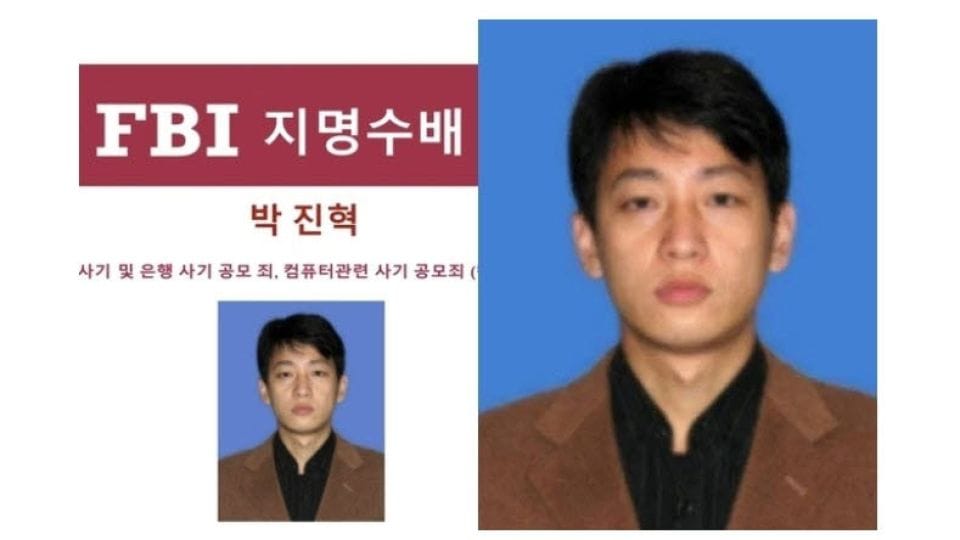
Park Jin-hyok, a North Korean programmer the United States has sought since 2018, is drawing fresh attention as investigators look at how Pyongyang's cyber operations have evolved.
The renewed interest follows an FBI finding that North Korean hackers, operating under the name TraderTraitor, carried out the October 29 theft of roughly $6.3 billion in cryptocurrency from Binance. US authorities have not named Park as a suspect in that breach. Still, his alleged role in earlier attacks offers a clear picture of how North Korea's cyber capabilities have grown over the past decade.
Park is believed to be a member of the Lazarus hacking group and has been on the FBI's wanted list for more than eight years. He is accused of taking part in operations ranging from the 2014 Sony Pictures hack to the theft of millions of dollars from Bangladesh's central bank. The FBI's public notice says he was probably born in 1981 or 1984 and has used several aliases, including Jin-hyok Park, Pak Jin-hek and Pak Kwang-jin.
A federal arrest warrant was issued in June 2018, and a criminal complaint was made public that September. Investigators linked Park to a state-sponsored hacking conspiracy tied to the Reconnaissance General Bureau, the regime's military intelligence agency. Security researchers use the names Lazarus Group and APT38 to describe different parts of that network.
Park reportedly worked for more than ten years at Chosun Expo Joint Venture, a software firm with operations in North Korea and China, including the northeastern Chinese city of Dalian. The company presented itself as a legitimate technology business serving international clients. US prosecutors, however, argued that it was a front for North Korean intelligence that mixed ordinary software development with covert hacking.
A Decade of Disruptive Attacks
The allegations date back to a period when North Korea's cyber activity drew global attention mainly for being disruptive and politically driven.
In 2014, hackers breached Sony Pictures Entertainment ahead of the release of “The Interview,” a Hollywood comedy about the assassination of leader Kim Jong-un. They stole confidential corporate data, leaked employees' personal information and damaged thousands of computers. US authorities blamed North Korea and alleged that Park took part, calling the attack retaliation for the film.
Two years later, the same network was reportedly behind a very different scheme: an attempt to steal close to $1 billion from Bangladesh's central bank. In February 2016, hackers broke into the bank's systems and used the SWIFT international messaging network to send fraudulent transfer orders to the Federal Reserve Bank of New York. Security checks and other irregularities stopped most of the transfers, but about $81 million was taken. The case showed that cyber intrusions could be used not only to disrupt foreign targets but also to generate large sums of money.
Park was later connected to the 2017 WannaCry ransomware outbreak, which infected computers around the world, including systems at businesses, hospitals and public institutions such as Britain's National Health Service. The malware locked files and demanded payment to restore them. US investigators also accused Park and his associates of trying to compromise the defense contractor Lockheed Martin with malicious emails, though the effort reportedly failed.
A Wider Conspiracy
The scope of the alleged plot came into sharper focus in February 2021, when the Justice Department unsealed an indictment naming Park alongside two other North Korean programmers, Jon Chang-hyok and Kim Il. Prosecutors said the three took part in a global campaign to steal or extort more than $1.3 billion from financial institutions, businesses and cryptocurrency platforms. The indictment also described malicious crypto applications designed to gain unauthorized access to victims' computers, underscoring how central digital assets have become to the alleged schemes.
The Binance incident has again raised questions about the scale and sophistication of these operations. According to the FBI, the hackers converted much of the stolen cryptocurrency into ether, apparently in an effort to move the illicit proceeds. The agency urged exchanges and other service providers to identify and block transactions linked to the stolen funds. The sheer size of the theft has intensified scrutiny, particularly because of long-standing concerns that illicit crypto proceeds could help finance North Korea's weapons programs and evade sanctions.
Pyongyang's Response
North Korea has rejected the allegations. In a statement carried by the Korean Central News Agency on November 3, Kim Yo-jong, sister of Kim Jong-un, dismissed the FBI's findings as a politically motivated attempt to portray Pyongyang as a cybercriminal state. She accused Washington of trying to tie North Korea to international cybercrime and warned that continued US hostility could affect Pyongyang's approach to relations with Washington.
Even so, the FBI's latest attribution does not establish Park's involvement in the Binance breach, and no publicly disclosed evidence directly connects him to it. Nevertheless, the allegations surrounding him over the years show the breadth of cyber operations US authorities have attributed to North Korea, from attacks meant to intimidate and disrupt foreign targets to increasingly ambitious efforts to extract money from the global financial system.
Park remains wanted by US authorities, and the criminal charges against him are still unresolved.