 Mekong Monitor
UN Program to Unlock $30 Million in Loans for Cambodian Farmers
The UN has launched a $3 million agricultural finance program in Cambodia that is expected to unlock more than $30 million in loans for farmers, cooperatives and rural businesses. The initiative will operate in seven provinces and aims to reach 7,000 farmers, at least half of them women.
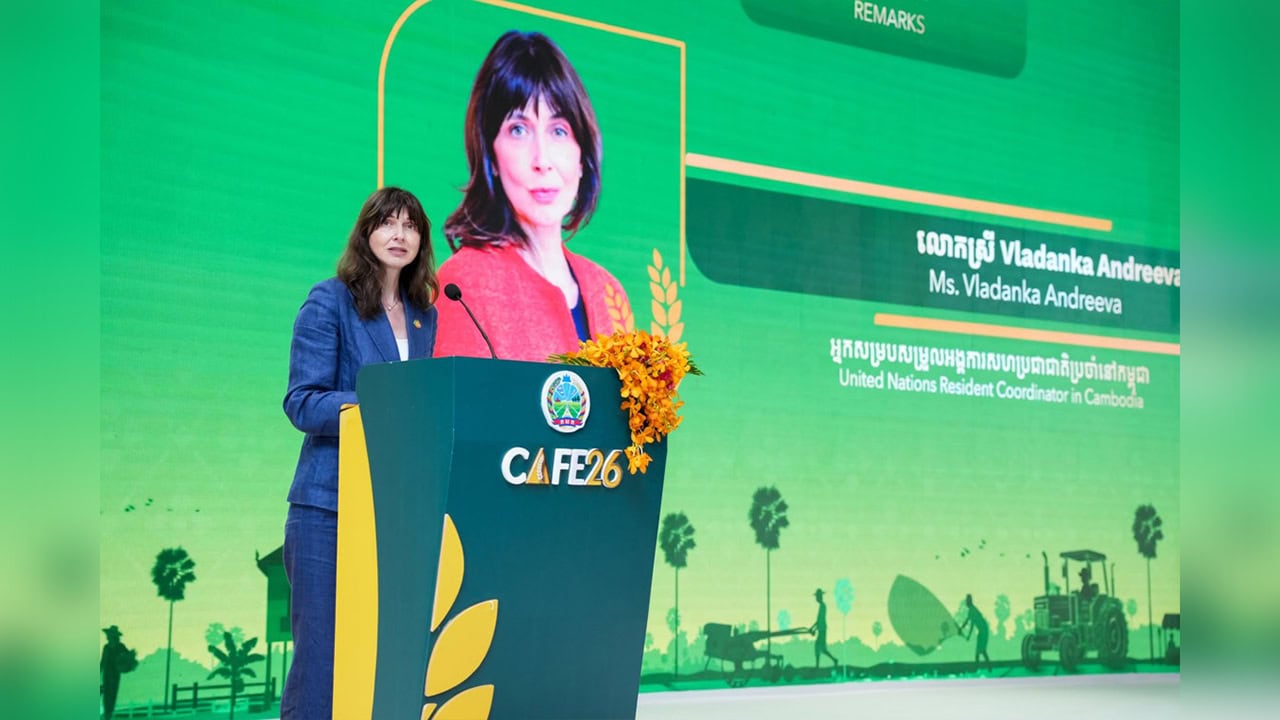
UN Resident Coordinator in Cambodia Vladanka Andreeva has unveiled a new $3 million agricultural finance program designed to draw more than $30 million in lending from banks and microfinance institutions. The goal is to help Cambodian farmers grow their operations, buy equipment and raise their incomes.
The initiative, called the Agricultural Finance for Inclusive Rural Prosperity (AGRIFIN), was approved by the UN and the Cambodian government on October 25. The sign-off took place during the Youth Innovation Forum and the Agricultural Cooperative Learning Forum, both held as part of the Cambodia Agriculture Forum and Exhibition 2026 (CAFE26) in Phnom Penh.
Funded by the Joint SDG Fund, the program targets one of the biggest obstacles facing farmers and rural businesses: a lack of affordable credit.
Andreeva pointed out that many farmers still rely on informal moneylenders, or they are pushed to sell their harvests straight away, often when prices are at their lowest. Much of Cambodia’s farm output is also exported without being processed at home, which means farmers miss out on extra value and income.
“To turn potential into prosperity, farmers need one more ingredient: finance,” she said.
Under the program, the Joint SDG Fund’s $3 million will be used to lower the risks banks and microfinance lenders face, working through the Credit Guarantee Corporation of Cambodia. That safety net is expected to encourage lenders to extend more than $30 million to farmers and agricultural enterprises.
“The Joint SDG Fund’s support is catalytic: every dollar from the Joint SDG Fund is expected to bring in ten more,” she said. She described the scheme as a way to use limited development money to attract far larger private-sector investment.
Three core areas
According to Andreeva, AGRIFIN will concentrate on three things: creating loan products that match the needs of farming, strengthening the business and financial management skills of farmers and cooperatives, and helping provincial authorities attract investment and connect viable projects with lenders.
The loans are intended to pay for better seeds, farm machinery and irrigation pumps, as well as storage facilities that let farmers hold produce until prices improve. Funds may also go toward activities that add value to products. Training and business planning will help farmers make sound borrowing decisions and get more out of the money they borrow.
The program will operate in seven provinces: Pursat, Battambang, Banteay Meanchey, Siem Reap, Kampong Thom, Preah Vihear and Oddar Meanchey. It aims to reach 7,000 farmers, at least half of whom are women.
Women-led businesses are a particular priority. The program plans to make it easier for women entrepreneurs to obtain financing and to provide hands-on business support, helping them expand and enter new markets.
Andreeva also said stronger agricultural cooperatives should give farmers greater bargaining power and better ability to store and sell their crops. The program will also equip commune-level agricultural officers with new tools to support farmers. Stronger value chains, she added, could carry the benefits to more farming households across the target provinces.
“Nowhere is this clearer than among women,” she said. Financing for women-led businesses, she explained, needs to fit their specific circumstances, come with practical business support, and give women a bigger voice in decision-making.
Partners and sustainability
The program brings together the Ministry of Agriculture, Forestry and Fisheries, the Credit Guarantee Corporation of Cambodia, banks, microfinance institutions, provincial authorities and agricultural cooperatives. The UN Development Programme (UNDP), the Food and Agriculture Organization (FAO) and UN Women are also contributing.
Andreeva argued the impact will outlast the program itself, since loan repayments can be recycled into new lending. Cambodian institutions, including the Credit Guarantee Corporation, SME Bank and the Agricultural and Rural Development Bank (ARDB), are expected to keep these financing mechanisms running over the long term.
She called on financial institutions, cooperatives, private companies and young entrepreneurs to take part. Access to credit, she stressed, must go hand in hand with support that helps farmers turn their investments into sustainable businesses.