 Mekong Monitor
Hun Manet Calls for Resumed Joint Border Demarcation at Francophonie Summit
Prime Minister Hun Manet used the 20th Francophonie Summit in Phnom Penh to call for resumed joint demarcation of the Thai-Cambodian border and proposed a Francophone mediation network to prevent conflicts.
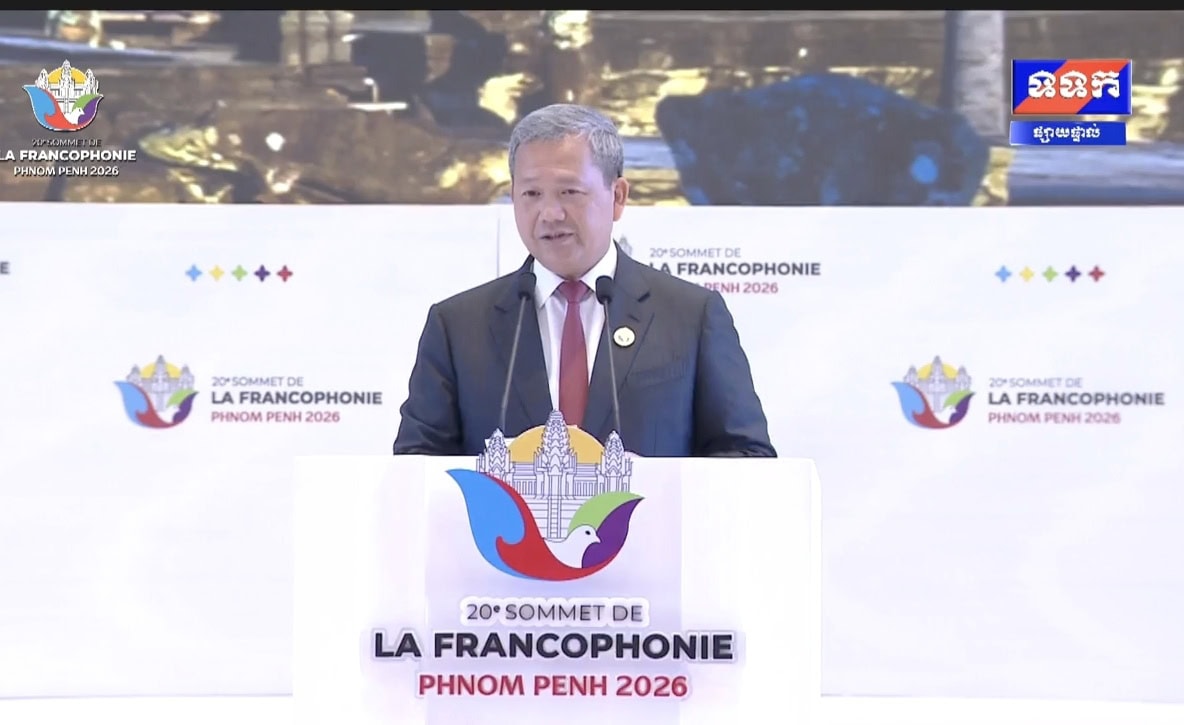
Prime Minister Hun Manet used his opening speech at the 20th Francophonie Summit in Phnom Penh this morning to urge both sides to restart joint work on demarcating the Thai-Cambodian border.
Welcoming heads of state and government, Manet described the situation along the frontier as fragile. The ceasefire agreed last December has largely held, but thousands of Cambodian civilians remain displaced.
He warned that thousands of soldiers are still facing one another, and accused Thai troops of continuing to occupy several areas that Cambodia regards as its sovereign territory. Around 20,000 Cambodians, he said, still cannot return home, and their safe and dignified return remains his government's top priority.
Manet called on Thailand and Cambodia to honour their existing agreements and resume the joint surveying and marking of the land boundary. He pointed out that the border was delimited more than a century ago and should be respected in line with international law.
The ceasefire took effect on December 27, 2025, following two rounds of fighting that cost lives and forced families to flee. Manet maintained that Cambodia did not fire the first shot.
He said Cambodia wants a border that protects both countries and allows their communities to build closer ties. He thanked ASEAN and other international partners for supporting the ceasefire, dialogue and respect for international law. No border, he stressed, should be altered by force or faits accomplis, because respecting international law safeguards the security of every state, large or small.
On the separate question of maritime boundaries, Manet said Cambodia had pursued compulsory conciliation under the UN Convention on the Law of the Sea. He described Thailand's participation in that process as a sign of hope.
The border dispute also shaped a broader proposal for the Francophonie to help prevent conflicts. Manet called for a network of diplomats, experts and institutions that could support mediation and dialogue at the request of member states, before disputes turn violent.
He framed these ideas within an agenda of prevent, prepare and prosper, in line with the summit theme, Reinvesting in Peace for Shared Prosperity and Lasting Stability.
Manet also proposed a Francophone programme to train young people in artificial intelligence, link universities and share French-language resources, with particular attention to countries with limited means. He noted that Cambodia is working with the French Development Agency to prepare a National Centre for Artificial Intelligence and Data Science.
On economic cooperation, he called for closer links between businesses in ASEAN and the Francophone world. Peace, he argued, must bring tangible benefits to families through jobs, income and education, and sharing the gains from growth could help reduce the risk of conflict.
Drawing on Cambodia's own recovery from war, Manet recalled the forced evacuation of Phnom Penh under the Khmer Rouge and the efforts of returning families to rebuild their homes, schools and markets. He also noted that the late King Father Norodom Sihanouk was among the founders of the institutional Francophonie in Niamey in 1970.
With the summit back in Southeast Asia 29 years after a gathering in Hanoi, Manet said Cambodia hopes Phnom Penh can serve as a bridge between Asia and the Francophone world. For families still displaced along the Thai border, he said, the immediate priority remains a safe return home.