 Mekong Monitor
Cambodia and Singapore Deepen Cooperation on Civil Service Reform
Thirty senior Cambodian officials completed a Singapore-run leadership programme aimed at improving government coordination and building a people-centred civil service. Both governments say the cooperation will continue to strengthen public institutions.
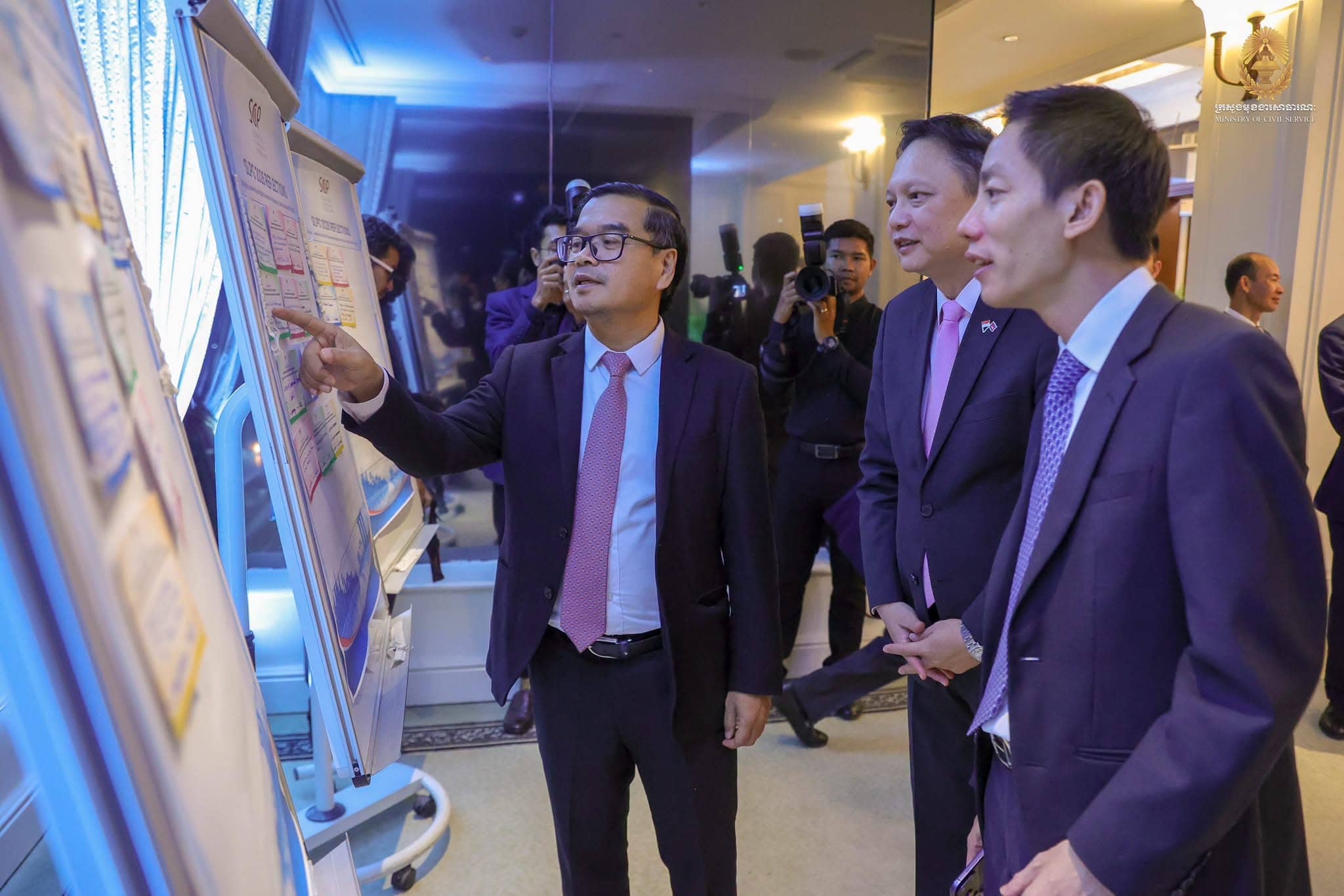
Cambodia and Singapore have renewed their pledge to advance public administration reform and build a professional, citizen-focused civil service. The commitment came as 30 senior Cambodian officials, including secretaries-general from several ministries and key reform leaders, completed a leadership course aimed at strengthening institutional capacity and improving coordination across government.
The officials attended the second Strategic Leadership and Public Governance (SLPG) Programme in Singapore from August 24 to 28. The course was run by Singapore’s Civil Service College under the Singapore Cooperation Programme (SCP) and was led by Youk Bunna, permanent secretary of state at Cambodia’s Ministry of Civil Service.
At a reception held at the Sofitel Phnom Penh Phokeethra on October 23, Singapore’s ambassador to Cambodia, Steven Pang, praised the active participation of the Cambodian officials, who were willing to question ideas and debate them during the five-day training.
Pang said effective public administration depends not only on sound policies but also on capable people, strong institutions and good leadership. He added that Singapore is proud to support Cambodia’s reform efforts, which are a key part of the first phase of Prime Minister Hun Manet’s Pentagonal Strategy. He also expressed his respect for the Ministry of Civil Service’s work to build a public service that is professional, people-centred and ready for the future, and said he hoped the knowledge and networks gained through the programme would feed into Cambodia’s reform agenda.
Bunna said the training was an important step toward his government’s vision of a public administration that is more capable, stronger, smarter and cleaner. He said the lessons on Singapore’s “Whole-of-Government” approach were especially relevant to Cambodia’s goals of improving coordination between ministries and putting policies into practice, particularly through the planned Secretary-General Network.
“The insights on the Whole-of-Government approach in supporting cross-agency collaboration and policy implementation are valuable for Cambodian context,” he said.
Bunna described the programme as a meaningful milestone in bilateral ties, reflecting both countries’ long-standing commitment to better governance, stronger institutions and improved public services through human resource development. He noted that 2026 marks the 61st anniversary of diplomatic relations between Cambodia and Singapore, a reminder of the value of continued cooperation in strengthening public institutions.
Since the SCP was launched in 1992, more than 19,000 Cambodian government officials have taken part in its training and capacity-building programmes. In 2027, the two countries will mark two anniversaries: the 35th anniversary of the SCP and the 25th anniversary of the Initiative for ASEAN Integration (IAI) training centre in Cambodia.
Beyond technical skills and institutional reform, Pang stressed that the personal relationships formed through bilateral training are just as important. He noted that policies and professional knowledge change over time, but the trust and mutual understanding between people tend to endure.
“But the friendships, the mutual understanding, and the trust built between people — those tend to last,” he said.
He described these personal connections as essential to making the partnership between Cambodia and Singapore meaningful beyond formal diplomatic arrangements.