At China-ASEAN Expo, Cambodian Artisans Build Contacts but Await Their Big Break
Cambodian handicraft businesses are using the China-ASEAN Expo in Nanning to raise the profile of Khmer-made goods and forge partnerships, but after years of attendance they admit major export deals remain out of reach.
Cambodian handicraft businesses are turning to the China-ASEAN Expo (CAEXPO) as a way to lift the international standing of Khmer-made goods, win back loyal customers and forge new partnerships. Yet those taking part admit that despite years of attendance, no significant export deals have materialised.
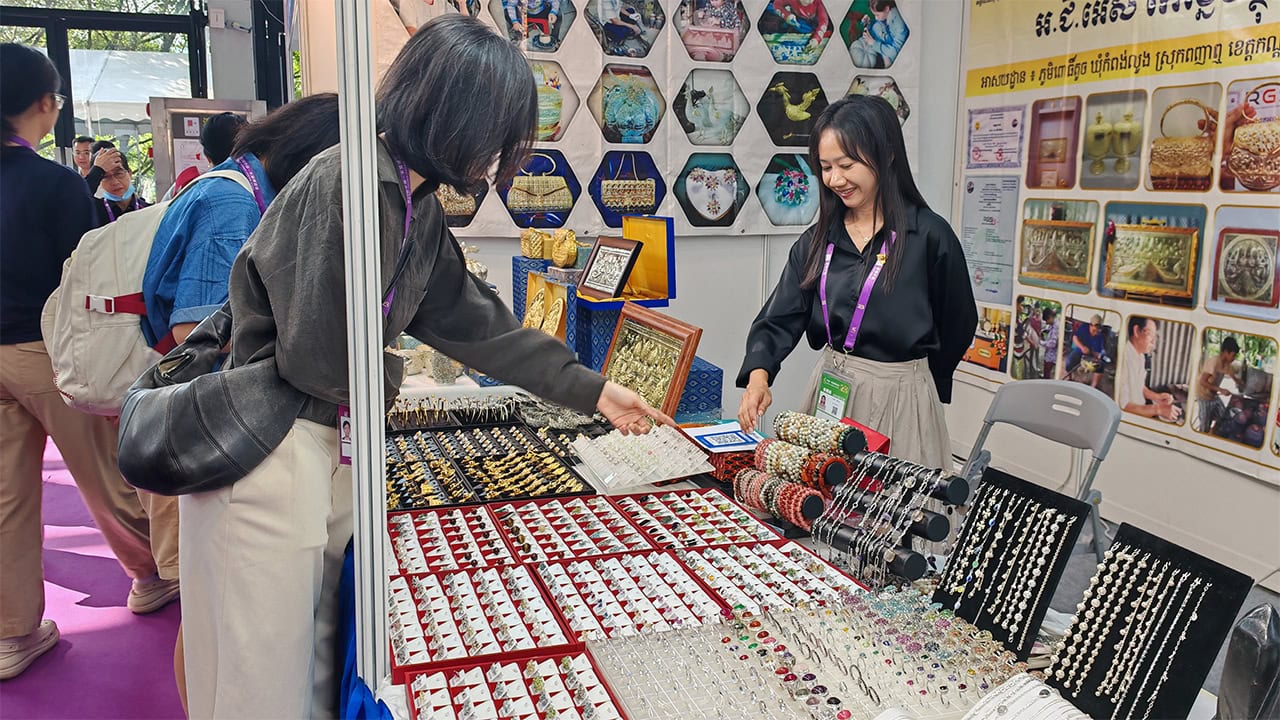
Inside the Cambodian pavilion in Nanning, visitors found traditional hol silk, handmade bags, jewellery, sculptures and decorative metalwork displayed alongside distinctive agricultural products. The showcase highlighted the talent of Cambodian craftspeople while giving small firms a chance to gauge demand and refine their offerings for Chinese, ASEAN and wider international buyers.
Patterned Khmer silk bags were arranged next to silver-toned vessels, jewellery and embossed pieces depicting scenes from the Angkorian era. Although the goods drew considerable curiosity at the 23rd CAEXPO, which opened on 17 September, the entrepreneurs present said that interest had not always led to sizeable orders.
Promoting Quality Over Price
Yan Chanveasna, also known as Metrey, brought Khmer silk, traditional hol fabric and bags carrying Cambodian designs to the fair in cooperation with the Ministry of Commerce.
"The main reason I wanted to take part was to prove that Cambodia produces beautiful, high-quality goods," she said. "It isn't that Cambodians can't make these things. We can, and they are completely handmade. I also want to raise our country's image by showing what our people are capable of."
Chanveasna has previously shown her work at exhibitions in Shanghai and at markets across Europe and Japan, where she found stronger demand for handmade silk. Her time in Nanning offered a chance to test a new market and to learn from fellow exhibitors.
Still, she conceded that selling Cambodian silk in China is difficult, as visitors often measure its price against far cheaper, mass-produced items.
"People are interested, but they call the products expensive. They don't yet grasp the quality and the effort that goes into making something entirely by hand," she noted. "When a piece is woven fully by hand, it is naturally costly. Handmade goods aren't sold cheaply anywhere."
The Craft Behind Khmer Hol
Traditional Cambodian hol is a type of ikat textile. Before weaving starts, portions of the silk thread are tied off and dyed to produce the desired colours and patterns. Weavers then have to line up the dyed threads on the loom precisely so that the design slowly emerges in the finished cloth.
This painstaking process explains why handmade hol and silk bags cannot match the price of factory-made textiles. Their worth lies instead in craftsmanship, cultural identity, design and the hours poured into each item.
Chanveasna stressed that her aim at the expo went beyond immediate sales. She wanted Chinese visitors and exhibitors from other ASEAN nations to appreciate the quality of Cambodian work.
"We want to show that handmade products can be beautiful too," she said. "If handmade goods from all 10 countries were placed side by side, Cambodia's would stand out."
Her account points to a broader challenge for small Cambodian firms trying to enter China: appearing at an international fair can build visibility, but turning that into sales requires interpreters, product details in Chinese and steady follow-up with prospective partners.
Nine Years of Building Relationships
At another stand, artisan Ra Manet displayed handmade sculptures, souvenirs, jewellery, silverwork and gemstone items made by Ramaneth Handicraft and its RGA Design brand in Kampong Luong, Kandal province.
The business, launched in 2010, works with local artisans and community members. Manet said it had exhibited in neighbouring Vietnam and in Singapore as well as in China. This year marked its ninth appearance at CAEXPO, stretching back to before the Covid-19 pandemic.
She said returning year after year had helped the enterprise sharpen its products and presentation to match ASEAN and international expectations.
"The rewards and experience come in the form of knowledge, developing and preserving Cambodian products, and supporting our communities and artisans," she said. "We learn what businesses and the market need. We have grown from an ordinary level to a standard that can be accepted at ASEAN and international levels."
Cambodian silverware has traditionally been made using several labour-intensive techniques, among them lost-wax casting, pressing metal into moulds and hand-raising or shaping metal sheets before patterns are chased or engraved into the surface, according to a UNESCO publication on Khmer silverware.
Kampong Luong, close to the former royal capital of Oudong in Kandal province, has a long history of metalwork. Its artisans craft decorative containers, jewellery, ceremonial pieces, sculptures and souvenirs, frequently adorned with floral, animal or Angkor-inspired motifs.
The items Manet showed in Nanning included engraved vessels, jewellery, ornamental containers and framed reliefs portraying Cambodian cultural scenes, their intricate surfaces reflecting the manual effort behind each one.
Visibility Without Big Deals
Even after nine visits to CAEXPO, Manet said the business had yet to land a major commercial agreement. It had, however, gathered contacts with possible partners and cultivated a group of repeat customers.
"In the beginning we came only to display our products, but over time we have also made business connections," she said. "We haven't achieved anything large or concrete yet, but the relationships remain. Every year some past customers come back to buy and recommend us to others."
She described this year's visit as more fruitful than earlier ones, praising the Ministry of Commerce for supporting participation and helping connect Cambodian producers with firms interested in importing.
Together, the two entrepreneurs' experiences suggest that CAEXPO gives Cambodian craft businesses a stage for visibility and market testing, but a booth on its own is unlikely to deliver steady exports. Lasting success will hinge on whether these firms can find dependable local partners, explain the value of handmade production, tailor designs and packaging to Chinese tastes, and keep in touch once the expo ends.