 Mekong Monitor
Xi, Trump and Putin: Are the Great Powers Set to Carve Up the World Again?
Xi Jinping, Donald Trump and Vladimir Putin are reportedly set to meet in Shenzhen. This analysis asks whether the talks aim to resolve conflicts or to divide influence, drawing on lessons from Yalta, Ukraine and the Middle East.
In February 1945, as the Second World War neared its end, three of the era's most powerful leaders, Franklin D. Roosevelt of the United States, Winston Churchill of Britain and Joseph Stalin of the Soviet Union, met at Yalta to shape the future of Europe and lay the groundwork for a postwar global order.
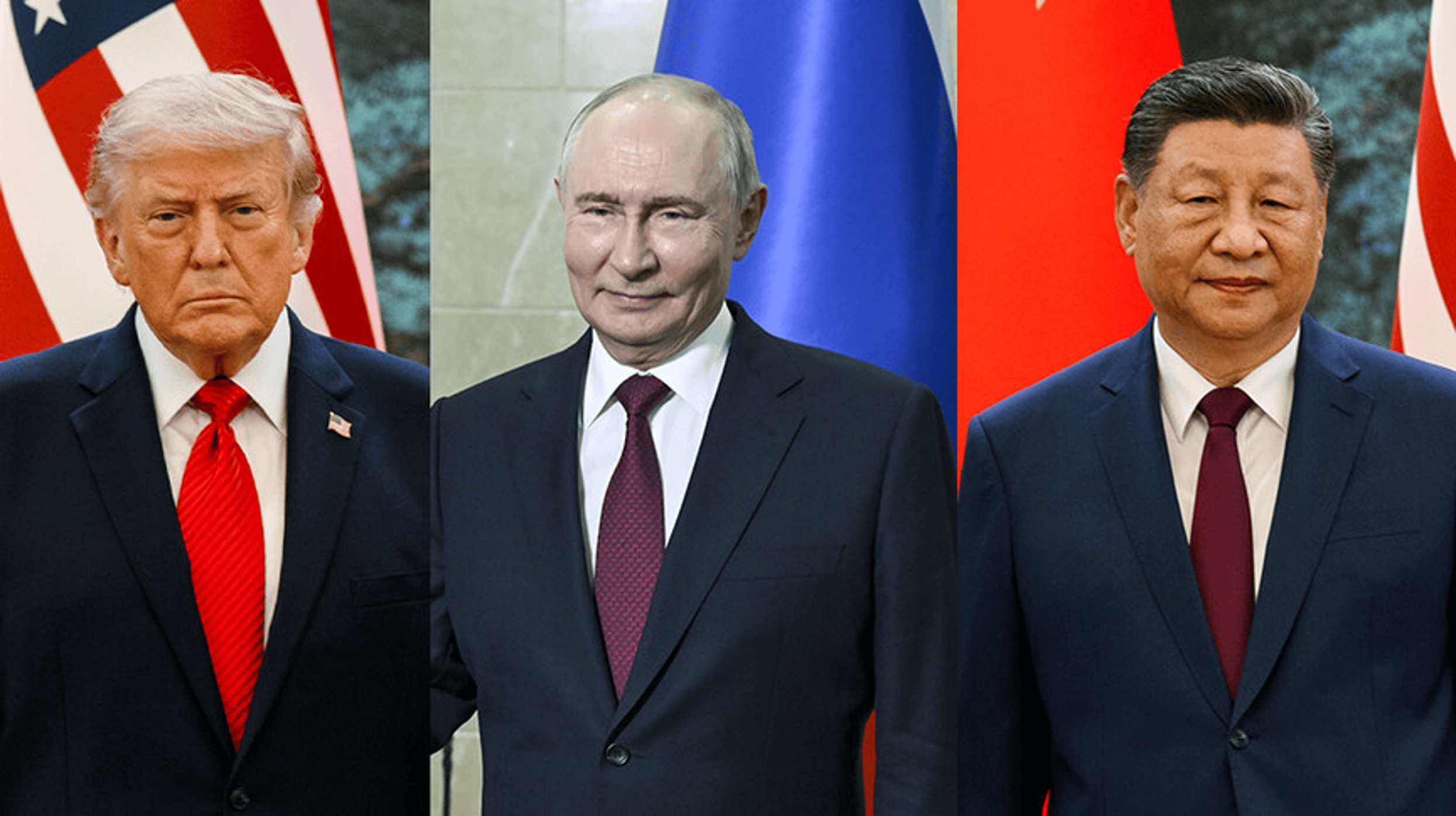
More than eight decades later, a strikingly similar scene may be taking shape. The three leaders now are US President Donald Trump, Russian President Vladimir Putin and Chinese President Xi Jinping, who are reportedly set to meet in Shenzhen, China, on November 19 to discuss international security and stability.
What makes this possible gathering notable is that three major powers are once again sitting around the same table, but the lineup has changed. Britain, once one of the largest colonial empires of the twentieth century, no longer has a seat at this trilateral table. In its place is China, a country that once endured foreign invasion and outside interference and that now has economic, military and technological strength, allowing it to deal directly with both Washington and Moscow in the twenty-first century.
This shift reflects a wider movement in the world's center of gravity. Europe, which once set the terms of international politics, is no longer the only pole of geopolitical influence. The international system is moving toward a structure in which Asia plays a growing role.
Yet the key question is not simply who is at the table. More important is whether these leaders are seeking to end existing conflicts, or whether they are working out a new arrangement for dividing spheres of influence and deciding the future of other nations.
Against the backdrop of the tense geopolitical climate of early winter 2026, this article examines five key dimensions of that question.
1. Yalta 1945: When Great Powers Shaped Postwar Europe
The Yalta Conference, held from February 4 to 11, 1945, is one of the defining events in the history of international relations. Nazi Germany was nearing defeat, and the Allied powers had begun discussing how postwar Germany would be administered, what would become of Poland and how the United Nations would be established.
Yalta was not an agreement to divide the entire world. Still, the decisions made there, together with the military balance on the ground at the time, did much to lay the foundations for the postwar division of influence in Europe.
After the war, Eastern Europe increasingly fell under Soviet influence, while Western Europe built closer political and security ties with the United States. Germany was split into four occupation zones, and by 1949 these eventually produced two separate states: the Federal Republic of Germany (West Germany) and the German Democratic Republic (East Germany).
Put differently, the Second World War did more than end an old international order. It also cleared the way for a new one, in which military power and spheres of influence became the central pillars of world politics for decades.
2. Shenzhen 2026: From Territorial Division to Division of Influence?
If the Yalta Conference of 1945 was about organizing the world after the war, the proposed Shenzhen meeting could be seen as a test of whether the great powers can manage conflicts that remain unresolved.
Washington has major stakes in nuclear arms control, its strategic rivalry with Beijing and the stability of the global economy. Moscow is likely to seek assurances that its security concerns and its demands regarding Ukraine will be taken seriously. Beijing may want to show that it can influence the direction of world politics while avoiding direct involvement in disputes that do not serve its strategic interests.
In this context, the old formula of dividing territory may not return in its original form. Instead, today's great powers may look for understandings based on recognizing one another's security interests, setting strategic red lines, reducing direct confrontation and negotiating over regions each considers strategically important.
Such arrangements could amount to a new way of dividing spheres of influence without redrawing borders on the map.
Still, deals of this kind would face serious obstacles. Ukraine, the member states of the European Union and other countries cannot simply be set aside without major political and legal consequences.
3. Could One Ukraine Become Three?
European history shows that large wars can redraw borders and give birth to new states.
After the First World War, the Austro-Hungarian Empire collapsed, and its former lands were divided among several states, including Austria, Hungary, Czechoslovakia and others.
Likewise, the Socialist Federal Republic of Yugoslavia broke apart during the 1990s and 2000s, producing six independent states from its former republics. Kosovo's statehood and international recognition, meanwhile, remain contested.
These examples show that borders are not necessarily permanent. Even so, territorial change does not mean that every war inevitably produces new states.
In Ukraine's case, three possible scenarios deserve consideration.
Scenario One: Ukraine Remains a Single Internationally Recognized State
Ukraine could keep its status as one internationally recognized sovereign state, even if control over some territories remains disputed.
In this case, Ukraine's internationally recognized borders would stay legally intact, although the government in Kyiv might not exercise effective control over every part of them.
Scenario Two: A De Facto Division of Territorial Control
Ukraine could face a prolonged split in effective control, with some areas run by Kyiv and others held by Russia, without formal recognition of any new independent states.
This would create a gap between internationally recognized sovereignty and the territory actually governed.
Scenario Three: Separate Administrative or Security Zones
After major political and military upheaval, Ukraine could in theory be reorganized into three distinct zones: territory administered by Kyiv, territory controlled by Russia, and a third area operating under a special security or administrative arrangement.
This third scenario, however, is highly speculative. There is not enough evidence to conclude that Ukraine will eventually become three separate countries, so premature conclusions should be avoided while developments are closely observed.
4. The Middle East: Will Borders Change, or Will the Balance of Power Shift?
The Middle East is another region that could be shaped either by strategic accommodation among the three major powers or by intensified competition between them.
The region is of enormous geopolitical importance because of its energy resources, the Strait of Hormuz, the Bab el-Mandeb Strait and major international trade routes.
At the same time, conflicts involving Iran, Israel and Palestine, along with wider security challenges across the region, have made the Middle East a focal point of competing great-power interests.
If the United States, Russia and China reached an understanding on Middle Eastern security, the outcome might be a redefinition of each power's role in regional security and conflict management, rather than a formal partition of existing states.