 Mekong Monitor
Xi, Trump and Putin: Are the Great Powers Dividing the World Again?
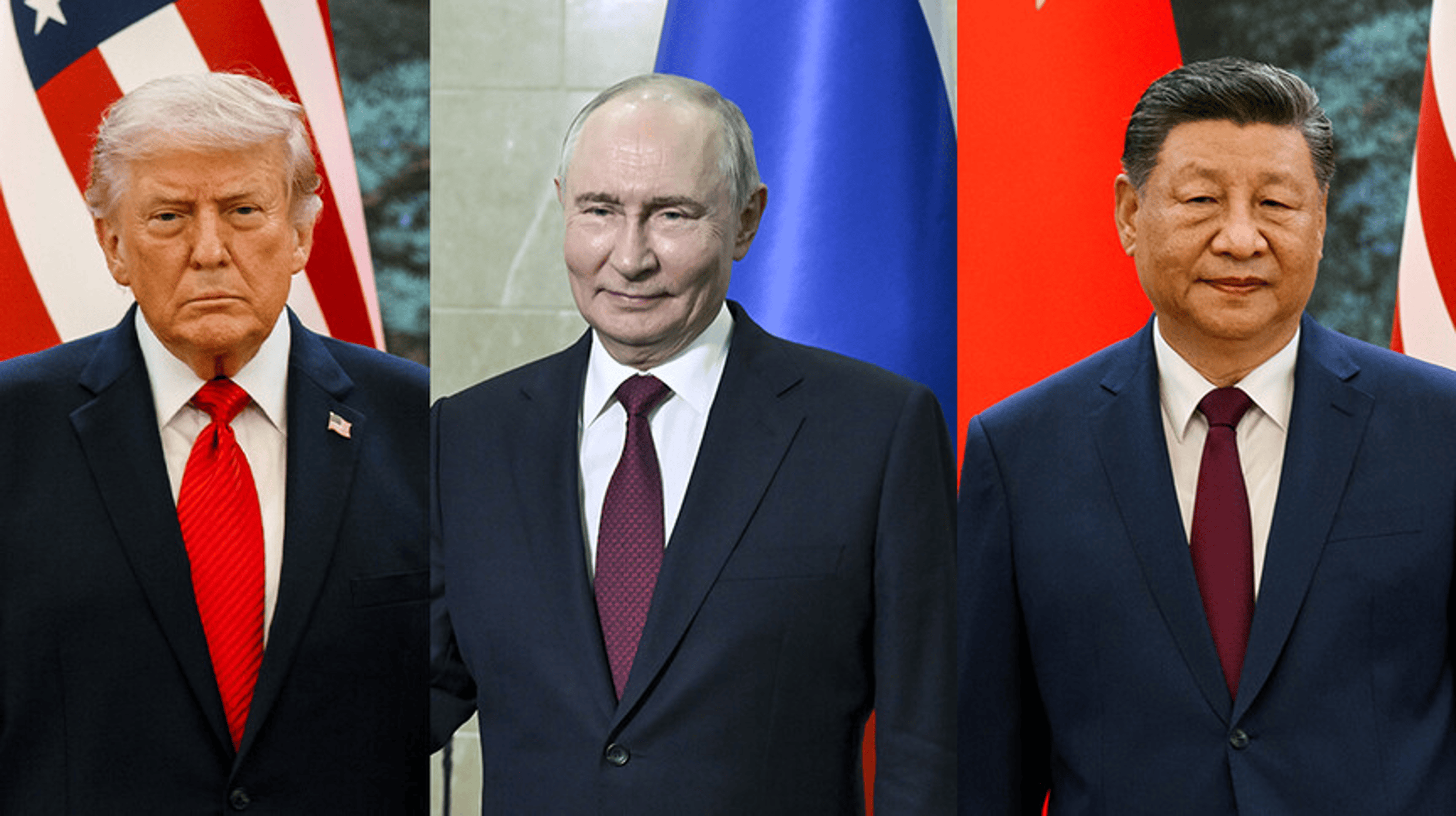
Trump, Putin and Xi reportedly plan to meet in Shenzhen, prompting comparisons with the Yalta Conference of 1945. The discussion centres on whether the great powers are seeking to end conflicts or to redraw spheres of influence.
At the end of the Second World War, three of the era's most powerful leaders met at Yalta in February 1945 to shape the future of Europe and lay the groundwork for a new global order. Franklin D. Roosevelt of the United States, Winston Churchill of Britain and Joseph Stalin of the Soviet Union sat down to settle these questions.
More than eighty years later, history may be offering a similar picture. Donald Trump, Vladimir Putin and Xi Jinping are reportedly scheduled to meet in Shenzhen, China, on November 19 to discuss international security and stability.
What makes this prospective summit especially striking is that the table has changed. Britain, once one of the largest colonial powers of the twentieth century, no longer has a seat. In its place is China, a country that was itself invaded and interfered with by foreign powers, and which has since grown into an economic, military and technological force capable of dealing directly with both Washington and Moscow.
This shift reflects a broader change in the centre of global power. Europe, which once dominated international politics, is no longer the sole hub of geopolitical influence. The international system is moving toward a structure in which Asia plays a far greater role.
Still, the central question is not simply who sits at the table. The more important issue is whether these leaders are trying to bring existing conflicts to an end, or whether they are seeking a new formula for carving up spheres of influence and deciding the fate of other countries.
Against the backdrop of the geopolitical tensions of early winter 2026, this article examines five key dimensions of that question.
1. Yalta 1945: When Great Powers Shaped Postwar Europe
The Yalta Conference, held from 4 to 11 February 1945, was one of the most consequential events in the history of international relations. Nazi Germany was nearing defeat, and the Allied powers had begun discussing how postwar Germany would be administered, the future of Poland and the creation of the United Nations.
Yalta was not an agreement to divide the entire world. However, the decisions reached there, combined with the military balance on the ground, helped lay the foundations for the postwar division of influence in Europe.
In the years that followed, Eastern Europe increasingly fell under Soviet influence, while Western Europe built closer political and security ties with the United States. Germany was split into four occupation zones, and in 1949 these eventually produced two separate states: the Federal Republic of Germany (West Germany) and the German Democratic Republic (East Germany).
In other words, the Second World War did not simply end an old international order. It opened the way for a new one, in which military power and spheres of influence became the central pillars of international politics for decades.
2. Shenzhen 2026: From Territorial Division to a Division of Influence?
If Yalta in 1945 was about organising the world after the war, the proposed Shenzhen meeting may be seen as a test of the great powers' ability to manage conflicts that remain unresolved.
Washington has major interests in nuclear arms control, its strategic rivalry with China and the stability of the global economic system. Moscow is likely to want assurances that its security concerns and its demands regarding Ukraine will be taken seriously. Beijing may want to show that it is a major power able to influence the direction of world politics, while avoiding direct involvement in disputes that do not serve its strategic interests.
Against this backdrop, the traditional formula of territorial division may not be repeated in its original form. Instead, today's great powers may look for understandings based on recognising one another's security interests, setting strategic red lines, reducing direct confrontation and negotiating over regions they consider strategically important.
Such arrangements could amount to a new kind of division of spheres of influence without redrawing borders on the map.
Still, deals of this kind would face serious obstacles. Ukraine, the member states of the European Union and other countries cannot simply be ignored without significant political and legal consequences.
3. Could One Ukraine Become Three?
European history shows that major wars can reshape borders and give birth to new states.
After the First World War, the Austro-Hungarian Empire collapsed, and its former lands were divided among several states, including Austria, Hungary, Czechoslovakia and others.
The Socialist Federal Republic of Yugoslavia also broke apart gradually during the 1990s and 2000s, producing six independent states from its former republics. Kosovo's statehood and international recognition, meanwhile, remain disputed.
These examples show that political borders are not necessarily permanent. At the same time, territorial change does not mean that every war inevitably creates new states.
In Ukraine's case, three possible scenarios deserve consideration.
- Scenario one: Ukraine remains a single, internationally recognised state. Ukraine would keep its status as one sovereign country, even if control over certain territories is contested. Its internationally recognised borders would remain legally intact, although the government in Kyiv might not exercise effective control over all of the land within them.
- Scenario two: a de facto division of territorial control. Ukraine could face a prolonged split in effective control between areas run by Kyiv and areas held by Russia, without the formal recognition of any new independent states. This would create a gap between internationally recognised sovereignty and actual control on the ground.
- Scenario three: three separate administrative or security zones. Under major political and military upheaval, Ukraine could in theory be reorganised into three distinct areas: territory administered by Kyiv, territory controlled by Russia, and a third zone under a special security or administrative arrangement. This scenario, however, remains highly speculative.
There is currently not enough evidence to conclude that Ukraine will eventually become three separate countries. It is wiser to avoid premature conclusions and to watch how events unfold.
4. The Middle East: Will Borders Change, or Will the Balance of Power Shift?
The Middle East is another region that could be affected either by strategic accommodation or by intensified rivalry among the three powers.
The region's importance is considerable. It holds vast energy resources and controls key chokepoints and trade routes, including the Strait of Hormuz and the Bab el-Mandeb Strait.
At the same time, conflicts involving Iran, Israel and the Palestinians, along with wider security challenges across the region, have turned the Middle East into a focal point of competing great-power interests.
If the United States, Russia and China were to reach an understanding on Middle Eastern security, the outcome might be a redefinition of their respective roles in regional security and conflict management, rather than a formal partition of existing states.