 Mekong Monitor
Women Farmers Push for Stronger Land Rights as Cambodia Extends LASED III
Women farmers and Indigenous representatives are calling for stronger land tenure protections and a bigger voice in land-use decisions as Cambodia extends its LASED III land allocation project to mid-2028.
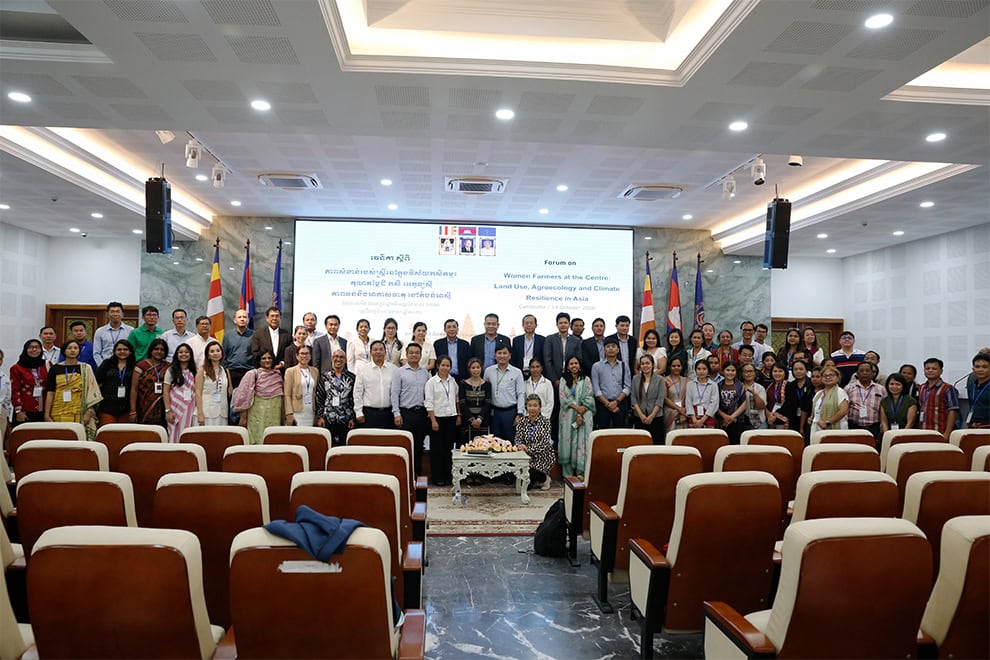
Women farmers and Indigenous community representatives are calling for stronger land tenure security and a bigger role in decisions about how land is used. Their appeal came as Cambodian officials acknowledged difficulties in collective land registration and announced that the national land allocation project, LASED III, will run for 18 more months, until mid-2028.
A regional workshop on women and land
The issues were raised at a regional workshop titled “Women Farmer at the Center: Land Use, Agro-Ecology, and Climate Resilience in Asia,” which opened on October 14 at the Ministry of Land Management, Urban Planning and Construction. The four-day event, held during the 2026 International Year of Women Farmers, brought together government officials, Indigenous peoples, women farmers, civil society groups and development partners from across Asia.
Women's work outpaces their land rights
Soeung Saroeun, executive director of the NGO Forum on Cambodia and chair of the International Land Coalition Asia (ILC Asia) Steering Committee, said women's contribution to farming is far out of step with their access to land and decision-making power. He described land as the basis of both economic survival and cultural identity, tying it to life, livelihood and heritage.
Saroeun said women make up more than 60 per cent of Asia's agricultural workforce, with shares reaching 70 to 80 per cent in some places, yet they own less than 15 per cent of the land. He insisted that women's views must be genuinely considered in decision-making, and he urged governments and development partners to turn the workshop's discussions into practical action plans with adequate funding.
Anu Verma, ILC Asia regional coordinator, argued that women farmers already have the knowledge and determination to solve agricultural problems. What they lack, she said, is recognition, timely action and real authority over the land and resources they depend on. She welcomed Cambodia's progress on land registration and tenure security, but said legal recognition must be properly enforced to offer real protection to women and communities.
Progress on land registration
At a national policy plenary, He Sophannara, deputy director-general at the land management ministry, outlined the country's systematic registration work. Since 2002, about 14 million land parcels have been surveyed nationwide, and more than 10 million ownership titles have been issued. The process covers surveys, boundary checks, a 15-day public display period, administrative decisions and title issuance. Records also show whether a property belongs to a husband or wife individually or is jointly owned, and he encouraged both women and men to take part in verifying ownership details.
Indigenous concerns over customary land
Indigenous representatives warned that formal registration has not solved the problems facing customary and collective land. Klan Sarit, a Jarai Indigenous woman from Ratanakiri province, explained that for Indigenous communities, land cannot be separated from forests, cultural practices and traditional livelihoods. She shared a saying from her community that describes the forest as a husband, the land as a wife and natural resources as relatives.
Sarit described rotational farming, in which families grow many crops, including rice, vegetables and medicinal plants. Indigenous farmers traditionally grew at least 30 crop varieties in a single field, and some grew more than 60. She warned that commercial crops such as cashew nuts, cassava and rubber are changing these practices and making farmers more dependent on outside markets. That shift has also led to the loss of traditional seeds, which are especially resilient to shifting climate conditions. She raised concern that economic land concessions are affecting customary farmland and spiritually important forests, and she highlighted community efforts to revive traditional crops and protect cultural heritage.
Gaps in agricultural leadership
Hor Sopor, a representative of the Ministry of Agriculture, Forestry and Fisheries, said the government has deployed about 1,600 commune agricultural officers, roughly 40 per cent of them women. Forty-one modern agricultural cooperatives have been set up, yet women hold only about 10 per cent of their leadership positions. The numbers show how wide the gap remains between women's role in farm work and their presence in leadership.
Later discussions covered affordable credit, farm inputs, processing facilities, markets, women-led agroecology, traditional seed conservation and climate finance. Participants also asked about administrative delays affecting Indigenous collective land registration and about how LASED III is being implemented.
LASED III extended to 2028
In his closing remarks, Rath Virak, secretary of state at the land management ministry, confirmed that LASED III has been extended by 18 months. Originally scheduled to end in 2026, it will now continue until the middle of 2028. He said preparations for LASED IV are also underway and stressed that all of the land allocation programmes remain important, with communities kept at their centre. Virak said the government is working to finish the country's initial land registration, while acknowledging that more complicated cases involving collective land and state land will need further attention. He also named land-use planning as a government priority, including work in the Angkor area and the Tonle Sap region.
Next steps
The workshop is expected to feed into a national action plan for Cambodia and a regional roadmap covering women's land rights, agricultural leadership, sustainable farming and climate resilience. Participants agreed that future policies should go beyond recognising women as producers. They should also help women own and manage land, access financial resources and take a direct part in decisions that shape their livelihoods.