 Mekong Monitor
Why Peace Can Demand Dialogue: Reassessing Cambodia's Ties with Myanmar
This analysis examines why Cambodia's engagement with Myanmar's leadership can be read as diplomacy rather than endorsement, and how it sits alongside Phnom Penh's commitments under international law.
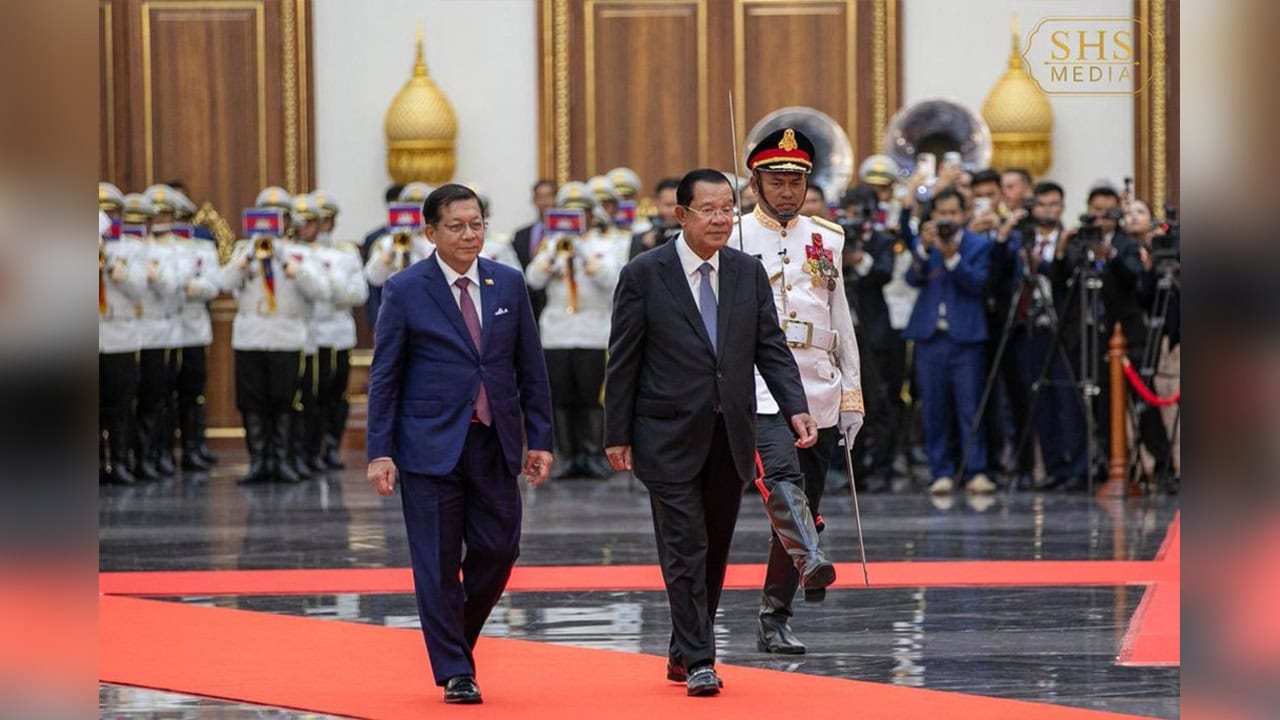
Cambodia's relationship with Myanmar is drawing closer scrutiny at a time when Southeast Asia is grappling with armed conflict, questions of sovereignty and the limits of international law. Phnom Penh has long presented itself as a peace-loving nation, and its decision to host high-level state visits by Myanmar's leadership raises an obvious question: how does that engagement fit with its legal commitments? A more revealing question may be what the engagement says about Cambodia's wider approach to peace and diplomacy.
Cambodia's Ministry of Foreign Affairs and International Cooperation has said that the country's stance during the recent border tensions with Thailand rests on respect for international law and the peaceful settlement of disputes. Against that backdrop, Cambodia's dealings with Myanmar understandably attract concern. The apparent contradiction is easier to make sense of if peace is treated not only as a moral principle but also as a working diplomatic practice, built on dialogue, negotiation, the rule of law and open channels for resolving disagreements.
Cambodia's diplomacy rests on the view that peace means far more than the simple absence of fighting. That outlook makes sense for a country whose recent history shows how heavy the human and political cost of prolonged conflict can be. Prime Minister Hun Manet has voiced the same conviction. In late April he called peace a major accomplishment, and in mid-May he stressed that even a one per cent chance of settling a dispute peacefully would be enough for Cambodia to keep pursuing dialogue and legal mechanisms to the end, in order to protect peace for the nation and its people.
Seen this way, Cambodia's engagement with Myanmar is best understood as an effort to maintain and strengthen diplomatic relations, not as an endorsement of the conduct of Myanmar's authorities.
Does Engagement with Min Aung Hlaing Undermine the Rome Statute?
The visits by Myanmar's leadership also prompt a pointed question: does engaging with Min Aung Hlaing weaken Cambodia's commitment to the Rome Statute? According to the International Criminal Court, the Prosecutor filed an application in November 2024 for an arrest warrant against Min Aung Hlaing, citing alleged crimes against humanity targeting the Rohingya population.
Because Cambodia is a state party to the Rome Statute, the Prosecutor's move naturally invites questions about how its bilateral diplomacy aligns with those obligations. However, a Prosecutor's application is not the same as an arrest warrant. The application is a formal request. A warrant is the official legal order, issued by judges only after they have reviewed and approved that request.
It is understandable that the case has intensified scrutiny of Cambodia's decision to host a Myanmar leader. A high-level state visit is a significant gesture of hospitality, especially when the visiting leader is under international scrutiny.
Even so, diplomatic engagement should be distinguished from political endorsement, and it should not be taken as proof that Cambodia is disregarding its international legal commitments. Diplomacy with a government and an independent judicial process operate in different spheres. Maintaining a relationship with a government does not determine the outcome of a court case, and dealing with a government does not amount to backing the conduct under examination. Cambodia can therefore pursue bilateral engagement while still upholding its Rome Statute obligations. What matters most is how it balances its diplomatic interests with its commitment to international law and accountability.
Comparing Cambodia's Approaches to Thailand and Myanmar
Beyond the legal questions, Cambodia's engagement with Myanmar raises a broader issue of consistency. Comparing its approach to Thailand with its approach to Myanmar helps clarify how Cambodia weighs different diplomatic principles in different situations.
With Thailand, Cambodia has stressed the peaceful settlement of disputes in line with international law and dialogue. With Myanmar, it has focused on dialogue, respect for sovereignty, non-interference and continued engagement within ASEAN. Together, these positions show that peaceful diplomacy does not depend on a single tool or on identical language for every crisis.
Different circumstances call for different diplomatic responses. In both cases, Cambodia has preferred diplomacy to escalation. Whether through international legal mechanisms, bilateral talks or regional engagement, it has tried to keep disputes and crises within peaceful bounds rather than letting them slide into confrontation.
This reading is consistent with remarks made by Senate spokesperson Chea Thyrith at a press conference on September 11. He said the Myanmar state visit showed an effort to strengthen friendly relations between the two countries, and that Cambodia's position rested on respect for the ASEAN principle of non-interference.
The harder issue is perception and credibility. Will engagement with Myanmar be seen as consistent with the principles of international law and peaceful dispute settlement that Cambodia so often champions in its dealings with Thailand? The answer depends on whether peace is understood as requiring isolation from difficult actors, or as requiring a willingness to keep diplomatic channels open even at the most challenging moments in a relationship.
Small-State Diplomacy: National Interests and Trade-offs
From the standpoint of a small state, diplomatic value often comes from the ability to maintain relationships across political divides rather than from coercive power. Cambodia does not have the military or economic weight of major powers to shape regional outcomes. Continued access to Myanmar's leadership lets it remain an active voice in regional dialogue, keep bilateral channels open and contribute to ASEAN efforts. A complete withdrawal from engagement, by contrast, would narrow those options.
Still, the approach carries trade-offs. Engagement keeps communication and access alive, but it also brings reputational and symbolic costs.
Diplomatic decisions usually involve competing interests rather than ideal outcomes. The visits signal meaningful ties between the two countries, although some observers may see state-level hospitality as lending political legitimacy to a leader facing serious international allegations.
The aim, then, is not to eliminate that tension but to manage it, while making clear that engagement is not political endorsement or impunity. How Cambodia maintains relations with Myanmar should not get in the way of its commitment to international law or its recognition of the importance of accountability.
Engagement and accountability are distinct mechanisms in diplomacy. Through engagement, states build relationships, negotiate treaties and agreements, and keep lines of communication open. Accountability, by contrast, is the obligation to prevent human rights abuses, treaty violations and breaches of international law.
Viewed from a small-state perspective, Cambodia's decision can be understood as an effort to preserve bilateral relations, respect sovereignty and non-interference, and keep lines of dialogue open.