 Mekong Monitor
Vietnamese Deportees From the US Face Uphill Battle Rebuilding Lives in an Unfamiliar Homeland
A sharp rise in U.S. deportations to Vietnam since 2025 has sent thousands of long-term residents back to a country they barely know, where they struggle with identity documents, employment, and severed family ties.
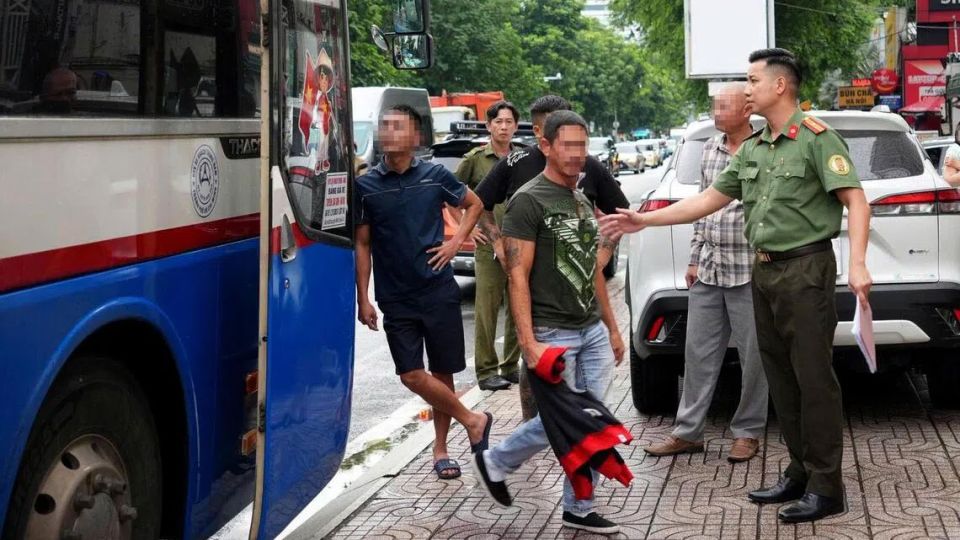
Vietnamese immigration officials recently welcomed home 110 nationals deported from the United States, the latest batch in a dramatic surge of removals since 2025. Court filings reveal that U.S. Immigration and Customs Enforcement expelled 1,851 Vietnamese citizens across fiscal years 2024, 2025, and the first half of 2026, with over 1,000 of those occurring in the current fiscal year alone. That number has climbed by nearly 200 more since those records were compiled.
Many of those returned spent decades living in the United States and were previously shielded from deportation under bilateral agreements. Now they confront a daunting array of practical challenges — securing identity documents, locating relatives, finding housing, and earning a living in a country most barely recognize.
Ho Chi Minh City police noted in a recent social media post that some returnees struggle to obtain identification papers, reconnect with family, or secure shelter and jobs. In some cases, individuals have lost touch with relatives for years, have no eligible family members to receive them, or are elderly and in poor health.
The Department of Homeland Security, which oversees ICE, stated in February that individuals subject to administrative warrants have received "full due process and a final order of removal from an immigration judge."
A Life Disrupted
Andrew Fenton, 58, has few memories of his birth parents. A Vietnamese birth certificate issued after his deportation lists him as Nguyen Bao Linh, born October 23, 1967. His mother's name is blank on the document. His father, Nguyen Bao Tinh, served in the South Vietnamese Air Force, but beyond that, Fenton knows little.
"My mother was in Hanoi caring for her aging parents, so my father raised me at an airbase in Da Nang," Fenton explained. "Right before the war ended, he told people I was an orphan so an American couple could adopt me and bring me to the U.S. in 1975."
Despite living in America for half a century, Fenton never obtained U.S. citizenship. His adoptive parents, both American citizens, assumed he had automatically become one through the adoption. In reality, no one ever filed the necessary paperwork — Form N-600 — to secure his citizenship.
Fenton's first deportation order came in 1989 following a drug arrest. Because the U.S. and Vietnam lacked diplomatic relations at the time, he was released. Over the years, he was arrested several more times for minor theft, never for violent offenses.
"Every time I was arrested, they'd flag me because my birthplace was listed as Vietnam, and the system showed I couldn't be deported," he recalled. "But the last time, in August 2025, immigration picked me up and told me I was being removed."
Fenton, who is unmarried and has no family in either country, now finds himself in Vietnam with no relatives, no money, and no command of the Vietnamese language.
A Policy Shift
Before this escalation, Vietnamese immigrants who arrived in the U.S. prior to July 12, 1995 — the date diplomatic ties were restored between Washington and Hanoi — had been largely protected from removal under bilateral understandings.
A 2008 deportation agreement between the two nations explicitly excluded pre-1995 arrivals. However, the first Trump administration pushed Vietnam to accept some of these individuals, and in November 2020, just before Trump left office, the countries signed a memorandum of understanding establishing a framework for returning certain pre-1995 immigrants.
After Trump resumed the presidency in January 2025, ICE intensified detention and removal efforts targeting pre-1995 Vietnamese arrivals. In June 2025, the agency formally withdrew its long-standing policy of generally considering these individuals unlikely to face deportation in the foreseeable future. Removals have surged ever since.
According to the Asian Law Caucus, more than 8,600 Vietnamese nationals currently have outstanding removal orders in the United States.
"Foreign governments, including Vietnam, are seeking to avoid trade tensions with the Trump administration, and accepting more returned migrants is part of that calculus," said Tin Nguyen, a U.S.-based immigration lawyer who also maintains an office in Ho Chi Minh City.
"Many people who lived in the U.S. for decades on green cards and never felt compelled to pursue citizenship now face deportation risk, especially if they have any criminal history," he added.
Data from the Southeast Asia Resource Action Center (SEARAC) in Washington shows that half of Vietnamese deportees removed between 2025 and 2026 had convictions dating back at least 20 years.
Families in Limbo
Lam T, a man in his 50s whose real name is being withheld, received a removal order over a minor offense — forging a driver's license — committed when he was a teenager. He was detained twice, in 2003 and again in early 2026, before being released both times. His case remains before an immigration judge after he received a gubernatorial pardon and filed a motion to reopen his removal proceedings, arguing he no longer carries a deportable conviction.
His attorney is hopeful the judge will grant the motion, restoring his green card and ending the threat of deportation.
His wife, who asked to be identified only as Susan, said the family lives in constant anxiety. The couple, along with their three young children, resides in the Midwest and depends on Susan's income while her husband remains unemployed.
"I have crippling anxiety," Susan said. "Imagine your husband calling to say he isn't coming home because they're detaining him, and you have no idea where he is."
Deportations of Southeast Asian nationals have climbed steeply since 2025. SEARAC reports that 42 percent of all Southeast Asian deportations since 1998 occurred in the last two fiscal years, along with 51 percent of all Vietnamese deportations in that same period.
Starting Over From Scratch
Do Phi Long, 60, is an Amerasian who left Vietnam in 1989. He settled in Orange County, California, where his wife and two sons still live.
"In 1997, I had a major fight with my wife, and she reported me. I was arrested and held for 15 days," Long said. "Then in 2007, I was arrested for DUI, and my green card was revoked. They issued a deportation order, but the Vietnamese government refused to accept me, so it was put on hold."
After 90 days, Long was released on the condition that he check in regularly with immigration authorities. In January 2025, shortly before the Lunar New Year, ICE arrested him while he was fueling his car at a gas station. It took Vietnamese officials months to issue him a passport.
On August 13, 2025, a chartered flight carrying Long and dozens of other deportees landed at Hanoi's Noi Bai airport.
"At first, the unfamiliar surroundings confused me — I'd never been to Hanoi. But mostly I just felt overwhelmed," Long said. He now operates a small coffee shop in Long Thanh, Dong Nai province, roughly 55 kilometers east of Ho Chi Minh City.