 Mekong Monitor
UN Chief Warns That Engagement Is Not Appeasement as ASEAN Weighs Renewed Ties With Myanmar
UN Secretary-General Antonio Guterres called Myanmar's humanitarian crisis intolerable as ASEAN considers a gradual return of the junta-led government to its political meetings. He insisted that engaging Myanmar's leaders must not mean excusing abuses.
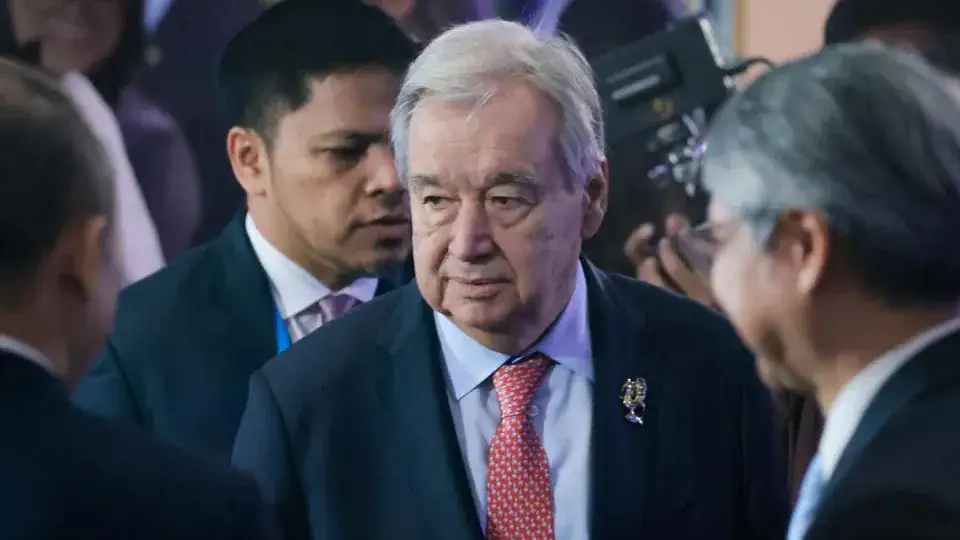
UN Secretary-General Antonio Guterres has described Myanmar's worsening humanitarian crisis as “intolerable.” He warned that violence and rights abuses must stop, even as ASEAN considers gradually restoring the country's political representation at its high-level meetings.
Speaking to reporters on the sidelines of the ASEAN Summit in Manila on November 16, Guterres said more than 16 million people in Myanmar need humanitarian aid and over four million have been forced from their homes. He added that aerial bombardment has become the leading cause of civilian deaths in the country.
With his term ending in December, this was one of his last major diplomatic appearances. “An intolerable humanitarian crisis is still unfolding in Myanmar,” he said. “The violence must stop. Impunity must end, and humanitarian assistance must reach people in need, regardless of who controls the territory, immediately and without conditions.”
His comments followed a decision by Southeast Asian leaders to take a measured approach to bringing Myanmar back into political dialogue. That return depends on sustained progress in ending the violence and carrying out the Five-Point Consensus (5PC). Since the 2021 military coup in the nation of roughly 51.3 million people, Myanmar has been excluded from sending political representatives to ASEAN summits and foreign ministers' meetings.
ASEAN adopted the 5PC in April 2021. It calls for an immediate halt to violence, the start of constructive dialogue among all parties, and mediation and humanitarian help from the bloc.
Asked whether the new approach could finally break a diplomatic stalemate that has lasted five years, Guterres cautioned that engaging Myanmar's military-backed leadership must not come at the cost of accountability. “Engagement is not appeasement,” he said. He stressed that rights violations must end, aid access must be granted, and people held without legal basis must be freed.
A step-by-step approach
On November 15, Philippine Foreign Secretary Ma. Theresa Lazaro said ASEAN leaders had agreed to a “calibrated engagement” that moves step by step and depends on progress. The first test, she said, is whether Myanmar can show it is implementing the 5PC, particularly its call to end violence. “Right now, there are still bombings and people are still being displaced in Myanmar,” she told reporters.
The decision reflects an effort to balance members who want closer engagement with those who are reluctant to make concessions to Myanmar's military-backed government.
Analysts, however, warned against restoring political representation before meaningful progress is seen on the ground. “Political acceptance should follow progress, not precede it,” Simon Tay, chairman of the Singapore Institute of International Affairs, told The Straits Times. “If ASEAN restores Myanmar's full political participation without securing concessions, it risks giving away one of its few remaining bargaining chips.”
On November 15, Singapore's Prime Minister Lawrence Wong told fellow leaders that any future return of Myanmar to full participation in ASEAN summits must be matched by real improvements in humanitarian aid, dialogue and violence reduction. He acknowledged that not all the violence is under the government's control, since some attacks are carried out by ethnic armed groups, but said its forces must not commit violence themselves. “We also want to make sure that there should not be any violence committed by the Myanmar government,” Wong said.
A compromise amid division
ASEAN members have long disagreed about how far to engage Myanmar's leadership. Thailand has pushed for its foreign minister to be allowed to attend high-level ASEAN meetings.
The Manila decision appears to split the difference. It keeps the current restrictions in place while opening a conditional route back to political participation. It also encourages individual members to pursue their own constructive engagement with relevant parties, in consultation with the ASEAN chair.
Moe Thuzar, a senior fellow and coordinator of the Myanmar Studies Programme at the ISEAS – Yusof Ishak Institute in Singapore, described the decision as a diplomatic compromise rather than a fundamental change in direction. “ASEAN decisions are the product of negotiated compromise, which is presented as consensus once an agreed position has been reached,” she told The Straits Times.
In her view, the decision keeps ASEAN's collective stance intact while allowing individual states to take different approaches.
Tay made a similar point, warning that warmer bilateral relations with Myanmar do not automatically shift ASEAN's collective position, which still requires consensus. “There is room for both good cop and bad cop within ASEAN, provided these different approaches remain within the 5PC framework. Otherwise, Myanmar could simply play one against the other,” he said.
Thuzar noted that engaging different parties in Myanmar is not new. It has long been part of ASEAN's push for inclusive dialogue. She pointed to the annual State of Southeast Asia survey by ISEAS, which has repeatedly found that engaging all stakeholders to build trust is the region's most preferred way of addressing the crisis.
Guterres said the UN has never opposed engaging parties to the conflict and noted that its special envoy, Julie Bishop, has maintained contact with a range of stakeholders. He said the envoy would keep working with ASEAN to find a way to end the violence and make inclusive dialogue possible.
Singapore inherits the challenge
The Manila decision puts more weight on continuity between successive ASEAN chairs, including further talks on appointing a longer-term special envoy for Myanmar. Under the current arrangement, the special envoy is named each year with the chairmanship.
The Philippines has pursued diplomatic and humanitarian efforts on Myanmar under Lazaro, who also serves as ASEAN's special envoy on the issue. Singapore takes over the chairmanship in 2027 and will be responsible for turning the Manila decision into concrete diplomatic results.
Thuzar said this will require clearer benchmarks to measure progress in Myanmar, such as sustained drops in violence and better humanitarian access. “A progress-based approach is premised on what and how progress can be measured,” she said.
Tay proposed three possible benchmarks: regular ASEAN access to detained former leader Aung San Suu Kyi and other political prisoners; a commitment from the military-backed government to stop violence in areas it claims to control and where it has held elections; and priority for humanitarian aid along the Myanmar-Thailand border.
He cautioned that these interim goals may seem unrealistic given the current stance of the Min Aung Hlaing administration, which appears to reject the 5PC entirely. “But ASEAN needs to find a middle path, and the MAH administration needs to show commitment to make progress,” he said.