 Mekong Monitor
Two Medieval Bridges Show Different Approaches to 12th-Century Construction
China's Anping Bridge and Cambodia's Kampong Kdei Bridge, both constructed in the 12th century, reveal how different engineering traditions solved the challenge of crossing water with the materials and knowledge available nearly nine centuries ago.
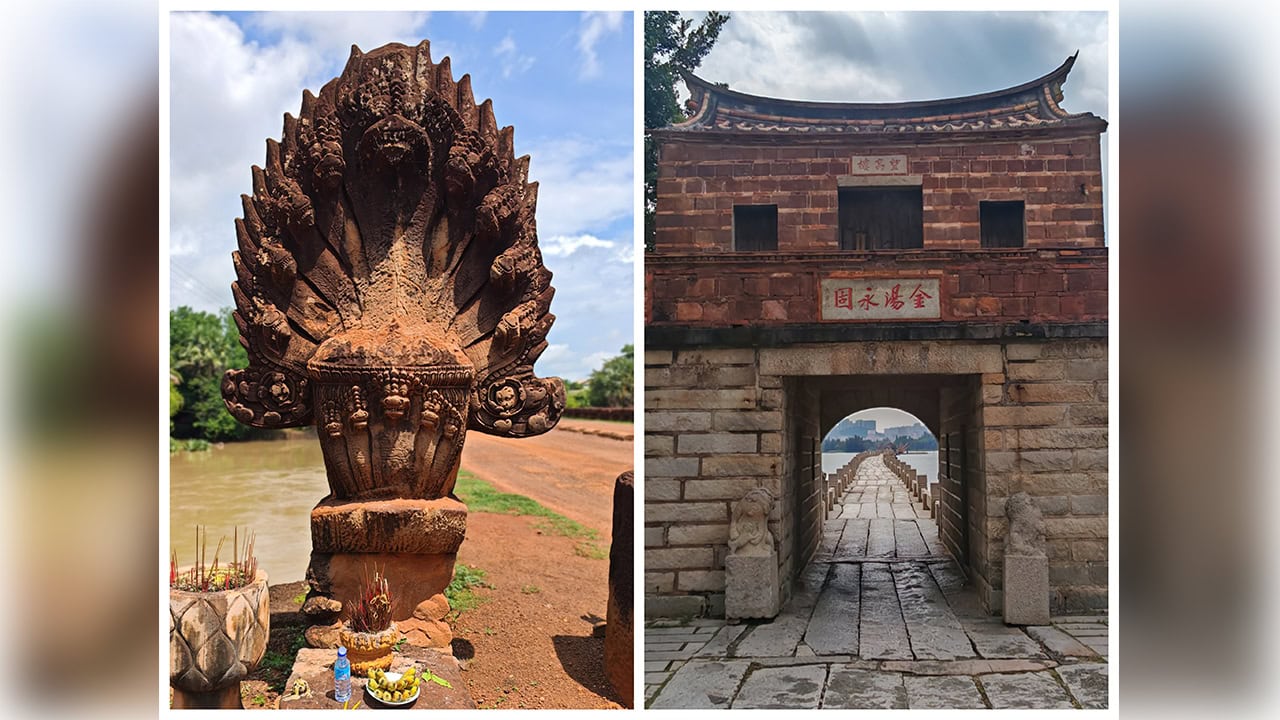
In the 12th century, engineers on opposite sides of Asia tackled bridge construction in dramatically different ways. While Chinese craftsmen in Fujian province were assembling enormous granite slabs across tidal waters, Khmer builders were creating arched stone crossings for the Angkor road system.
These two structures—China's Anping Bridge and Cambodia's Kampong Kdei Bridge (also called Spean Praptos)—represent distinct engineering philosophies from roughly the same era, both still standing today as evidence of sophisticated medieval construction techniques.
The Challenge of Building Across Water
In late September, journalists from ASEAN countries toured Anping Bridge in Anhai town, part of Jinjiang in Fujian province. A local guide detailed how builders working between 1138 and 1152 managed to construct a crossing despite challenging conditions: unstable seabed sediment, strong tidal flows, and the need to maneuver stone blocks weighing up to 25 tonnes without modern lifting equipment.
The finished bridge, completed 874 years ago after 14 years of work, stretches about 2.25 kilometers and ranges from 2.9 to 4 meters in width. Its alternative name, Wuli Bridge, references its length of roughly five traditional Chinese li units. Individual stone slabs reach up to 11 meters long.
Ingenious Construction Methods
Workers transported granite blocks by boat and timed their placement to coincide with tidal movements, allowing the natural rise and fall of water to help position heavy slabs onto their supports. The stone itself may have come partly from Kinmen and neighboring islands, though the complete sourcing remains uncertain.
A particularly clever technique involved laying wooden logs across the soft mud bottom, then gradually loading them with heavy stones. This forced the foundation deeper until it reached a stable layer capable of bearing the bridge's weight over centuries.
The structure's longevity also owes something to an unexpected ally: oysters. As these shellfish colonized the submerged portions, their accumulated shells created a protective layer that helped shield the masonry from wave action and erosion.
Bridge designers used three different pier configurations—rectangular, single-pointed (or half-boat-shaped), and double-pointed boat-shaped—strategically placed according to local current patterns. Most sources identify 360 piers in total: 290 rectangular, 44 single-pointed, and 26 double-pointed, creating 362 openings for water flow.
The bridge facilitated commerce and movement between Quanzhou and regions to the south, supporting the maritime trade that enriched the area during the Song and Yuan dynasties. In 2021, UNESCO recognized it as one of 22 sites comprising "Quanzhou: Emporium of the World in Song–Yuan China."
A Different Solution in Cambodia
Kampong Kdei Bridge, located in Chi Kreng district of Siem Reap province, offers an instructive contrast. Built during the reign of King Jayavarman VII, this roughly 87-meter structure served the road network radiating from Angkor throughout the Khmer Empire.
Rather than long granite beams on numerous piers, Cambodian engineers constructed it from laterite blocks arranged in more than 20 corbelled arches. The bridge features distinctive nine-headed naga serpent balustrades that merge structural function with religious meaning and Khmer artistic expression.
Two Philosophies, One Purpose
These bridges addressed similar problems through different means. Anping was designed for a maritime trading hub, exploiting tidal patterns, timber foundations, and current-adapted pier shapes. Kampong Kdei carried travelers across a river as part of an overland network connecting the Angkorian realm.
Both structures demonstrate that ancient bridges served purposes beyond simple transportation—they embodied economic strength, engineering expertise, and the cultural values of the civilizations that built them.