 Mekong Monitor
Two Bridges, Two Empires: How 12th-Century Engineers Tackled Nature's Challenges
Two ancient bridges from the 12th century reveal how Chinese and Khmer engineers created contrasting solutions to span water, each reflecting their empire's economic and cultural priorities.
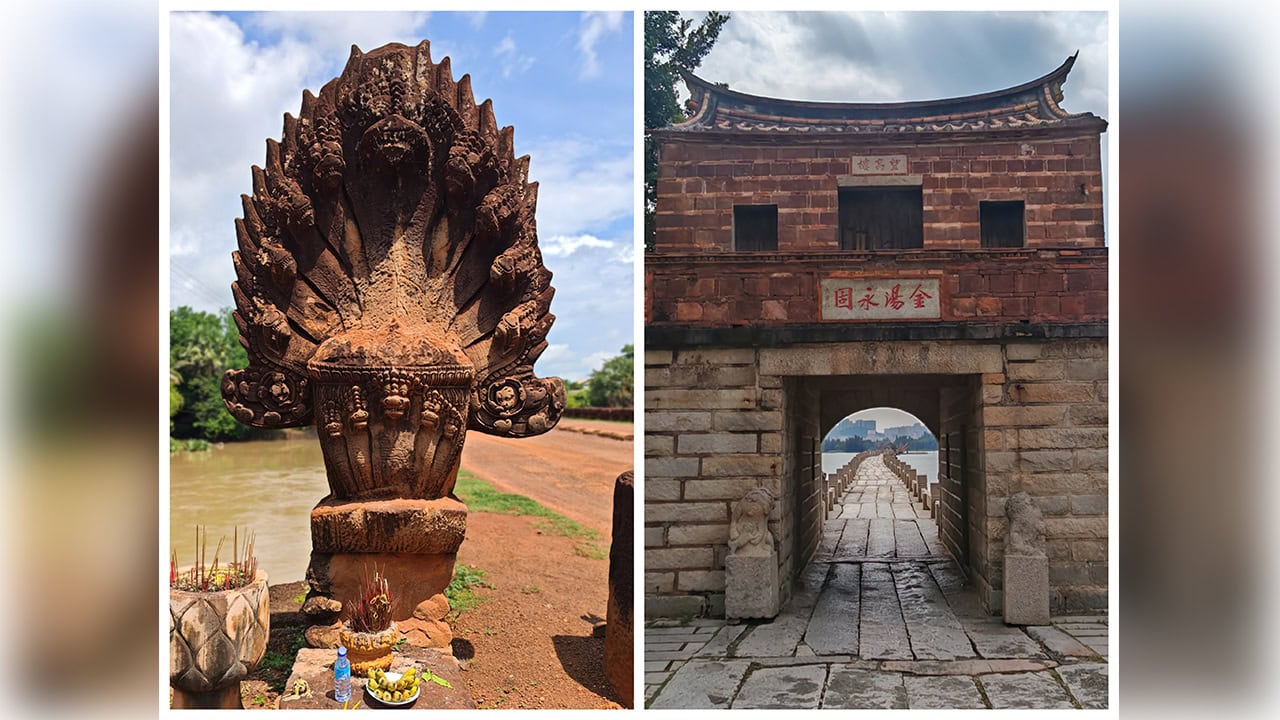
In the 12th century, two ambitious engineering projects took shape on opposite sides of Asia. Along the coast of Fujian province in China, workers assembled an enormous stone causeway to span tidal waters. Thousands of kilometers away, Khmer builders were crafting arched passages to connect the roads of their empire. Though separated by geography and purpose, the Anping Bridge and Kampong Kdei Bridge reveal how medieval engineers adapted their designs to local conditions.
China's Maritime Solution: The Anping Bridge
Construction of the Anping Bridge began in 1138 during China's Southern Song dynasty and took fourteen years to complete. Stretching over 2.25 kilometers and varying between 2.9 and 4 meters wide, it links two towns in what is now Quanzhou. The structure has endured nearly nine centuries since its completion in 1152.
The primary challenge was the environment itself. The bridge's foundation rests on soft seabed mud, subject to strong tidal currents. Chinese builders devised an ingenious solution: they transported massive granite blocks by boat and used the natural rhythm of tides to position them over wooden supports. The sleeper-log technique involved laying timber across the mud, then stacking heavy stones atop it—the weight gradually forced the foundation deeper until it reached stable ground.
Individual granite slabs sometimes stretched 11 meters and weighed up to 25 tonnes. Rather than use mortar, builders relied on oyster shells that naturally accumulated around the submerged stonework, binding it together and protecting it from erosion. The bridge incorporates three different pier designs—rectangular, single-pointed, and double-pointed—each shaped to handle different water flows. Together, roughly 360 piers support the structure.
The Anping Bridge facilitated trade between Quanzhou and southern ports during an era of maritime prosperity. Its historical significance is now recognized as part of a UNESCO-designated site celebrating Song and Yuan Dynasty commerce.
Cambodia's Architectural Expression: Kampong Kdei Bridge
In Cambodia, roughly contemporary with China's project, King Jayavarman VII commissioned a different kind of bridge. Located in Siem Reap province, the 87-meter Kampong Kdei Bridge formed part of a road network binding the Angkorian Empire together. Rather than relying on massive stone beams and countless piers, Khmer engineers built from laterite blocks assembled into more than 20 corbelled arches.
The bridge's design incorporates nine-headed naga figures along its railings—a religious symbol that merged practical engineering with cultural and spiritual meaning. This artistic dimension distinguished Khmer architecture from purely utilitarian structures elsewhere.
Engineering Across Cultures
Both bridges solved the fundamental problem of spanning water, yet their solutions reflected the needs of their respective societies. Anping served maritime trade and withstood tidal forces through its numerous piers and tidal engineering. Kampong Kdei carried land travelers across a river, relying instead on the arch—a different technology suited to its purpose.
Nearly 900 years later, both structures remain standing. They represent more than functional infrastructure; they embody the technical knowledge, economic power, and cultural values of their builders. In their survival lies evidence of how engineering excellence transcends time.