 Mekong Monitor
Two 12th-Century Bridges Show Different Approaches to Ancient Engineering
China's Anping Bridge and Cambodia's Kampong Kdei Bridge, both constructed in the 12th century, demonstrate sophisticated engineering solutions adapted to vastly different environments and purposes.
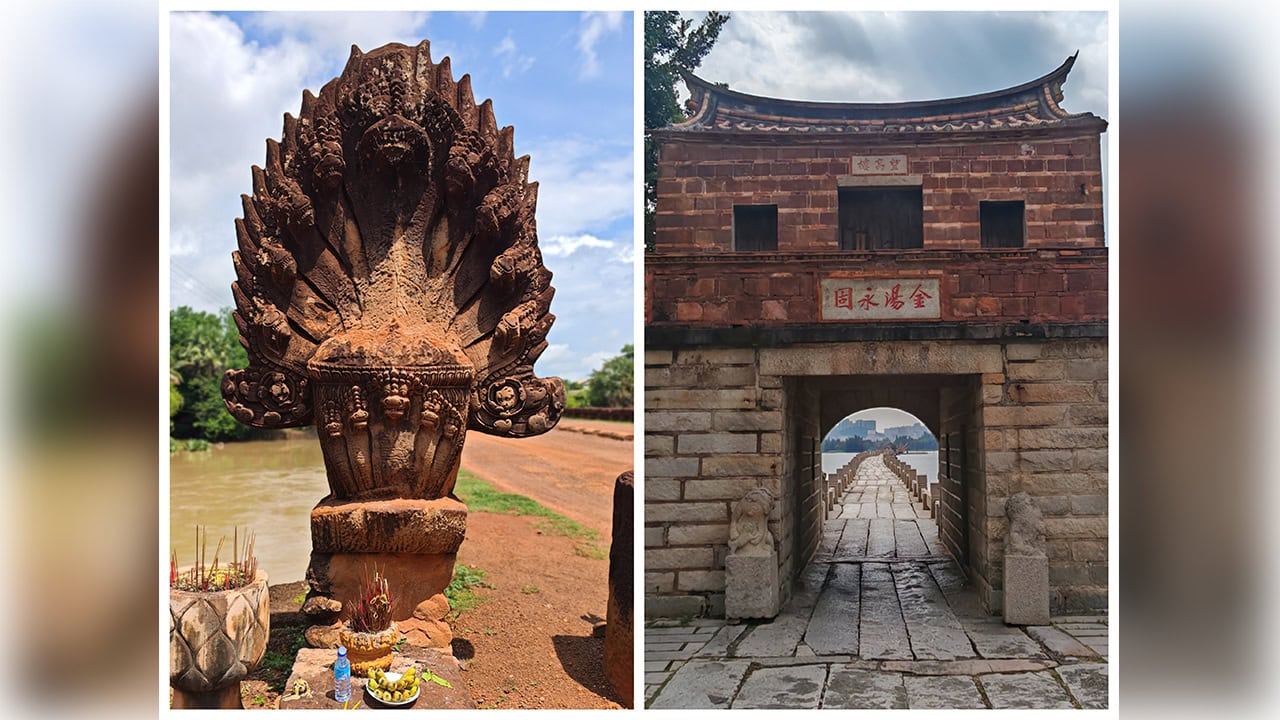
Almost 900 years ago, two remarkable construction projects unfolded on opposite sides of Asia. In China's Fujian province, workers were placing enormous granite blocks across a tidal waterway, while in the Khmer Empire, craftsmen built arched stone bridges to link the road system radiating from Angkor.
Despite their geographic separation and distinct construction methods, the Anping Bridge in China and Spean Praptos (widely called Kampong Kdei Bridge) in Cambodia both stand as testament to sophisticated engineering from the 12th century.
Engineering a Tidal Crossing
When ASEAN journalists toured the Anping Bridge site in Jinjiang's Anhai town on September 22, local guides described the technical challenges faced by medieval builders. The structure links Anhai town in Jinjiang with Shuitou town in Nan'an, both part of Quanzhou municipality.
Work started in 1138 under the Southern Song dynasty and finished in 1152. The bridge stretches roughly 2.25 kilometers and measures between 2.9 and 4 meters in width. Its alternative name, Five-Li Bridge, comes from its length equaling about five traditional Chinese distance units.
According to guides, individual stone slabs reach up to 11 meters long, with the heaviest weighing around 25 tonnes. Without lifting equipment, construction teams moved granite by watercraft and exploited tidal movements to maneuver the massive slabs into position atop supporting columns.
While some local traditions indicate that Kinmen and neighboring islands supplied part of the stone, the complete origin of the granite remains uncertain.
Innovative Foundation Methods
Builders employed a "sleeper-log foundation" approach to address the soft seabed. Workers spread wooden beams across the muddy bottom and stacked heavy stones on top, forcing the foundation downward until it reached a more solid layer capable of bearing the load.
Over time, oysters colonized the submerged sections, their shells accumulating around the masonry and creating a protective barrier against wave action and erosion. Contrary to some descriptions, these mollusks did not secrete binding material—their shells simply accumulated and reinforced the structure's outer surface.
The design incorporates three distinct pier shapes to handle varying water flows: rectangular forms, single-pointed or half-boat configurations, and double-pointed boat-shaped supports. Official records typically list 360 piers—290 rectangular, 44 single-pointed, and 26 double-pointed—though some counts reach 361. The bridge contains 362 openings for water passage.
The structure facilitated commerce and movement between Quanzhou and southern territories, reflecting the wealth generated by maritime trade during the Song and Yuan eras. In 2021, it joined 22 other sites as part of the UNESCO designation "Quanzhou: Emporium of the World in Song–Yuan China."
A Different Solution in Cambodia
Cambodia's Kampong Kdei bridge offers a valuable point of comparison from roughly the same era. Situated in Chi Kreng district of Siem Reap province, the approximately 87-meter structure dates to the reign of King Jayavarman VII and served the road system connecting Angkor with other regions of the Khmer Empire.
Rather than extended granite beams supported by numerous piers, Kampong Kdei consists of laterite blocks forming more than 20 corbelled arches. Its balustrades feature nine-headed nagas, merging structural function with religious symbolism and Khmer artistic expression.
Enduring Legacy
The two bridges addressed comparable problems through divergent strategies. Anping supported a maritime trade network and depended on tidal patterns, timber substructures, and pier designs tailored to specific currents. Kampong Kdei carried travelers over a river along the Angkorian overland routes.
Both structures have survived to the present day, proving that ancient bridges represented more than simple transit infrastructure. They embodied economic strength, technical capability, and cultural character that transcended their practical function.