 Mekong Monitor
Talks on the Podium, Control on the Ground: Thailand's Border Contradiction
Cambodia argues that Thailand champions bilateral dialogue in public while stalling joint border mechanisms and consolidating control over disputed land. The commentary calls for Thailand to honour its December 27 ceasefire commitments.
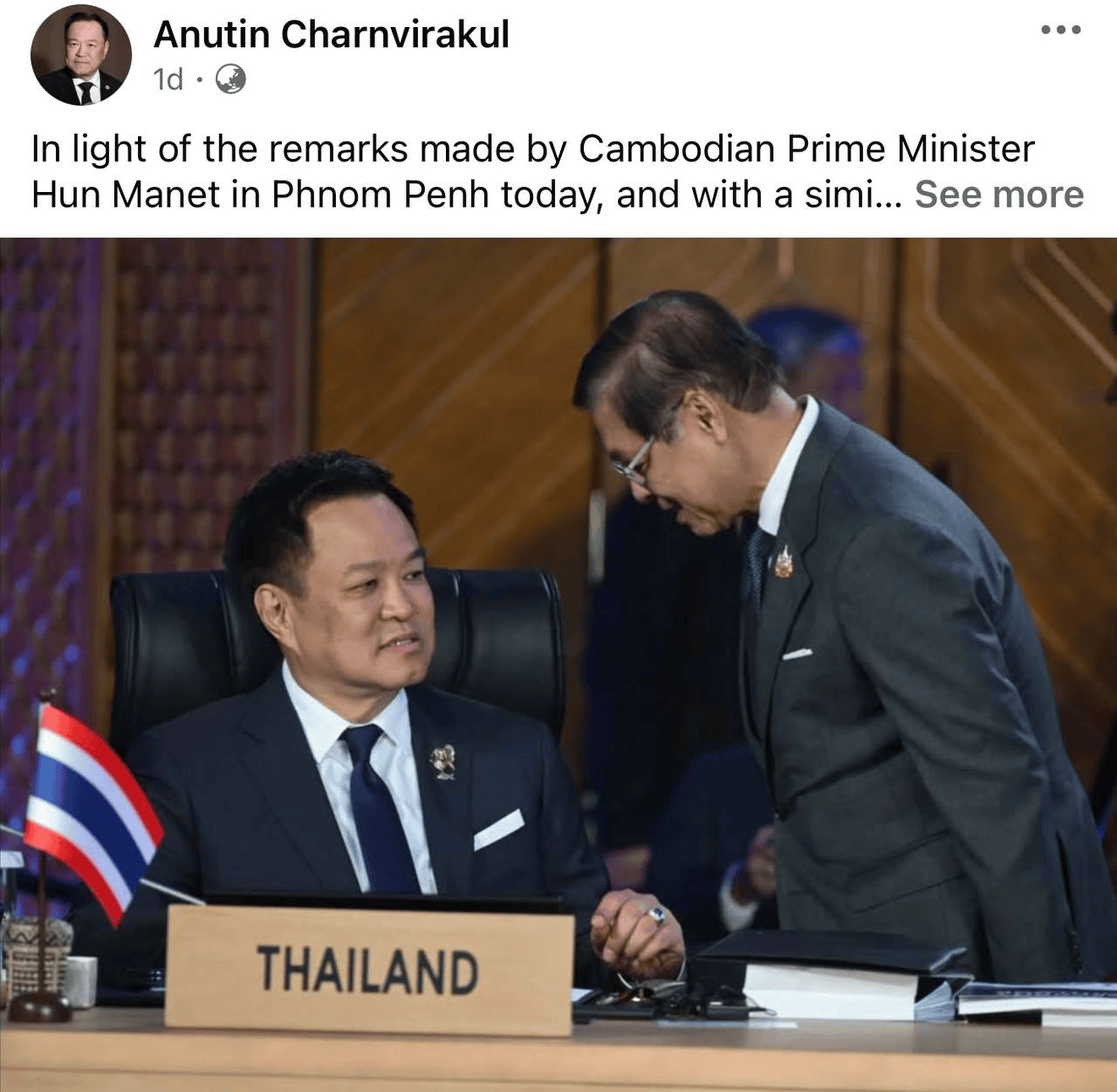
Thailand's leaders have repeatedly urged Cambodia to settle their border dispute through direct bilateral talks rather than raising it at international forums. On November 15, Thai Prime Minister Anutin Charnvirakul reaffirmed that Thailand does not want to bring territorial and humanitarian disputes before countries that are not parties to the conflict.
Foreign Minister Sihasak Phuangketkeow has taken a similar line, championing bilateral negotiations and criticising Cambodia's efforts to put the border situation on the international agenda.
On the surface, this stance sounds reasonable. Neighbours should seek peaceful solutions through dialogue, established mechanisms and mutual respect, and Cambodia does not fundamentally disagree. The real problem is the widening gap between Thailand's public praise for bilateralism and how it actually behaves.
Bilateralism should not be judged by how often a government invokes it before foreign audiences. The real test is whether both sides engage in good faith, respond to formal proposals, honour their agreements and refrain from steps that undermine negotiations.
The question, then, is not whether Cambodia supports bilateral talks. It is whether Thailand is willing to act on what it preaches.
A record of unanswered requests
Cambodia's diplomatic record is a sensible place to begin. On November 10, Cambodian government spokesperson Pen Bona said Phnom Penh had sent Thailand 12 diplomatic notes asking for Joint Boundary Commission (JBC) meetings to resume after the December 27, 2025 ceasefire. According to him, Thailand has not replied to any of them.
These notes were not vague expressions of goodwill. They included concrete proposals: convening a special JBC meeting, deploying Joint Survey Teams to restart fieldwork, and continuing technical discussions on boundary demarcation.
Cambodia also sought to carry out arrangements agreed at the October 2025 JBC meeting, including replacing 15 boundary pillars whose locations had already been settled. Thailand later cited domestic administrative procedures and the need to complete the appointment of its JBC representatives. Those factors may explain some delays, but they cannot indefinitely keep a bilateral mechanism from functioning.
The General Border Committee (GBC) offers another important example. Cambodia took part in the negotiations that produced the third special GBC meeting on December 27, 2025, which issued a joint statement establishing the ceasefire and practical steps to ease tensions.
It would be inaccurate to claim Thailand has never taken part in bilateral negotiations. The two countries have held meetings and signed agreements. The more pressing question is whether those agreements are being implemented in good faith.
A meeting means little if its commitments remain unmet, and a signed document cannot stand in for action.
Bilateralism does not require silence toward the world
Thailand's position also raises a broader question: does pursuing bilateral talks oblige Cambodia to stay quiet about its humanitarian and territorial concerns internationally?
There is no inherent contradiction. Cambodia can keep engaging Thailand through the JBC, the GBC and other established channels while also raising its concerns with ASEAN, the United Nations and other international partners.
Engaging the international community does not automatically amount to rejecting bilateralism. It can bring transparency, encourage compliance with agreements and help keep a bilateral dispute from widening into a regional problem.
There is also a clear distinction between seeking international attention and asking third countries to decide sovereignty. Taking a case to international forums does not necessarily mean handing responsibility for resolving the dispute away from bilateral mechanisms.
Thailand is entitled to defend its position. Cambodia is equally entitled to explain the consequences of an unresolved border, particularly when thousands of civilians cannot return home.
If Thailand truly believes bilateral mechanisms are the right solution, the most constructive response would be to make them work again, rather than criticising Cambodia for pointing out how long they have been inactive.
Security or consolidation of territorial control?
The most decisive test of Thailand's commitment to bilateralism lies not in diplomatic statements but on the border itself.
Thailand may describe its troop deployments and physical barriers as necessary security measures. Every sovereign state has the right and duty to protect its territory and citizens. The real question is whether the scale, location, duration and nature of Thai military and civilian activity in disputed areas can reasonably be explained as purely defensive.
Cambodia says it has repeatedly reported military deployments, shipping containers, barbed and razor wire fencing, trenches, bunkers, checkpoints and other structures in areas it considers Cambodian territory. It has also reported the demolition of civilian homes and property, and restrictions that keep residents from returning to their communities.
The concern is not simply the presence of Thai soldiers. It is the cumulative effect: building physical barriers and fortifications, restricting civilian access, and maintaining control over locations whose boundaries are still disputed.
Taken together, these developments raise serious concerns that Thailand is consolidating effective physical control over territory Cambodia claims, rather than simply maintaining a defensive posture.
This creates the risk of a fait accompli: physical control is established and maintained first, while sovereignty and final demarcation remain unresolved. It risks changing conditions in disputed areas before the agreed bilateral mechanisms have finished their work.
Thailand maintains that its security measures sit within territory it regards as sovereign, and that position must be acknowledged. But a unilateral reading of territory cannot replace joint demarcation, and military control cannot establish lawful sovereignty.
The December 27 GBC joint statement sets an important benchmark. Both governments agreed to keep their existing troop deployments, avoid provocative actions, and refrain from building or expanding military infrastructure or fortifications beyond their own sides. They also agreed to resume JBC surveying and demarcation as soon as possible.
These commitments must be respected in both letter and spirit. Any alleged violations should be examined through agreed verification mechanisms, including the ASEAN Observer Team.
A military presence does not confer territorial title. Razor wire cannot substitute for boundary demarcation. And the passage of time alone cannot turn a disputed position into an internationally recognised border.
Peace must mean the right to go home
Behind the diplomatic exchanges are families whose lives remain on hold.
According to Pen Bona on November 10, more than 20,000 displaced Cambodians were still unable to return home. A separate Ministry of Interior update on November 4 put the wider remaining displacement figure at roughly 24,000 people.