 Mekong Monitor
Talk of Dialogue, Facts on the Border: Thailand's Contradictions
Thailand calls for bilateral talks with Cambodia, yet its inaction on joint mechanisms and its build-up of physical control along the border point to a different reality.
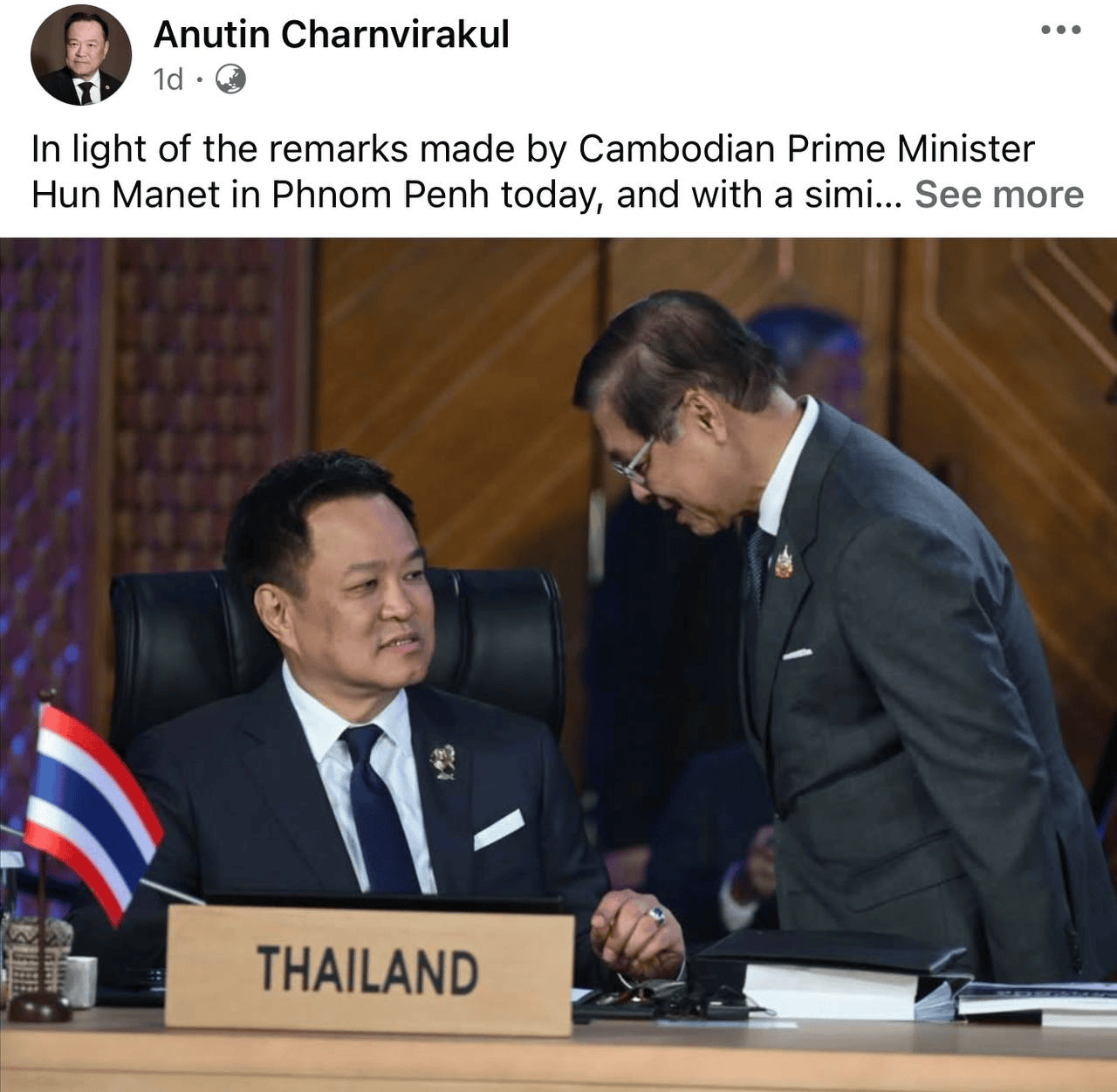
Thailand's calls for bilateral talks with Cambodia have to be judged against how it actually behaves at the negotiating table and on the ground along the frontier.
Thai leaders have repeatedly asked Cambodia to settle the border dispute through direct negotiations rather than by raising it in international forums. On November 15, Prime Minister Anutin Charnvirakul said Thailand did not want to take territorial and humanitarian disputes to countries that were not party to the conflict. Foreign Minister Sihasak Phuangketkeow has made similar arguments and criticised Cambodia for drawing international attention to the border situation.
On the surface, the position sounds sensible. Neighbours should seek peaceful solutions through dialogue, existing mechanisms and mutual respect, and Cambodia does not disagree with that principle. The real problem is the widening gap between Thailand's public support for bilateralism and what it does in practice.
Bilateralism should not be judged by how often a government invokes the word in front of foreign audiences. The better test is whether both sides genuinely engage, respond to formal proposals, honour their agreements and avoid steps that undermine the talks. The real question is not whether Cambodia backs bilateral solutions, but whether Thailand is ready to live up to the principle it promotes.
A record of unanswered requests
Cambodia's diplomatic record is a useful place to start. On November 10, government spokesperson Pen Bona said Phnom Penh had sent Thailand 12 diplomatic notes asking for the Joint Boundary Commission (JBC) to resume meetings after the ceasefire of December 27, 2025. According to him, Thailand has not replied to any of them.
These were not vague statements of willingness. They included concrete proposals: a special JBC meeting, the deployment of Joint Survey Teams to restart fieldwork, and continued technical talks on boundary demarcation.
Cambodia also tried to carry out steps agreed at the JBC meeting in October 2025, including replacing 15 boundary pillars whose locations had already been agreed. Thailand later pointed to its domestic administrative procedures and the need to finish appointing its JBC representatives. Those explanations may account for some delays, but they cannot justify keeping a bilateral mechanism idle indefinitely.
The General Border Committee (GBC) offers another example. Cambodia took part in the talks that led to the third special GBC meeting on December 27, 2025, which produced a joint statement setting out the ceasefire and practical steps to reduce tensions.
It would be wrong to say Thailand has never taken part in bilateral negotiations. The two countries have held meetings and signed agreements. What matters more is whether those agreements are being carried out in good faith.
A meeting has little value in itself if its commitments are left unfulfilled, and a signed document is no substitute for action.
Bilateral talks should not mean silence
Thailand's stance also raises a wider question: does pursuing bilateral talks oblige Cambodia to stay quiet about humanitarian and territorial concerns in international settings?
There is no inherent conflict between the two. Cambodia can keep engaging Thailand through the JBC, the GBC and other established channels while also briefing ASEAN, the United Nations and other international partners.
Engaging the international community does not amount to rejecting bilateralism. It can bring transparency, encourage compliance with agreements and help keep a bilateral dispute from spilling into a larger regional problem.
There is also an important difference between seeking international attention and asking outside countries to decide who owns the land. Taking a case to international forums does not mean handing responsibility for the dispute away from bilateral mechanisms.
Thailand is free to defend its position. Cambodia is equally free to explain what an unresolved border means for its people, especially while thousands of civilians still cannot return home.
If Thailand truly believes bilateral mechanisms are the right path, the most constructive move would be to make them work again, rather than criticising Cambodia for pointing out how long they have been stalled.
Security or control of territory?
The clearest test of Thailand's commitment to bilateralism is not what it says in diplomatic settings but what happens along the border.
Thailand describes its troop deployments and physical barriers as necessary security measures. Every sovereign state has the right and the duty to protect its territory and citizens. The real question is whether the scale, location, duration and nature of Thai military and civilian activity in disputed areas can reasonably be explained as purely defensive.
Cambodia says it has repeatedly documented troop deployments, shipping containers, barbed and razor wire fencing, trenches, bunkers, checkpoints and other physical structures on land it regards as Cambodian. It also reports the demolition of homes and property and restrictions that stop residents from going back to their communities.
The concern is not just that Thai soldiers are present. It is the combined effect of these measures: putting up barriers, building fortifications, limiting civilian access and holding positions in places whose boundaries are still disputed.
Taken together, these actions raise serious questions about whether Thailand is trying to establish effective physical control over territory that Cambodia claims, rather than simply maintaining a defensive presence.
This risks creating a fait accompli: physical control is established first, while sovereignty and final demarcation remain unsettled. It also risks changing conditions in disputed areas before the agreed bilateral mechanisms have finished their work.
Thailand maintains that its security measures sit inside territory it considers its own, and that view has to be acknowledged. Still, a unilateral reading of territory cannot replace joint demarcation, and military control cannot create lawful sovereignty.
The December 27 GBC joint statement offers an important benchmark. Both governments agreed to keep their existing troop levels, avoid provocative acts, and refrain from building or expanding military infrastructure and fortifications beyond their own sides. They also committed to resuming JBC surveying and demarcation as soon as possible.
Those commitments should be honoured in both letter and spirit. Any alleged violations should be examined through agreed verification channels, including the ASEAN Observer Team.
A military presence does not confer territorial title. Razor wire cannot substitute for boundary demarcation. And the passage of time alone cannot turn a contested position into an internationally recognised border.
Peace means being able to go home
Behind the diplomatic exchanges are families whose lives remain on hold.
According to Pen Bona on November 10, more than 20,000 displaced Cambodians were still unable to return home. A separate Ministry of Interior update on November 4 put the broader number of people still displaced at roughly 24,000.
These are broader displacement figures and should be read as a wider picture of the situation, not as a precise count of