 Mekong Monitor
Singapore Haze: Mask Queues Grow as Smoke Lingers, with Relief Possibly Only by Weekend
Long queues formed across Singapore as residents collected free N95 masks during a worsening haze, while air-conditioned haze shelters remained largely empty. Officials say conditions may only improve by the weekend.
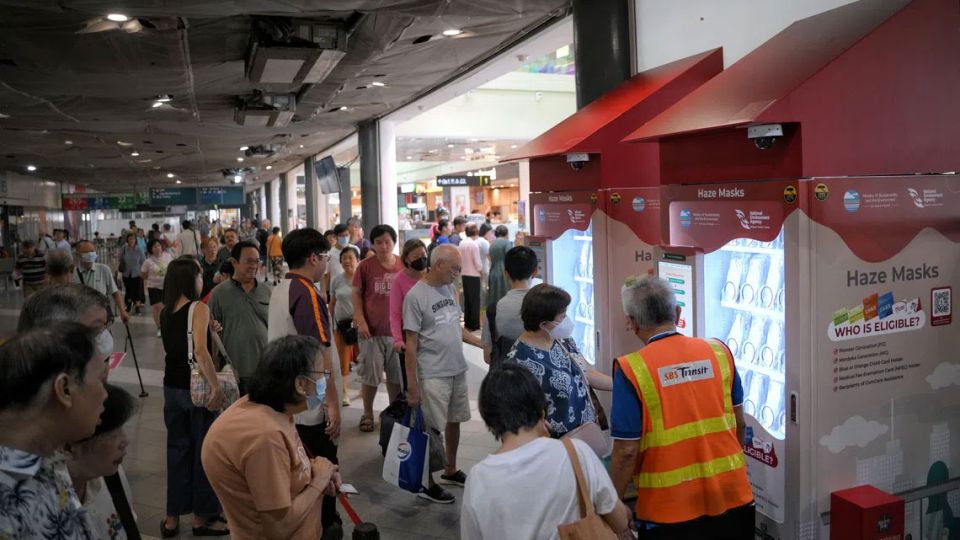
Crowds gathered at community clubs across Singapore on October 15 to collect N95 masks, though early morning rain did little to clear the haze.
Haze shelters drew far fewer people. The air-conditioned rooms at community clubs (CCs), residents' committee centres and residents' network (RN) centres were meant to offer relief from the smoke, but many were quiet or closed.
Masks in high demand
The People's Association (PA) had announced on October 14 that it would distribute masks to eligible residents and open haze shelters. The move followed a spike in PM2.5, the main haze pollutant, which rose above 200 in many parts of the country.
By 5pm on October 15, the Pollutant Standards Index (PSI) was in the unhealthy range across Singapore, reaching 188 in the west and 186 in the central region. PM2.5 readings were in the high band (151 to 250) everywhere, peaking at 205 in the central region.
Conditions are not expected to improve on October 16, but they could ease on October 17 and 18.
In an evening update, the National Environment Agency (NEA) said dense smoke from fires in Kalimantan was still drifting toward Singapore on south-easterly winds, with smoke also visible over Sumatra. Showers were expected on October 16, but southern Sumatra and parts of Kalimantan would likely stay dry, so smoke would keep reaching the island. The agency added that showers were forecast for the weekend, and that southerly or south-easterly winds could slow the flow of smoke from Kalimantan, although some haze from Sumatra might still drift in.
Long lines at distribution points
At Punggol 21 CC, distribution began at 10am in the multipurpose hall, with about 20 people waiting. Eligible groups, including seniors, pregnant women, young children and people with medical conditions, could collect two masks each. A 73-year-old coffee shop assistant who gave only the name Tan said he came to collect masks as a precaution, even though the haze had not made him ill. He said he now spends less time outdoors and goes straight home after work.
At Jurong Spring CC, about 15 people were in line by 10.20am. One of them, Elien Chan, in her 50s, was wearing a surgical mask. She had experienced nose irritation and headaches when PM2.5 spiked in the west on October 14. Although she appreciated the free masks, she questioned whether two would be enough, since each one lasts only about three days and cannot be washed. She planned to buy an air purifier with her husband.
At One Punggol CC, retired aviation officer K.C. Tan, 68, was one of only a handful of people collecting masks. He said every pharmacy he had recently visited had sold out of N95 masks. He had a sore throat and had skipped his usual morning workout for several days. At home, he had been running air purifiers and air-conditioning more often.
Smaller crowds were also seen at Kallang CC and Sengkang CC.
NEA had said on October 14 that distribution would start because PM2.5 levels had reached the very high band (above 250) in some areas.
That evening, shortly after 8pm, several residents, mostly seniors, visited Yuhua CC in Jurong East to collect masks. Among them was real estate consultant Joel Tan, 40, who picked up masks for his primary school children as a precaution. "There isn't much stock left in the market," he said. An air purifier and air-conditioning were helping his family cope at home. His 11-year-old daughter Chloe was starting to cough. She would be eating recess meals in her classroom at Clementi Primary School, using her own food containers.
Retiree Chew Lai Fong collected masks for herself and her husband, then picked up extra for neighbours and friends, especially those who live alone.
Haze shelters draw few visitors
Unlike the masks, the community haze shelters, which are located at selected CCs, residents' committee centres and other sites, saw little traffic. These rooms offer a cool, comfortable escape from the pollution. At Yuhua CC, for instance, an air-conditioned room was stocked with drinks, water and snacks for residents who needed a break from the haze.
When a reporter visited the shelter at One Punggol CC around 11am on October 15, only one person was there: a retired ship captain. Sarun, who goes by one name, was waiting to pick up his granddaughter from childcare. The 62-year-old said the haze had given him a sore throat and itchy eyes.
Financial consultant Florence Ong, 40, and her mother were using a small pre-function room at Kreta Ayer CC around 12.50pm. Ong said she came to work there because she tries not to run the air-conditioning at home during the day, and her three-room flat in Sago Lane has no air purifier. She had first gone to an RC centre at Block 333 Kreta Ayer Road, which also has a shelter, but found it closed.
NEA had advised residents to contact their nearest CC to check the operating hours and locations of haze shelters.
Other sites were harder to use. Although the main office at Jurong Green CC also serves as a shelter, people who turned up shortly before noon on October 15 came only to collect masks and did not stay. The shelters at the Jurong Spring Zone B and Punggol Bayvue residents' networks appeared to be locked. Staff at Jurong Green CC, located across from the Jurong Spring Zone B RN, said that network would open only if there was demand. Residents can instead reach grassroots members or PA staff through a hotline.