 Mekong Monitor
Protecting Mangroves Means Backing Cambodia's Future
A conservation group in Cambodia is showing that mangrove protection and coastal livelihoods can go hand in hand. Its community-led aquaculture project offers a model that could be expanded along the country's coastline.
Along Cambodia's coast, mangrove forests quietly do a great deal of work. At no cost, they shield the shoreline, sustain fish stocks, provide habitat for remarkable wildlife and support the families who live along the coast.
Too often, though, these ecosystems are seen as empty land waiting to be cleared, rather than irreplaceable natural assets that deserve protection.
Research shows that healthy mangroves help keep fisheries productive and prevent an estimated $65 billion in flood damage worldwide each year. Protecting them is therefore central to both coastal livelihoods and economic growth.
Cambodia, however, has lost 42% of its mangroves between 1989 and 2017. Overfishing and coastal development are also putting marine ecosystems under strain, adding pressure on the communities that rely on them. Clearing mangroves may bring quick income, but over time it undermines fish productivity and the natural defences that protect the coast.
At Wild Earth Allies, we start from a simple principle: it is neither fair nor effective to ask coastal families to protect nature while leaving them without a secure way to make a living. Conservation and community development need to advance together.
We believe conservation works best when it draws on local knowledge, values and leadership, and when it is built on long-term relationships grounded in trust, respect and shared responsibility. Protecting nature cannot simply mean shutting people out. It should create real opportunities for people and nature to flourish side by side.
A New Approach to Sustainable Aquaculture
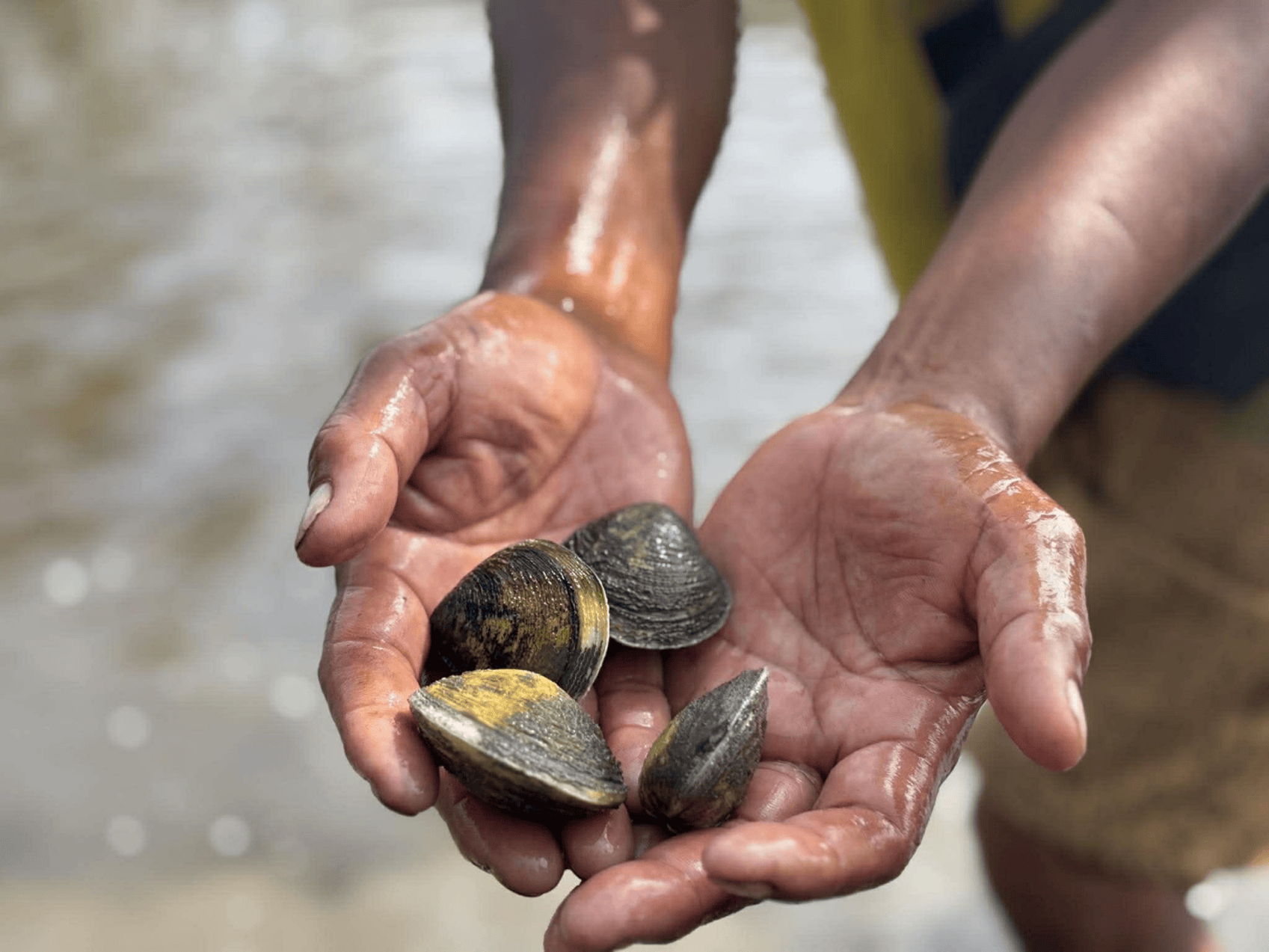
This philosophy underpins our new sustainable aquaculture initiative. Working with the Marine Aquaculture Research and Development Centre (MARDeC), provincial Fisheries Departments and eight Community Fisheries, we are helping coastal communities farm mud crabs, Asian green mussels and mud clams in Kampot, Kep and Preah Sihanouk provinces, using methods designed to limit environmental harm.
The aim is straightforward: help coastal families earn an income from healthy marine ecosystems, so that the habitats their livelihoods depend on are protected rather than destroyed. Our team works with community fishers to raise mud crabs in carefully managed enclosures that keep standing mangrove trees in place. Mussels and clams are grown without added feed, and because farmed shellfish can serve as a food source for crabs, the crabs depend less on wild-caught fish.
The early results are encouraging. By September 2026, eight mud crab farms had been set up and 335 kilograms of juvenile crabs had been distributed. Four community groups completed their first sales of more than 40 kilograms of crabs, bringing in roughly $700. Six mussel farming sites were established using 144 concrete poles, and two clam farming sites received 1,000 kilograms of seed stock for production and crab feed.
These figures are still modest, but they point to a promising, locally led model that links economic opportunity with ecosystem protection.
Rigorous testing at every stage of production is essential to successful crab farming and to delivering seafood that is safe, clean and of high quality.
Crucially, our model sets aside a share of aquaculture income for community conservation funds. Local businesses that do well can help finance the protection of the ecosystems their livelihoods depend on. This matters greatly at a time when global funding for biodiversity is falling sharply.
These early outcomes lay a solid foundation for growth, built on collaboration, shared learning and local ownership.
Scaling the Model Across the Coastline
Cambodia now has the chance to scale this approach along its entire coastline, pairing sustainable livelihoods with mangrove conservation. Development banks, impact investors, businesses, governments and philanthropic organisations can help turn promising local projects into lasting economic opportunities. Still, lasting success depends on backing local leaders, strengthening community capacity and forging partnerships that endure.
Cambodia does not have to choose between thriving coastal communities and healthy mangroves. Success should be judged not only by how much seafood is produced or how much money is earned, but also by flourishing communities, healthier ecosystems and conservation that lasts for generations.
We already have a promising model. Let us work together to expand its benefits for people and nature.