 Mekong Monitor
Preah Vihear Temple Enters Second Stage of Emergency Repairs
Restoration crews have begun the second phase of emergency stabilisation at Preah Vihear Temple, targeting 29 badly damaged locations. The work aims to prevent further collapse and preserve the World Heritage site until full restoration can take place.
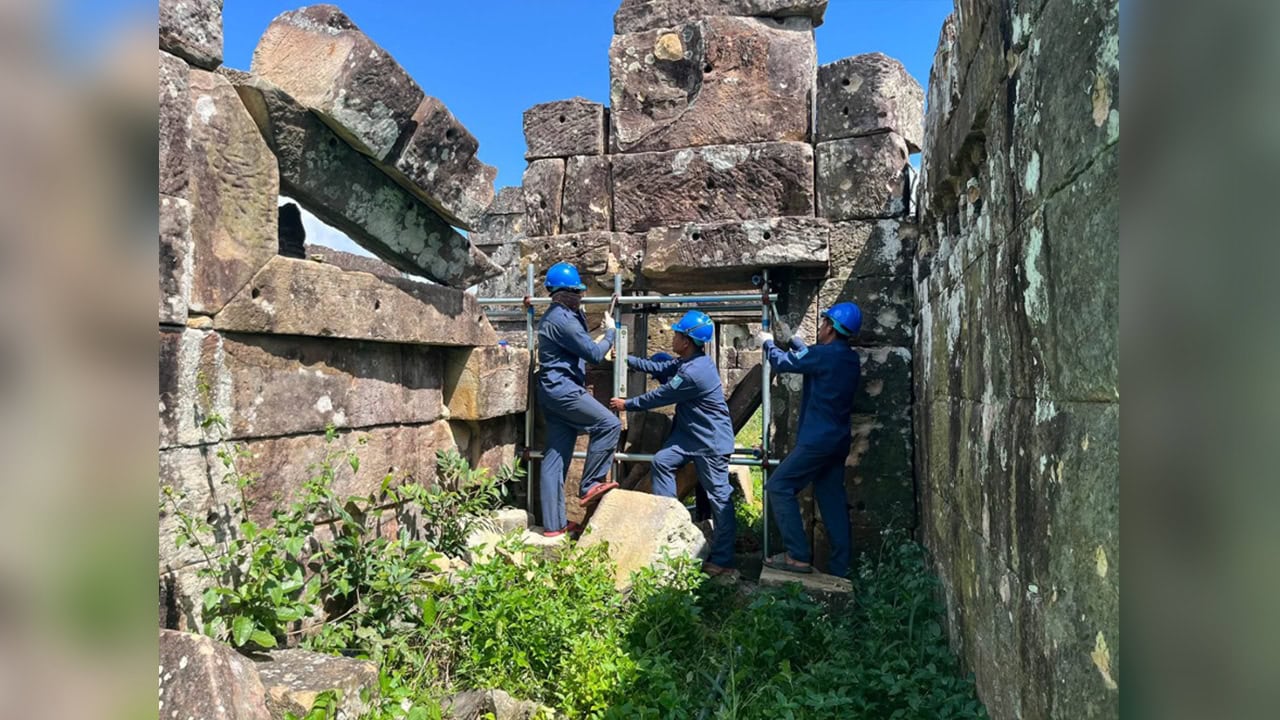
Restoration specialists have started the second stage of emergency stabilisation work at Preah Vihear Temple, a UNESCO-listed site that was badly damaged by Thai shelling and airstrikes during last year's border conflict. Hundreds of impacts have been recorded, and more than 80,000 stone fragments are still scattered across the complex.
Targeting 29 damaged locations
The second phase began on October 19 and focuses on 29 severely damaged spots:
- Gopura I: 10 sites
- Gopura II: eight sites
- Causeway between Gopura II and III: two sites
- Gopura III: five sites
- Gopura IV: one site
- Causeway between Gopura IV and V: one site
- Gopura V: one site
- Western naga-balustrade platform on the first level of the ancient northern staircase: one site
Building on the first phase
During the first phase, experts from the Department of Conservation and Archaeology of the National Authority for Preah Vihear (NAPV) carried out emergency stabilisation at another 23 locations spread from Gopura I to Gopura V.
The aim of the project
The Ministry of Culture and Fine Arts says the work is meant to head off collapse and structural failure, protect the temple's historical value, and keep the site stable and safe until full restoration can begin.
The scale of the damage
The Cambodian Mine Action Centre (CMAC) reports that Thai forces fired at least 1,599 rounds at the temple from 501 different directions. The NAPV has logged 562 impact points, which caused serious structural harm and left 84,800 stone fragments strewn across the World Heritage site.
Clearing unexploded ordnance
In March, the authority, together with international partners and CMAC, cleared unexploded ordnance from roughly 70 hectares around the temple. The operation documented:
- 625 craters
- 730 pieces of ordnance lying on the ground
- 247 buried items
- Four unexploded cluster submunitions