 Mekong Monitor
Preah Vihear committee asks Thailand for strike data to speed up explosive clearance
The ICC-Preah Vihear has asked Thailand for bombardment and artillery data to guide the clearance of explosive remnants around the damaged World Heritage site.
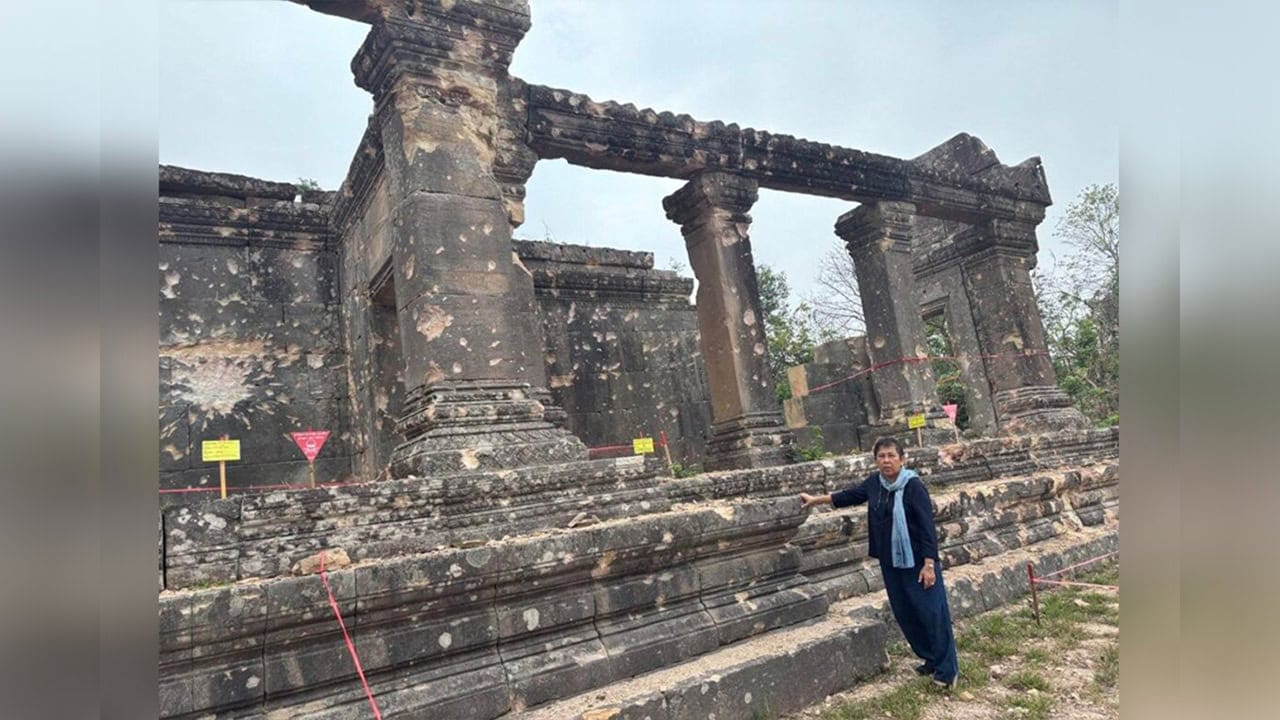
The international body responsible for conserving Preah Vihear Temple has asked Thailand to share data on aerial bombardments and artillery fire, aiming to speed up the removal of explosive remnants of war and restore safety around the conflict-scarred World Heritage site.
The request was made during the 11th Technical Session of the International Coordinating Committee for Preah Vihear (ICC-Preah Vihear), held in Siem Reap on September 30, according to a press release from the National Authority for Preah Vihear.
The committee requested firing directions and related information to guide mine and unexploded ordnance clearance in the temple and surrounding development zones. It also recommended that the authority identify and prioritise areas contaminated by explosive remnants of the fighting, including cluster munitions.
Clearance and conservation work
The effort is part of a broader push to make the site safe for Cambodian and international conservation teams as emergency work continues to stabilise damaged structures and prevent further collapse.
- The Cambodian Mine Action Centre (CMAC) cleared unexploded ordnance across roughly 70 hectares, finding 730 items of ordnance on the surface and 247 buried, as well as four drones.
- The operation recorded 625 craters.
- The National Authority for Preah Vihear collected, registered and stored 84,800 broken temple stone fragments and propped up high-risk structures at 23 locations.
- Stone movement monitoring devices were installed at 50 sites, protective roofs were built over four temple areas, and nearly 250 metres of an ancient drainage system were restored.
The meeting reviewed these clearance results alongside emergency conservation measures carried out following recommendations from a UNESCO assessment and the committee's March plenary session.
Despite the progress, officials identified urgent additional work, including emergency support for 25 more structures, a shelter to protect stored stone fragments from damage and loss, and further drainage improvements to divert water away from the site.
The emergency interventions were carried out with international partners, with funding from UNESCO, the ALIPH Foundation, the French Ministry of Culture and the Cambodian government, the release said.
Damage assessment and calls for safety
The session was presided over by Minister of Culture and Fine Arts Phoeurng Sackona, together with Chinese co-chair Li Qiaozhi, deputy director of the Foreign Affairs Department of China's National Cultural Heritage Administration, and Indian co-chair Vijay Shankar Prasad, second secretary at the Indian embassy.
Representatives from Belgium, France, Japan, Thailand and the United States also attended. Around 150 national and international researchers took part in person and online, along with heritage experts and bodies including CMAC, the APSARA National Authority and the Sambor Prei Kuk National Authority.
During the session, the authority presented findings from a March 1-6 assessment by experts from the international World Heritage Committee and the International Council on Monuments and Sites. The assessment examined damage caused by armed conflict on July 24-28 and December 7-27, 2025.
According to the release, the conflict damaged 562 locations at the temple, affected infrastructure on the mountain and severely disrupted surrounding communities.
The committee voiced deep concern over the damage and stressed the need to keep conservation teams safe so they could continue protecting the site's Outstanding Universal Value.
Minister's remarks
Sackona said Preah Vihear must continue to serve its cultural and heritage functions, asserting that the area is not used, and has never been used, for military purposes.
She expressed hope that the Cambodia-Thailand Joint Boundary Commission would resume its work to complete border demarcation peacefully, in line with agreements accepted by both countries and international law.
The minister also called for roughly 20,000 displaced Cambodians to be allowed to return to their villages, attributing their continued inability to do so to the ongoing occupation of Cambodian areas by Thai forces.
Other projects reviewed
Alongside the Preah Vihear emergency work, the session reviewed conservation and research at Koh Ker, including the completed restoration of the Prasat Krahom tower and southern gate with ALIPH support, as well as ongoing projects at other structures.
The committee called on member states and national and international institutions to keep providing technical and financial assistance for the rescue and restoration of Preah Vihear, with the aim of preserving the temple's authenticity, integrity and heritage value for future generations.