 Mekong Monitor
Phnom Penh Protests Thai Road Building on Occupied Cambodian Land
Cambodia has formally protested against Thailand over road construction and preparations for more work by Thai troops inside Cambodian territory in Oddar Meanchey province. Phnom Penh says the moves breach its sovereignty and existing border agreements.
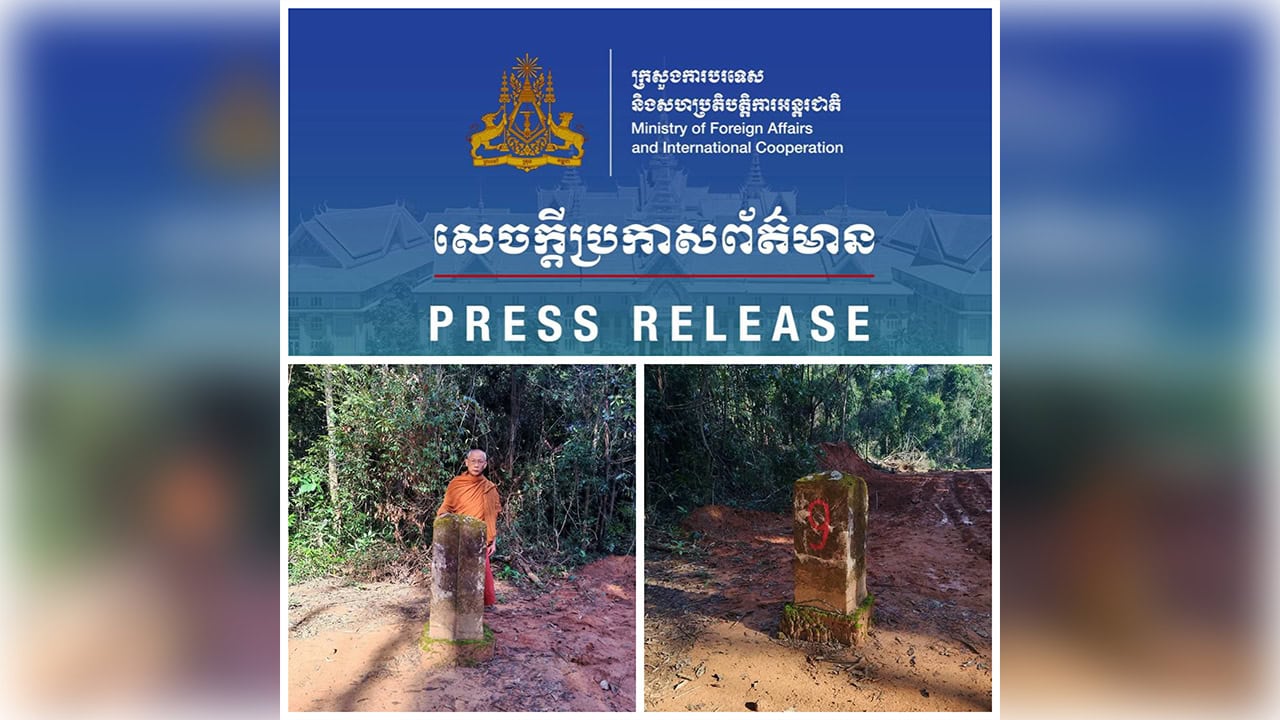
Cambodia has formally protested against Thailand over road construction and preparatory work by Thai troops in Oddar Meanchey province. Phnom Penh says the Thai military is occupying Cambodian territory there.
In a statement dated October 23, the Ministry of Foreign Affairs and International Cooperation said these activities violate Cambodia’s sovereignty and territorial integrity, as well as existing border agreements and de-escalation commitments.
What happened on the ground
- On October 15, Thai forces reportedly used heavy machinery to build a road in the Ta Tum area of Anlong Veng district, between boundary pillars 9, 10 and 11.
- Two days later, troops allegedly sprayed red markings on trees between pillars 10 and 11, signalling that more road work was planned.
Cambodia’s legal position
The ministry said the international boundary is defined by 1:200,000-scale maps produced by the Commissions for the Delimitation of the Boundary between Indo-China and Siam, based on the 1904 Franco-Siamese Convention and the 1907 Treaty. It also argued that the activities breached Article 5 of the 2000 Memorandum of Understanding on surveying and demarcating the land boundary, which was signed on June 14, 2000.
Cambodia further accused Thailand of violating the de-escalation measures in Item I of the joint statement from the third Special Meeting of the General Border Committee (GBC), held on December 27, 2025. That agreement was meant to halt hostilities, ease military tensions and help restore stability after renewed fighting drove hundreds of thousands of civilians from their homes.
Rejecting unilateral claims
Cambodia said it does not recognise any boundary line or territorial claim that Thailand asserts on its own, and that these activities cannot undermine its legal rights or its position on the international boundary. Its stance rests on historical treaties, international legal principles and bilateral agreements, rather than on changes made on the ground.
The ministry called on Thailand to stop all such unlawful activities, refrain from further unilateral steps, and work to ease tensions, build mutual trust and keep the border peaceful and neighbourly.
Calls for talks through the JBC
Cambodia has repeatedly said land boundary disputes should be settled through the Joint Boundary Commission (JBC), using legal and technical procedures based on historical documents, relevant treaties and existing agreements. Prime Minister Hun Manet has also stressed that boundary negotiations must rest on legal and technical evidence, with the JBC as the proper forum.
Officials warned that unilateral construction in contested areas could complicate demarcation and weaken the confidence-building measures agreed after the December 2025 ceasefire. The statement did not say how long the road is, or whether it has been completed or is still under construction.
Despite the latest protest, Cambodia said it remains committed to resolving all its border disputes with Thailand, as with its other neighbours, only through peaceful means and in line with international law. It stressed that international boundaries must never be altered by force.