 Mekong Monitor
Paper Straws May Be Worse for the Environment Than Plastic, Government Study Finds
A government-commissioned study in South Korea finds paper straws have a higher carcinogenic impact than plastic straws over their life cycle. The findings raise questions about the country's straw restrictions.
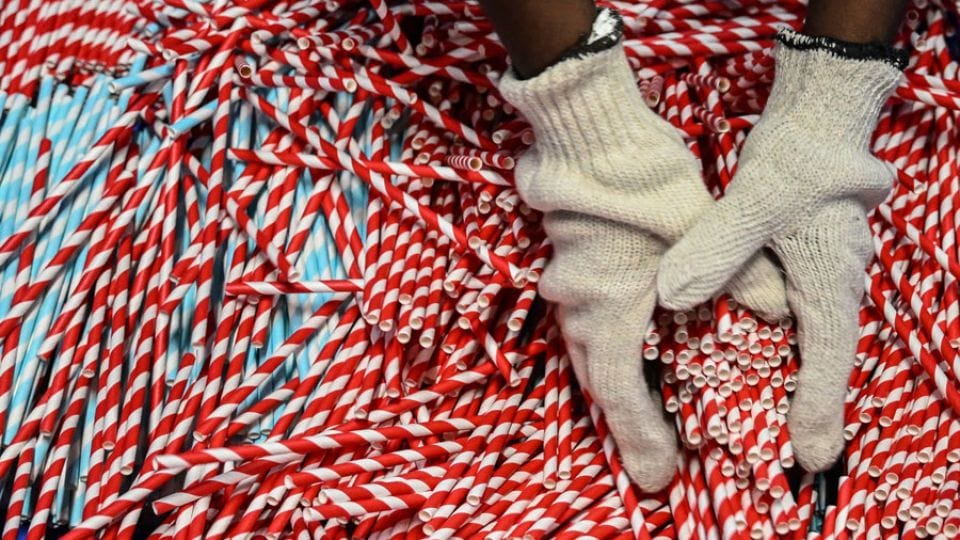
Paper straws, long promoted as the greener option, have scored far worse than conventional plastic straws in a South Korean government-commissioned study. The research put the carcinogenic impact of paper straws at 6.33 times that of plastic straws across their full life cycle, from manufacturing and use through to disposal.
The report was commissioned by the Ministry of Climate, Energy and Environment and released on Wednesday by Kim Wi-sang, a lawmaker from the People Power Party. It compared four types of straws: conventional plastic, paper, biodegradable plastic, and bio-based polyethylene (bio-PE). Researchers tracked each one from raw material production to disposal and scored them across 16 environmental categories.
The carcinogenic figure comes from a modeled life-cycle calculation. It does not directly measure the cancer risk faced by people who use the straws. For disposal, the model drew on national waste statistics, assuming that 73.6 percent of discarded straws are incinerated and 26.4 percent are sent to landfill.
How the straws compared
Relative to conventional plastic straws, the alternatives fared as follows:
- Paper straws had 6.33 times the carcinogenic impact and 2.04 times the acidification impact.
- Bio-PE straws performed worst, with 16.18 times the carcinogenic impact and 5.9 times the acidification impact.
- Biodegradable plastic straws had 3.34 times the carcinogenic impact and 1.98 times the acidification impact.
Conventional plastic straws had the lowest impact in 10 of the 16 categories, including climate change, acidification, particulate matter, and human toxicity. Bio-PE straws had the highest impact in 10 categories, among them ozone depletion, acidification, and smog. Paper straws had the highest impact in three categories, and biodegradable plastic in two.
Bio-PE is made from renewable plant sources such as sugarcane, but its chemical structure is the same as conventional polyethylene, so it does not biodegrade. It should not be confused with biodegradable plastic.
A policy that missed the mark
Restrictions on plastic straws at cafes and restaurants took effect in November 2022. In November 2023, the government indefinitely extended the enforcement grace period after public complaints and doubts about whether the rule was working. Kim said the government should admit that its policy, which focused on substitute materials, had failed, and should not repeat that approach. In his view, the priority should be reducing the overall use of disposable products.
Are alternative straws really greener?
Paper straws are often marketed as recyclable, but the study found that straws made from any material are hard to recycle in practice. Their small size makes them difficult for sorting facilities to pick out, and coatings and adhesives can further interfere with recycling.
A survey of 1,001 people included in the report found that 87.5 percent preferred plastic straws. Some 54.4 percent supported providing straws only when customers asked for them, while 18.4 percent opposed the policy altogether.
The researchers recommended that stores stop offering any disposable straw by default and provide one only when a customer requests it.