 Mekong Monitor
Mondulkiri Farmers Gain Sustainable Farming Skills as WWF Project Nears Its End
More than 350 farmers in Mondulkiri have been trained in sustainable agriculture, and about 350 hectares now use greener production methods. A closing workshop in Phnom Penh reviewed the WWF-Cambodia project, which ends in December.
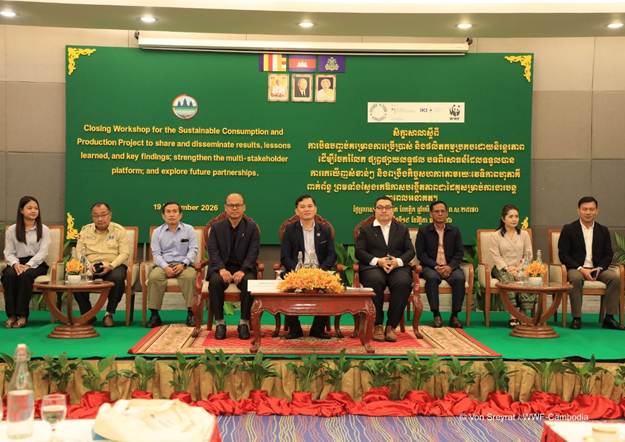
More than 350 farmers in Mondulkiri province have completed training in environmentally friendly farming, and about 350 hectares of farmland have shifted to sustainable production. The results come from a WWF-Cambodia project that aims to raise rural incomes and encourage responsible consumption. It is set to wrap up at the end of December.
The project’s achievements were presented at a closing workshop in Phnom Penh on November 19. Officials from the Ministry of Environment and WWF-Cambodia reviewed the results of the Sustainable Consumption and Production (SCP) Asia Phase II project, which has been running since 2022.
Funded by the German government through its International Climate Initiative (IKI), the project set out to connect sustainable farms in Mondulkiri with markets and eco-conscious buyers in Phnom Penh.
Uk Navann, deputy director general of the ministry’s General Directorate of Policy and Strategy, said the project had helped farmers adopt better practices, earn more and rely less on natural resources. He noted that 34 farmers, including vegetable and coffee growers, had earned Cambodian Good Agricultural Practices (CamGAP) certification.
The workshop brought together government officials, farmers, private companies, civil society groups and development partners.
Navann added that higher incomes had allowed many families to depend less on forest resources and on hunting wildlife. The project also promoted farming methods that protect the environment, boost productivity and deliver safer food to consumers.
Janes Imanuel Ginting, WWF-Cambodia’s country director, outlined the training given to more than 350 farmers. It covered CamGAP standards, soil and water management, climate resilience and environmentally responsible techniques. He said the project had shown that training must be paired with real economic opportunities if farmers are to keep using sustainable methods.
“Teaching alone is not enough,” Ginting said. “Farmers adopt sustainable methods when they can see concrete gains, such as lower costs, higher yields, better access to buyers and greater resilience against shocks.”
He added that hands-on demonstrations and knowledge sharing among farmers had played a key role in encouraging them to change their methods.
Beyond the fields, the project also aimed to shape shoppers’ habits in Phnom Penh, encouraging greener purchases and less plastic use. Ginting said the share of surveyed consumers who always check food labels had risen from 10 to 43 per cent during the project. Meanwhile, the share who always use plastic bags fell from 46 to 24 per cent.
“These figures are encouraging,” he said, “because they show that people can change their behaviour when they have accurate information and practical ways to act.”
The project also supported farmers’ markets and local green markets, linking sustainable producers directly with city residents. This helped promote locally grown food and strengthen local economies.
Navann said the ministry had worked closely with WWF-Cambodia on campaigns promoting sustainable consumption, environmental awareness and waste reduction. From January to April 2025, the ministry’s Department of Green Economy and WWF-Cambodia ran six major campaigns and training workshops in Phnom Penh and Mondulkiri. These included the “Clean Cambodia, Khmer Can Do” campaign and the “Today I Will Not Use Plastic” initiative, as well as workshops on sustainable urban development, the circular economy and cutting plastic use in the public and private sectors. Participants included local authorities, students, teachers, companies and community members.
According to Navann, participants showed greater environmental awareness and pledged to cut plastic waste, stop burning rubbish in the open, and follow the principles of refusing, reducing, reusing and recycling. He linked these efforts to the ministry’s Circular Strategy on Environment, which focuses on cleanliness, greenery and sustainability.
The project also supports Cambodia’s wider environmental policy goals. These include the National Strategic Plan on Green Growth 2013–2030, the Sustainable Consumption and Production Roadmap 2022–2035 and the country’s circular economy strategy. The workshop concept note adds that the initiative contributed to consultations on Cambodia’s updated Nationally Determined Contributions (NDC 3.0), with Indigenous communities taking part.
In July 2025, the project helped establish the Multi-Stakeholder Platform for Sustainable Consumption and Production. The platform brings together government institutions, businesses, civil society organisations and farmer representatives. It is designed to keep cooperation going on sustainable agriculture, responsible consumption, efficient resource use, waste management and environmental policy.
Ginting described stakeholder cooperation as one of the project’s most important achievements, arguing that reshaping Cambodia’s food system requires collective action. “No single organisation can transform our food system on its own,” he said.
He added that the platform would give organisations and communities a way to keep working together once the project ends.
The November 19 workshop, titled “From Farm to Fork: Towards a Sustainable Future for Cambodia’s Food Systems,” was organised by WWF-Cambodia and the ministry. Its aims were to review results, share lessons and explore ways to expand sustainable production and consumption.
With the project due to close on December 31, discussions centred on sustaining support for farmers, strengthening market links and building future cooperation among participating institutions. Ginting stressed that the project’s end should not mark the end of this work. “Although the project closes on 31 December 2026, our shared responsibility does not stop there,” he said. He called for expanding the approaches that have worked, including continued support for sustainable farmers, better market access, responsible consumer choices and the incorporation of project lessons into future policies and programmes.
Navann described the closing workshop as an important transition rather than simply the conclusion of a development initiative.
The ministry and WWF-Cambodia said continued cooperation among government bodies, businesses, farmers and communities will be essential to sustaining the project’s gains and moving Cambodia toward a more environmentally sustainable food system.