 Mekong Monitor
Measuring Change: What the Evidence Shows About Cambodia's ICT Education Push
A look at the midline evidence behind Cambodia's ICT education reforms, covering gains in student digital literacy, teacher capability, and gender equity. It also examines how the model is moving from pilot schools to a national system led by Cambodians.
Change Has to Be Measured
A principal at one of Cambodia's ICT-leading schools on the edge of Phnom Penh remembers that just a few years ago her school had no ICT classes at all. Even where lessons existed, students mostly learned to switch on a computer and move a mouse. Now, she says, they gather data, make charts, build programs in Scratch, and present their work with real confidence. For her, that is what educational transformation looks like.
Her account is inspiring, but personal stories alone are not enough. Sound journalism and sound public policy both need evidence beyond compelling anecdotes. Real change has to show up in measurable results as well as in individual experience.
That is why the project was built around a Baseline, Midline, and Endline evaluation framework from the start. Students' ICT skills were assessed before the project began, a midline evaluation was carried out while it was underway, and an endline evaluation is planned for when it ends. Taken together, these three stages create a solid body of evidence. That evidence is useful well beyond the project's own reports, and it can guide future ICT education policy in Cambodia.
Evidence Shows Real Progress
The midline survey points to meaningful progress.
Compared with the baseline, students at the ICT-leading schools showed clear gains in overall digital literacy. The biggest improvements were in searching for and evaluating information, creating digital content, and applying digital tools in practical ways.
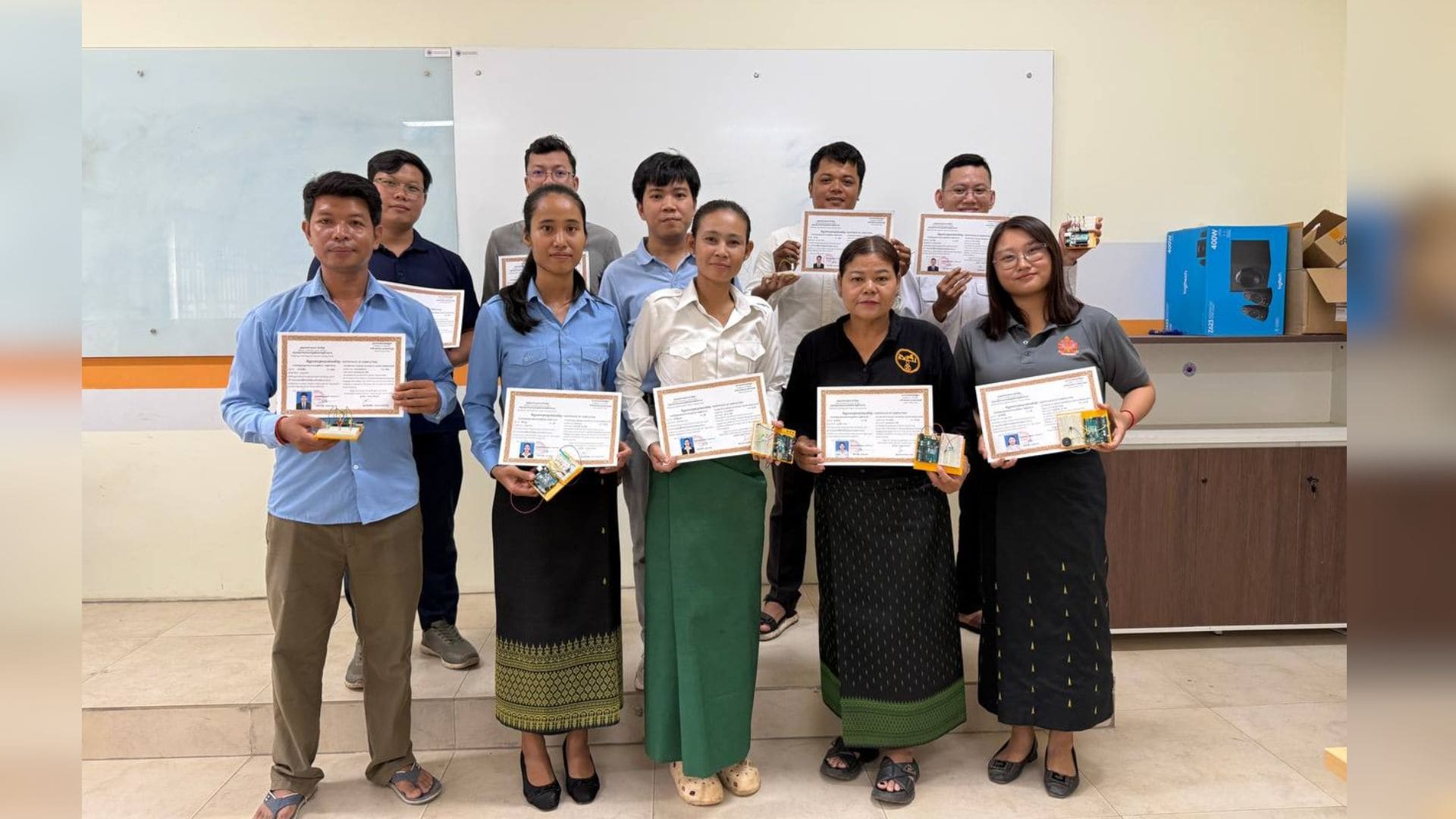
Teachers also improved considerably. The project did more than deepen their knowledge of ICT subject matter; it also helped them bring technology into their teaching and learning. Gains in Technological Pedagogical Content Knowledge (TPACK) after professional development suggest that teachers are developing new teaching approaches, not just gaining technical skills.
Gender equity stands out as well. Girls took part in ICT classes at higher rates and showed more confidence using digital technology. This is an important step toward closing the digital gender gap and making ICT education open to every learner.
The evidence increasingly points one way: ICT education is no longer limited to a privileged few. It is becoming an opportunity for every student.
From Pilot Schools to a National System
What started in twenty ICT-leading schools is now laying the groundwork for nationwide education reform.
The goal is not simply to add more participating schools. The aim is to make the model part of national ICT education policy and to keep it running through Cambodia's own systems, resources, and leadership.
Four Regional Teacher Training Centers (RTTCs) sit at the heart of this expansion. They were designed not just as training providers during the project, but as permanent regional hubs that will keep strengthening ICT education after outside support ends. Several centers have already started running ICT teacher training on their own, which shows growing institutional capacity and a sense of ownership.
Meanwhile, the Ministry of Education, Youth and Sport (MoEYS) is drawing up a phased plan to scale the ICT-leading school model across the country. The roadmap has three stages: first, extend the model to neighboring school clusters; second, spread it across the country through the RTTC network; and third, build a standardized national ICT education system.
Cambodia Takes the Lead
Perhaps the most important achievement of the project is one that statistics cannot fully capture: a genuine sense of national ownership.
Cambodian education officials now set the policy direction. RTTC faculty design and deliver professional development. Teachers at the ICT-leading schools are developing new practices and sharing them with colleagues across the country. As Cambodian leadership has grown stronger, the role of Korean experts has shifted accordingly. They began by providing technical assistance, moved on to offering professional advice, and are increasingly acting as partners and observers. This is the kind of collaboration the Korea International Cooperation Agency (KOICA) hoped to foster from the outset.
This is what real capacity development looks like. Success is not measured by how long people keep relying on outside help, but by whether they can move forward on their own. Only by following that path can the goal of Sustainable Development Goal (SDG) 4.4.1, which is to raise the share of young people with relevant ICT skills, be sustained over the long run. In a paradoxical way, the ultimate aim of international development cooperation is to reach the point where outside cooperation is no longer needed.
Cambodia's ICT education journey has not reached that point yet. Significant challenges remain. Reliable electricity is still a problem in some rural schools, and high teacher turnover continues to disrupt learning. Even so, the direction is clear, and a firm foundation is in place.
Looking Ahead
A Grade 8 student in Takeo Province will finish lower secondary school next year. He plans to keep studying ICT in high school, and when asked about his future, he answers without hesitation that he wants to become a web developer or a graphic designer.
Only two years ago, he was learning to type on a keyboard for the first time. Today, he is picturing a digital future for himself, and that is the project's most meaningful result.
Computer labs matter. Textbooks matter. Teacher training matters. Yet perhaps the greatest achievement is that young people like him now see the digital world not as something distant or out of reach, but as a place where their own futures will be.
The future of ICT education in Cambodia increasingly rests in Cambodian hands. What began with four Regional Teacher Training Centers and twenty ICT-leading schools is steadily spreading across the country, and that change will continue.