 Mekong Monitor
Lao silk weavers craft keffiyehs in solidarity with Palestine
Lao silk weavers in Vientiane are handcrafting keffiyehs that intertwine national symbols with Palestinian motifs, raising funds and solidarity while preserving endangered textile traditions.
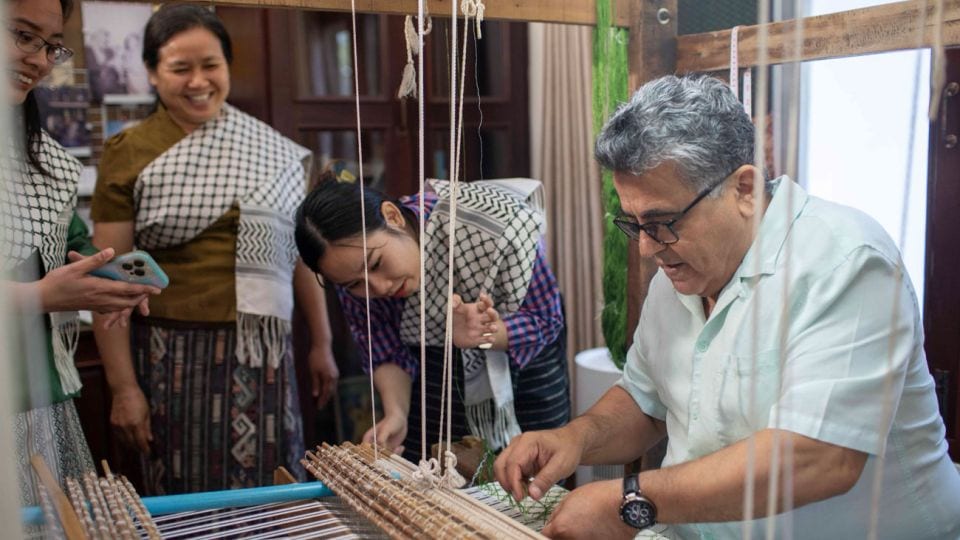
In Vientiane, Laos, a small collective of textile artists is weaving Palestinian keffiyehs using traditional Lao mulberry silk—a powerful fusion of culture, craft, and political solidarity. Each piece takes over a month to complete, merging the Lao symbol of the naga, a mythical serpent representing protection and resilience, with the Palestinian fishnet motif tied to coastal heritage.
Souvixada Somsacksy launched the Silk Keffiyeh project in December 2024 alongside her godmother, Bouakham Phengmixay—known affectionately as Mae—who spent over three decades in a textile factory before dedicating herself to preserving Lao weaving traditions. Together, they now run a full-time residency where participants learn traditional techniques while engaging in tatreez embroidery circles, drawing connections between Lao and Palestinian ornamental practices.
The project’s significance deepened in May 2026 when Palestinian Ambassador to Laos, Saadi Salama, visited the workshop.Moved by what he saw, he urged Souvixada to continue, affirming how deeply the gesture resonated with Palestinians. For her, this validation reinforced the project’s potential not only as fundraising efforts but also as cultural diplomacy—introducing Laos to global audiences through shared stories of resistance and survival.
Laos bears a heavy historical burden: it remains the most bombed country per capita in modern history, with over two million tons of ordnance dropped between 1964 and 1973. Roughly 30 percent of those bombs—many cluster munitions—remain unexploded, having claimed over 20,000 lives since the war ended. Nearly half of the victims are children.
By drawing these parallels, Souvixada highlights the moral and historical links between Laos and Palestine. In her words, if a nation like Laos endured decades of devastation and still carries its identity forward, then Palestine too will persist. The initiative also brings awareness to Laos itself—offering a nuanced counter-narrative to conventional portrayals of the country as merely a site of tragedy.
With financial constraints ever-present, the team recently welcomed Maiphon Vivongxay—also known as Pa Mai—a former factory worker and survivor of the U.S. bombing campaigns. Her own story of weaving amidst air raids reinforces the symbolism embedded in each keffiyeh: resilience, continuity, and hope.