 Mekong Monitor
Kim Jong-un’s Dandong Trip Blends Wartime Memory With Economic Ambitions
Kim Jong-un made a brief day trip to the Chinese border city of Dandong, crossing the newly opened New Yalu River Bridge to honor the Korean War alliance and push for stronger economic ties with Beijing. The visit also raised questions about possible renewed talks with the United States ahead of an APEC summit.
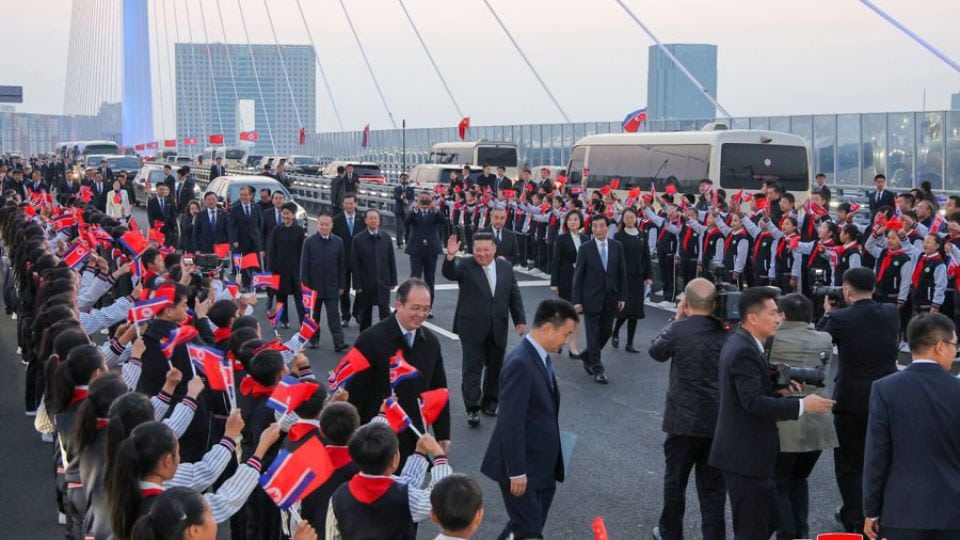
North Korean leader Kim Jong-un made a whirlwind day trip to the Chinese border city of Dandong on Saturday. The visit highlighted two pillars of Pyongyang’s ties with Beijing: an alliance rooted in the Korean War and a growing push for economic cooperation.
It was Kim’s sixth trip to China and his first in 13 months. It came just nine days after the long-delayed opening of a bridge meant to boost cross-border trade, and on the eve of a major Chinese commemoration of its role in the 1950–53 Korean War.
Instead of travelling by train, as he usually does, Kim crossed into China by motorcade over the New Yalu River Bridge. The four-lane span, roughly three kilometers long, links Dandong with the North Korean city of Sinuiju.
The trip also comes as Beijing prepares to host the Asia-Pacific Economic Cooperation (APEC) summit in Shenzhen next month. Speculation is growing that the gathering could open the door to renewed talks between Kim and US President Donald Trump.
A visit with a wider purpose
Joung Eun-lee, director of the North Korea Research Division at the state-funded Korea Institute for National Unification, sees several goals behind the trip: reaffirming political and military ties with Beijing, expanding economic cooperation, and possibly laying groundwork for talks with Washington before APEC. She noted that Kim travelling in person, rather than sending a senior delegation, suggested a more significant strategic purpose. Choosing the newly opened bridge, she added, was a symbolic signal of Pyongyang’s determination to pursue economic cooperation with China in earnest.
Lim Eul-chul, a professor at Kyungnam University’s Institute for Far Eastern Studies, called the visit a clear example of “Kim Jong-un-style pragmatic diplomacy.” By invoking shared wartime history and reaffirming the alliance, Kim aimed to strengthen the political foundation for closer economic ties, Lim said. Kim’s personal endorsement of the bridge, which sat unused for 12 years after its completion, showed how much he expects from trade through it.
The bridge opened on October 15, just over a month after North Korea and Russia inaugurated a road bridge across the Tumen River on September 7. Lim said this suggests Pyongyang wants to deepen economic ties with both neighbors rather than rely on China alone. He added that the trip allowed Kim to reset his diplomatic position, with both Beijing and Moscow in his corner, by reaffirming the military and historical alliance “forged in blood” with China.
Wartime memory on display
North Korea’s state news agency, KCNA, reported on Sunday that Kim had visited the Memorial Hall of the War to Resist US Aggression and Aid Korea in Dandong the previous day, ahead of the October 25 anniversary of China’s entry into the Korean War. There he paid tribute to Chinese soldiers who fought in the conflict. Kim described the hall as “a precious testament, sealed in blood,” to the friendship between North Korea and China.
After the memorial, Kim met Wang Huning, China’s fourth-ranking official and a longtime adviser to Xi Jinping, widely regarded as a key ideological architect of the Chinese Communist Party. Wang hosted a banquet in Kim’s honor under Xi’s special instructions. Kim also inspected a bus factory in Dandong and, on his return, stopped at the midpoint of the New Yalu River Bridge to say he hoped it would fulfill its historic role of connecting the two countries and binding their hearts more closely.
Signals in propaganda and policy
Michael Bosack, founding director of the Parley Policy Institute and a former UN Command official, said the visit reflected a shift in North Korean propaganda. In recent years, Pyongyang had portrayed Russia as the more dependable partner. Since the Kim-Xi summit in June, however, it has begun to highlight China’s role in the Korean War, and the Dandong trip is another notable step in that direction.
Yang Gab-yong, a senior research fellow at the Institute for National Security Strategy, called the trip a natural visit to mark the elevation of relations to a strategic partnership following Xi’s state visit to Pyongyang in June. This year also marks the 65th anniversary of the Treaty of Friendship, Cooperation and Mutual Assistance, signed on July 11, 1961. The treaty commits both sides to provide immediate military and other assistance if the other is attacked and enters a state of war. Yang said the timing, on the eve of the October 25 anniversary, was meant to underline the treaty’s significance.
The stop at the Huanghai Bus Factory also reflected Pyongyang’s economic priorities, particularly its drive to build up local industries under the Regional Development 20×10 Policy. Yang said China’s experience and support are important for North Korea’s development, especially in regional manufacturing.
Divided views on a Trump meeting
Neither Beijing nor Pyongyang explicitly mentioned North Korea-US dialogue in its official account of the visit, and analysts disagree on whether it came up. Joung believes it “may have been one of the main agenda items.” She noted that Kim’s trip coincided with discussion of a possible Trump-Kim meeting ahead of APEC. She also pointed to the presence of Chinese Foreign Minister Wang Yi and North Korean Foreign Minister Choe Son-hui as a sign the two sides may have discussed prospects for US-North Korea talks.
Kim’s meeting with Wang came just before the fifth plenary session of the 20th Central Committee of the Chinese Communist Party, which runs from Monday to Thursday. Joung said this suggested Beijing’s top leadership placed considerable importance on the visit. She suggested Wang may have conveyed Xi’s intentions while gauging Kim’s position, meaning the trip could serve purposes beyond the immediate goal of expanding North Korea-China economic cooperation.