 Mekong Monitor
Judged in Three Minutes: How Podcast Outrage and Weak English Expose Cambodia's Thinking Gap
Cambodian Gen Z's habit of condemning long podcasts after watching short teaser clips points to deeper problems in schooling, English proficiency and university teaching. The author argues that building critical thinking must start in both classrooms and social media feeds.
Under nearly any viral Cambodian podcast clip on Facebook or TikTok, the same pattern repeats. A host posts a conversation that runs two or three hours on a complex topic, then promotes it with a sharp three-to-five-minute teaser. Within hours, a wave of young commenters labels the episode “misleading” and tears it apart, even though none of them have watched the full discussion where the evidence is laid out and the context explained. They have judged a long book by its short cover.
This is more than simple online impatience. It points to a deeper problem. Reports suggest that Cambodia's Gen Z increasingly takes in news passively through algorithm-driven feeds instead of seeking out complete sources, which has raised concern about weakening critical thinking. A month later, Education Minister Hang Chuon Naron backed up that worry, noting that roughly one in three Cambodian students who go online never consider where an answer comes from.
From Memorisation in High School to Silence at University
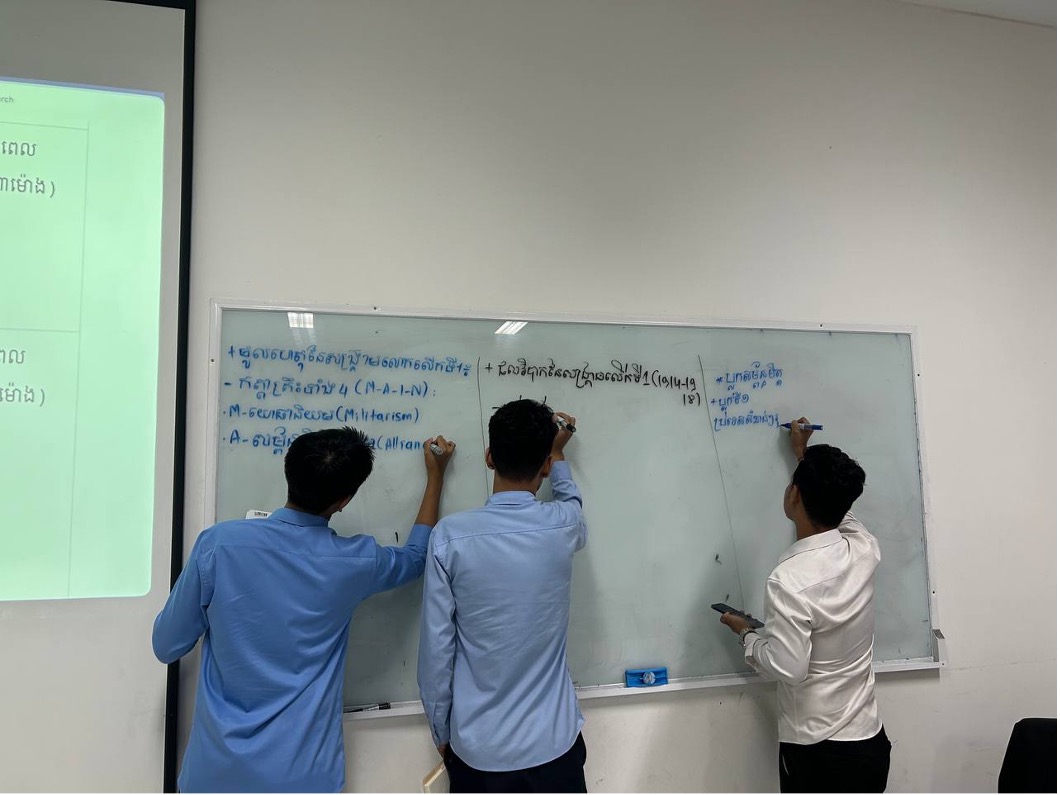
Walk into a university lecture hall and the same aversion to depth becomes obvious. Lecturers at public and private universities, in classroom observations and interviews, describe the same frustration. First-year students can recite material from slide decks with diligence, but they freeze when asked to question an argument or weigh competing evidence. Nearly all faculty members trace the problem back to general education.
The numbers help explain why. The pass rate for Cambodia's Grade 12 national exam (Bac II) climbed above 84 percent in both 2025 (84.56 percent) and September 2026 (84.06 percent), a sharp rise from about 25 percent a decade earlier. Yet crowded classrooms and evening tutoring still center on drilling model answers. The cost became clear in September 2026, when the OECD's PISA 2025 results were released. Cambodia's reading score rose from 329 to 347, but only 13 percent of 15-year-olds reached the baseline reading level, compared with 69 percent across the OECD. Almost no students reached Levels 5 and 6, the tiers needed to work through lengthy texts and tell fact from opinion. The education minister warned that when teaching stops at memorisation, students simply cannot answer questions of this kind.
The English Bottleneck
Alongside rote learning sits a barrier that receives less attention: weak English skills. On the Bac II, English is an optional subject worth up to 50 bonus points, and only marks above 25 count. Because an F carries no penalty, students sensibly put their effort elsewhere. As a result, 89.05 percent of Bac II passers in 2022 and 86.86 percent in 2023 still failed English, according to peer-reviewed analyses of ministry data. On the international stage, Cambodia placed last of 123 countries in the 2025 EF English Proficiency Index and ranked 116th of 117 in 2026, still within the “Very Low” band.
English matters so much because many fields in higher education have few Khmer-language textbooks or peer-reviewed journals, which makes English the main route into complex scholarship. A student who is struggling just to decode an English page has little mental energy left to question the logic of the text. Overwhelmed by long material, whether an academic article or a three-hour interview, students take shortcuts: memorised translations, unchecked AI-generated answers and short clips. In the classroom, that leads to silent seminars. Online, it leads to instant outrage.
Repairing Both Ends of the Pipeline
Lecturers are right to blame high schools, but that does not excuse universities for their own inertia. Many institutions run their foundation year much like an extra grade of passive lectures and recall tests, which can even breed false confidence. A survey of 232 undergraduates published in the Cambodian Journal of Educational Research in June 2026 found that students rated their own critical thinking fairly highly, at 4.02 out of 5, slightly behind collaboration at 4.32, even though clear analytical gaps persisted.
Closing that gap calls for coordinated action. First, universities should make Media and Information Literacy mandatory in every foundation year. This would build on the national MIL framework from UNESCO and the Ministry of Post and Telecommunications, which is scheduled to roll out in 2027, and teach first-year students to check viral claims against full original sources. Second, universities need to separate reasoning skills from language fluency. That means offering logic and debate courses in Khmer alongside intensive academic English for reading long texts, while high schools gradually remove English's no-penalty bonus status.
Third, institutions should swap recall-based exams for local case studies and oral defences. Doing so will require stable full-time positions for lecturers and training in teaching methods. Finally, universities and ministries should jointly fund high-quality Khmer-language textbooks and campus forums so that serious inquiry is not restricted by a foreign language.
As Cambodia approaches its UN Least Developed Country graduation in 2029 and aims for high-income status by 2050, degrees built on memorisation will not be enough. Ending the blame game means building one civic habit in both classrooms and online feeds: read the whole article, watch the whole conversation, and think before you hit “comment.”