 Mekong Monitor
Judge Cambodia by What It Is Doing Now, Not by Its Past
A Cambodian scam victim argues that international coverage of Cambodia’s fight against online fraud should weigh recent reforms and shared regional responsibility, not just the country’s past failures.
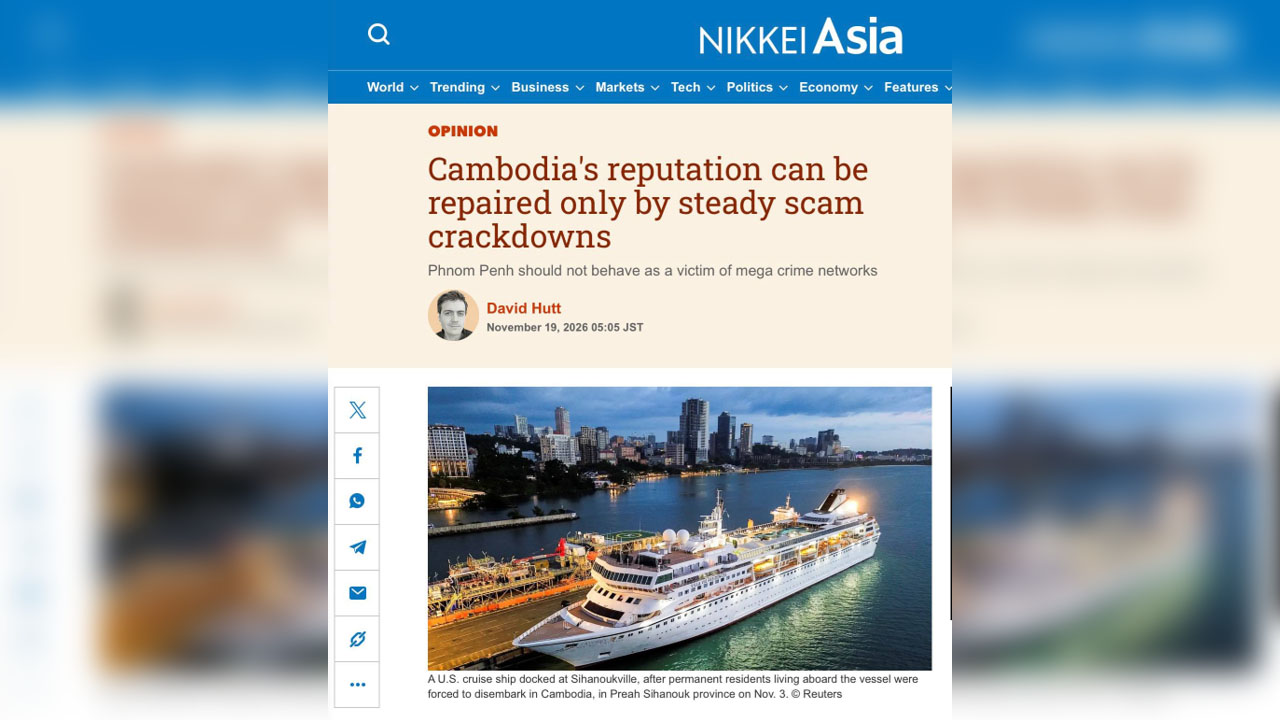
I write as a Khmer citizen and as a victim of online scams, both “pig butchering” schemes and illegal online lending, which have left me impoverished to this day. So when I read the Nikkei Asia article titled “Cambodia’s reputation can be repaired only by steady scam crackdowns,” I felt it was deeply unfair to Cambodia. I even wondered whether its author, or the people behind its publication, resent Cambodia’s growing success on the international diplomatic stage.
Having read it, and despite my own disappointment with some Cambodian authorities, I believe Cambodia should not be judged by a single negative image. Cracking down on scam networks requires analysis that looks beyond national borders, a full understanding of the problem from every angle, and regional cooperation.
An honest starting point
We cannot deny that Cambodia’s early response to online scam networks was slow and faced many obstacles. The problem was a tangled web, known in Khmer as somlor kampeus, or “tiny shrimp soup,” and criminal groups kept changing their methods and taking over new locations. Victims hesitated to file complaints because their cases received little attention, and some were even blamed instead. When I filed a complaint through a ministry’s online system and then went there in person, I got no help. I was passed from one person to another and left discouraged. Later, another country used the fight against online scams as a pretext to attack Cambodia and violate its sovereignty, and it continues to occupy territory to this day.
Still, fixing past circumstances as a permanent negative label, without acknowledging the present efforts and changes, is an imprecise assessment. Admitting shortcomings does not mean Cambodia must accept a negative verdict forever. Cambodia should be evaluated on how the situation has actually evolved, on the government’s efforts, and on the results of the measures it has put in place.
I also respect the perspective of David Hutt of Nikkei Asia, whose coverage of Cambodia is often critical. But in return, we should ask whether his assessment adequately reflects the real changes of recent times. And should an analysis of transnational scam crime focus only on the countries where scam compounds are located, or on the whole network, which spans many countries?
What has changed
Dismantling these networks is not a short-term task. They are transnational, systematically organised, deeply entrenched, technologically sophisticated, and linked to human trafficking, money laundering, and corruption. Even so, the Royal Government has recently carried out strict and sustained operations. These include strengthening the legal framework, shutting down scam sites, and conducting intensive investigations. These efforts have drawn recognition and positive evaluations, a change that should not be overlooked.
Cambodia also hosted the International Conference on Combating Online Scams (ICCOS 2026) in Phnom Penh on 23–24 September 2026. The conference produced the Phnom Penh Declaration, which contains 11 commitments to strengthen international cooperation, curb illicit financial flows, seize the proceeds of crime, protect victims, and dismantle the infrastructure that supports scam networks.
Isn’t hosting such a meeting a sign that Cambodia’s role is changing, from a country grappling with the problem to one mobilising international cooperation to solve it? A conference does not prove the problem has been solved, but it is wrong to ignore these diplomatic efforts and keep portraying Cambodia solely as a country implicated in scams. A government trying to hide a problem would not put it on the agenda for international discussion on its own soil.
A crime without borders
Scam operations are transnational networks, not confined to a single country. Many centres sit in border areas, where crossing is easy and law enforcement is easily evaded.
Neighbouring countries with long borders, large financial systems, and major international crossings, Thailand among them, are also deeply involved, both through sites along their borders and through financial flows that pass through or into their economies. According to the Financial Action Task Force’s 2026 report on illicit financial flows linked to scam centres, Thailand is not only a target of scams but also a transit point for people and logistics tied to the crime, as well as a hub for moving money.
I do not say this to single out any country. The point is that a scam network may run its operation in one country, find its victims in another, and rely on technology providers in a third, while the money moves through banks and exchange firms in many more. Closing scam sites in Cambodia alone cannot solve the problem. We must trace who profits from the proceeds and which networks help move money and hide its origins. Every country’s role in this system needs careful study. Hosting a scam centre does not make a country solely responsible, and no country should be exempt from scrutiny.
That is why the Japanese newspaper’s assignment of blame seems to overlook the shared responsibility of the many actors in this chain. As the old saying goes, everyone at the table shares the noodles, but only Mok is left to clear the dishes.
What fair criticism looks like
Criticising governments and exposing social problems is an essential role of international journalism. But professional criticism must weigh the problems against the actions being taken to address them. Judging Cambodia at the end of 2026 by the period from 2023 to 2025, when my own case happened in mid-2023, while ignoring the crackdowns, arrests, prosecutions, deportations of foreigners involved in scams, the capture of ringleaders, and cooperation with international institutions, paints a picture that does not reflect the present.
I am not asking the international press to stop criticising Cambodia. I want criticism grounded in evidence, comparing conditions across time and examining the accountability of every party involved.
Restoring Cambodia’s reputation cannot rest on scam crackdowns alone. It also requires a better justice system, a genuine fight against corruption, greater transparency, and assurance that the powerful and politically connected answer to the law like everyone else. If Cambodia achieves this, it will restore not only the country’s reputation but also the trust of its citizens and of the international community.
The way forward
No country can solve transnational crime on its own. The United States, China, Japan, Thailand, Myanmar, Laos, Vietnam, Singapore, and others all have important roles to play. Japan, with its technological capacity, financial system, and strong law enforcement, should engage more actively with Southeast Asian countries to dismantle these networks.
For Cambodia, the task is to keep cracking down without favouritism, step up investigations into site owners and those who profit alongside criminals, strengthen the monitoring of financial flows, and protect victims who were forced into scam operations. In return, the international community should give Cambodia the chance to show results and judge it by its actual conduct. Negative labels do not solve transnational crime. Sincere cooperation, information sharing, financial investigation, and impartial law enforcement do.
Cambodia cannot deny that it once had a serious scam problem, nor can it claim the problem has been fully eliminated.
Fighting international criminal networks takes time, commitment, and constant follow-up. But the changes that have occurred must also be acknowledged. Cambodia has intensified crackdowns nationwide, taken legal action against thousands of suspects, and hosted an international meeting to rally cooperation. This progress deserves to be noticed and judged fairly, and I say so as a victim of this crime myself.
Please judge Cambodia by its present actions and its vision for the future, not by the images of its past.