Inside a Shuttered Scam Complex: Journalists Get First Look at Prey Veng's '8 Park'
Cambodian authorities gave journalists their first tour of the '8 Park' complex in Prey Veng, a 120-hectare site that officials say once housed a scam operation employing some 20,000 people.
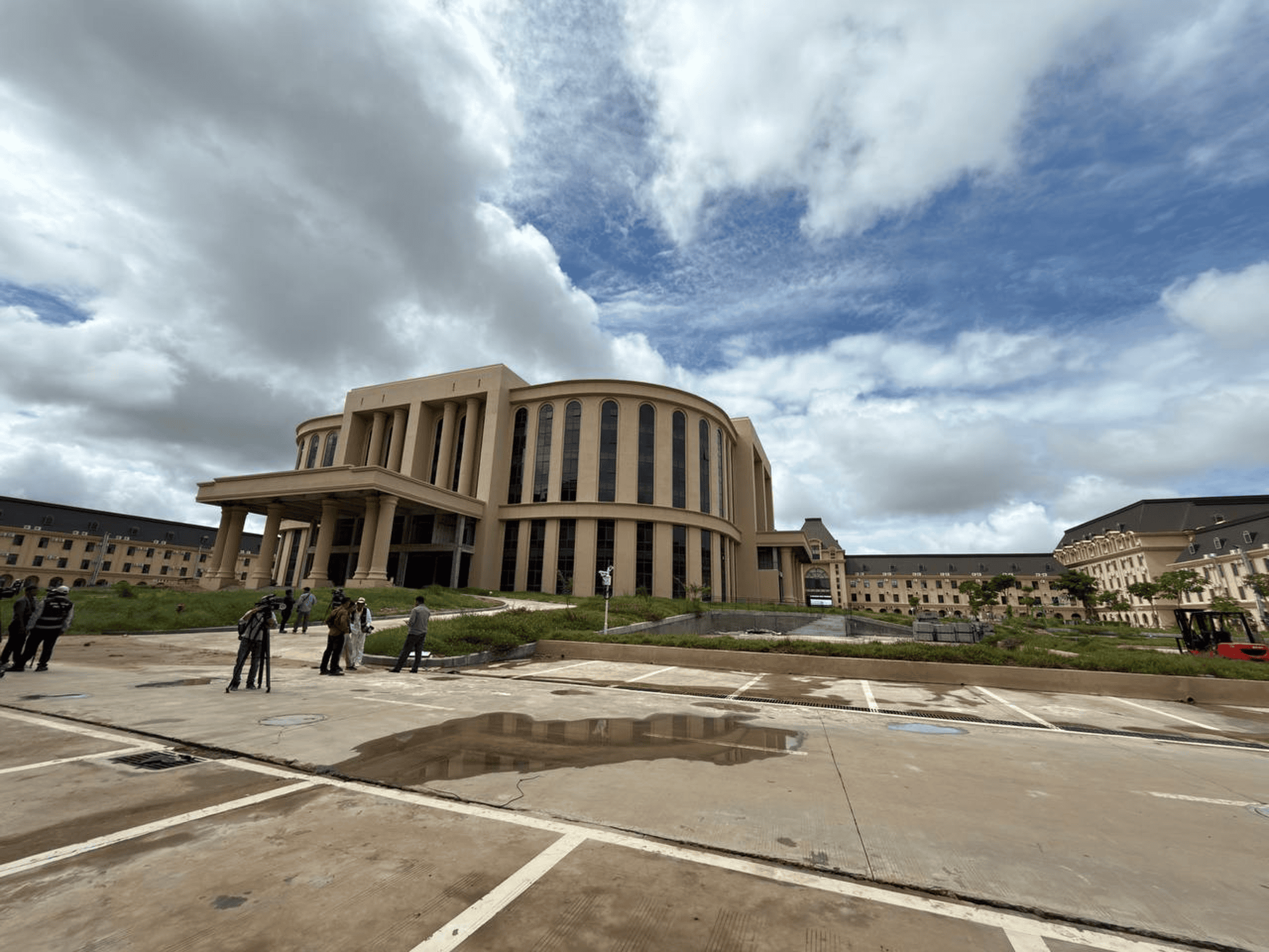
Roughly 60 journalists from Cambodia and abroad were given access on September 21 to a sprawling resort complex in Prey Veng province that officials say once served as the base for a large-scale online scam operation.
While foreign reporters had toured former scam locations in the capital before, this marked the first occasion authorities permitted entry to the site in Kra Bao commune, Kamchay Mea district. At its peak, the facility is believed to have housed as many as 20,000 people.
A Town Behind Walls
Referred to as "8 Park," the compound spans around 120 hectares and took approximately two years to complete. Work started in 2023, and it began operating in 2025. The property holds a wide range of structures, from residential blocks and office buildings to a market and shops, with a casino positioned at its heart.
The scale of the development gave it the appearance of a small, self-contained town. Its size and facilities suggest it was purpose-built to sustain large operations, offering workspaces, housing and various services for those who lived and worked within its walls.
How the Operation Was Uncovered
Hay Makara, a member of the Commission for Combating Technology-enabled Scams (CCTC), said the site was raided in February of this year. He explained that the operation drew on intelligence supplied by China's Ministry of Public Security and the US Federal Bureau of Investigation (FBI), along with accounts from people who had previously escaped the compound.
These sources, he said, helped authorities pinpoint the individuals running the scheme and the activities being carried out inside. During the raid, several suspected leaders and members of their management team were detained, while the roughly 20,000 workers left the site voluntarily afterward.
The complex was subsequently sealed and kept under round-the-clock watch to preserve it during ongoing legal proceedings. Communications gear and IT equipment were confiscated and moved to Phnom Penh, leaving behind only scattered office furniture and beds by the time of the visit. Makara noted that the buildings and other assets could be seized through court order.
Links to Known Figures
Officials say the compound had ties to business networks and individuals connected to Chen Zhi and Li Xiong. Chen Zhi founded Prince Holding Group, while Li Xiong formerly chaired Huione Group. Both are reported to have been arrested and sent to China, where they were said to be sought over transnational criminal activity tied to online fraud.
Seng Hieng, a deputy prosecutor at the Phnom Penh Municipal Court, said all cases connected to the 8 Park compound remain under investigation. The court may require more time to identify everyone involved and establish their legal accountability, though several people have already been arrested and brought before the courts.
Local Authorities Claim They Were Unaware
Prey Veng provincial governor Sourn Somalin maintained that local officials had no prior knowledge that the property was being used for online scams. He said the site's owner had originally presented it as a residential and integrated development project, and authorities expected it to boost the local economy.
"At first, we were happy with the plans for the development. But later on, when the authorities strengthened efforts to combat online scams, we found out that this place was not what we thought it was," he said, adding that local administrators lack the power to investigate private complexes of this kind.
Part of a Broader Campaign
The decision to open the site to reporters reflects Cambodia's intensifying campaign against online fraud, which has become a serious threat to the country's standing abroad. In recent years, international reporting has repeatedly flagged the Kingdom as a hub for scam centres, with accusations of human trafficking, forced labour and organised crime on a transnational scale.
The fallout has hurt Cambodia's image and raised safety worries among foreign investors and tourists. In response, the government is working to restore trust by ramping up raids, pursuing criminal networks and their leaders, deepening cooperation with foreign governments and law enforcement, and seizing assets tied to illegal activity.
Makara stressed that working with international partners and collecting intelligence are essential to locating criminal networks and scam operations. He said opening the compound to foreign media was also intended to showcase Cambodia's efforts against such crimes.
The tour took place two days ahead of an international conference on combating technology-facilitated scams, scheduled for Phnom Penh on September 23-24, with a focus on cross-border cooperation, information sharing and countering transnational scam networks.
Prime Minister Hun Manet has pledged to stamp out online fraud transparently, warning last week that these crimes have badly damaged the nation's reputation. Combined with the continuing border tensions with Thailand, the problem has driven a sharp drop in international visitors. For Cambodia, cracking down on major compounds like the one in Prey Veng is a key move in its wider push to rebuild international confidence and show it is confronting an issue that has weighed on its global image.