Indonesian wildfires and haze in Kalimantan cost billions as families struggle to cope
A fierce fire season in Indonesia has left farming families in Kalimantan facing ruined crops, rising costs and mounting health bills as haze chokes the region.
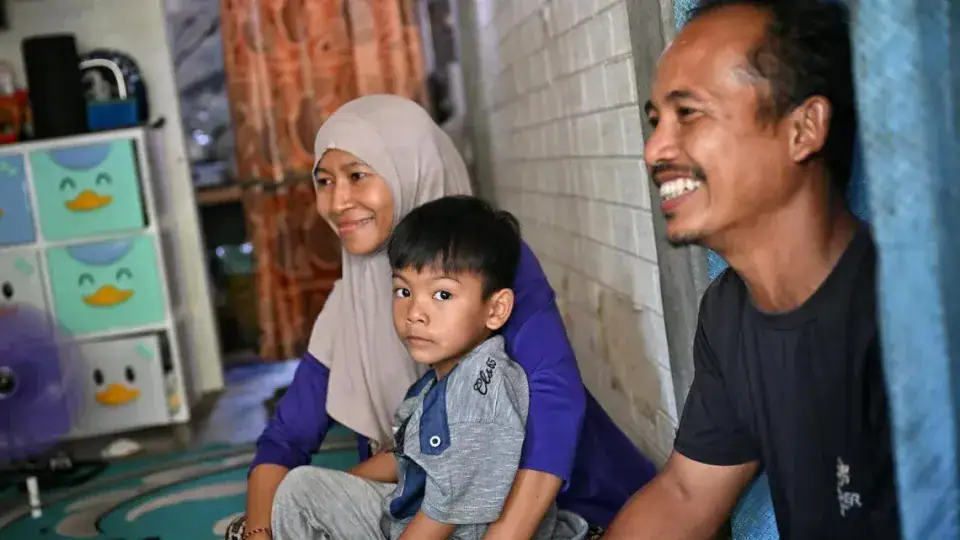
BANJARBARU, SOUTH KALIMANTAN – When fire crept toward his vegetable plot on August 27, farmer Adi Siswoyo could do nothing but watch. The 43-year-old had called for help, and more than 20 fire engines arrived, but he was told their hoses could not reach the flames. "If the hoses were too short, they could have borrowed more and connected them. It should have been doable," he said. Local authorities did not respond to questions about why the equipment fell short or what other options were considered.
Within hours, his 1,960 square meter field – about the size of five basketball courts – was blackened. Lost was his tabuk, the raised growing beds farmers laboriously build on waterlogged ground to keep vegetables above the waterline, a project that had taken roughly three months. Also destroyed were his chye sim and water spinach, planted just two weeks earlier.
He estimates the damage at 13.5 million rupiah (S$979): 12 million rupiah to rebuild the raised beds, one million rupiah for the chye sim and 500,000 rupiah for the spinach. "We had already put in the labour, the money and the time," he said. "Everything was wasted."
A country under strain
Indonesia is enduring an unusually brutal fire season, sharpened by extreme heat and dry conditions driven by a powerful El Nino. Flames have devoured wide stretches of Sumatra and Kalimantan, and smoke has drifted across Malaysia, Singapore and the Philippines.
The Center of Economic and Law Studies (CELIOS) estimates that fires from January through August could inflict between 39.29 trillion and 123.1 trillion rupiah in economic and health-related losses nationwide.
Adi's household shows how those costs reach far beyond the burn zones. For families already living on thin margins, the damage arrives as a series of small blows that pile up: a ruined crop here, a clinic visit there, a steeper power bill, less food at dinner.
Earning less, spending more
Two of Adi's four sons – Arif Achmad Rifai, 11, and Rahmat Rafis Saputra, 5 – came down with coughs and colds as the haze settled in. Their mother, Asmarawati, 39, took them to a village midwife at 60,000 rupiah a visit including medicine, for a total of 120,000 rupiah. The family paid out of pocket because they suspended their BPJS Kesehatan national health insurance payments during the Covid-19 pandemic.
The heat also forced them to run their two fans longer, lifting the monthly power bill by about 100,000 rupiah, from roughly 200,000 to 300,000 rupiah. When Arif's primary school moved classes online for two weeks, the family spent another 100,000 rupiah on mobile data.
None of these outlays is large on its own, but they weigh heavily on a household whose monthly earnings have slid from about five million rupiah to nearly three million. Meanwhile, fixed costs remain: Adi pays around 1.5 million rupiah monthly toward a bank loan for fish farm gear, and his 17-year-old son, Riky Dwi Ramadan, has 300,000 rupiah in vocational school fees each month.
The pressure shows up at the market, too. The long dry spell has pushed farming costs higher, with Adi and Asmarawati pumping water more often and burning more petrol. Vegetable supplies have tightened, lifting prices without boosting farmers' earnings.
Asmarawati has raised the price of a bundle of water spinach from 3,000 to 6,000 rupiah, but customers are buying less. A bakso vendor who once took three or four bundles of chye sim now buys one or two, or opts for cabbage. Haze has also kept some shoppers away.
"The price goes up, but consumers do not want to go up with it," she said. "My capital has increased, but my income has fallen."
Her daily net takings have dropped from about 200,000 rupiah to 100,000, and sometimes as little as 50,000. On some days, she loses money.
The squeeze is visible at the dinner table. "Usually, when I come home, I might bring a kilo of fish. Now, maybe only half a kilo," she said. The family has also trimmed snack purchases.
On the farm, Adi now irrigates almost daily. In the wetter months, usually November to April, he rarely needs to pump water. "If we plant a lot and cannot look after the crops, we'll lose even more," he said.
Searching for new income
The family is hunting for extra earnings. Gourami need 10 to 12 months to reach market size, and the couple must cover fingerlings, feed, electricity and water.
The mushroom venture began when regular customers asked them to supply the fungi after another seller stopped. "We did not have the knowledge," Asmarawati said. "But we dared to try, learning as we went." Dry weather, though, ruined part of the crop.
Local officials have handed out masks and urged people to stay indoors when haze thickens, but that is little help for farmers who must work outside. "Farmers have to hoe the fields. We cannot wear masks; it is hard to breathe," Adi said. "When the wind blows the fire and haze in from the south, the best I can do is hoe facing north."
Beyond a single family
Some households in Syamsudin Noor village – especially those with babies or small children – have moved in with relatives in Banjarmasin and Martapura, where the air is cleaner, according to community leader and farmer Hendri Wibowo. For farmers, he said, the dry spell amounts to a lean year. "For us farmers, we cannot plant. We have no harvest income because of the drought."
The village has 28 registered farmer groups, about 14 of them still active, growing melons, chillies and tomatoes. Hendri estimated combined agricultural losses could reach hundreds of millions of rupiah, though he had no figures to back that up.
Village head Fitria Khairani said roughly 10 hectares had burned but could not put a value on the damage, since affected farmers either had not reported losses or could not quantify them accurately. The lack of reliable numbers is itself evidence of how hard it is to measure the fires' toll at village level.
Fitria said haze has disrupted daily routines, with residents complaining of shortness of breath and irritated eyes, and community hospitals have logged more respiratory infections.
At Ratu Zalecha Hospital in neighbouring Banjar regency, public health surveillance officer Winanda Rosalina said acute respiratory infections, known as ISPA, started climbing in mid-June. Hospital records reviewed by The Straits Times showed 341 cases between June and September 9. She cautioned, however, that not all could be blamed on haze: respiratory infections have many causes, and ISPA is sometimes entered as a secondary diagnosis rather than the main complaint. "Patients come to us with a main symptom like fever, and only later do we find out it is ISPA, or it could turn out to be dengue," she said.
Economist Achmad Nur Hidayat of Universitas Pembangunan Nasional in Jakarta said the burden of repeated fires lands hardest on lower-income households, which have the fewest ways to escape the effects or absorb the losses. "The ones who suffer most are the lowest-income groups because they have no alternatives," he said.
The haze has also strained schools and families. At SMP 15 Banjarbaru, a state junior high with 466 students, lessons have been disrupted as authorities try to protect children from the polluted air.