 Mekong Monitor
‘I’m Not Afraid’: Fallen Soldier’s Daughter Steps Up to Defend Cambodia
After her father was killed in artillery fire during the December 2025 Cambodia-Thailand border fighting, San Sopheak chose to join the armed forces and carry on his service. Now training as a soldier, she says she is ready to face the front lines.
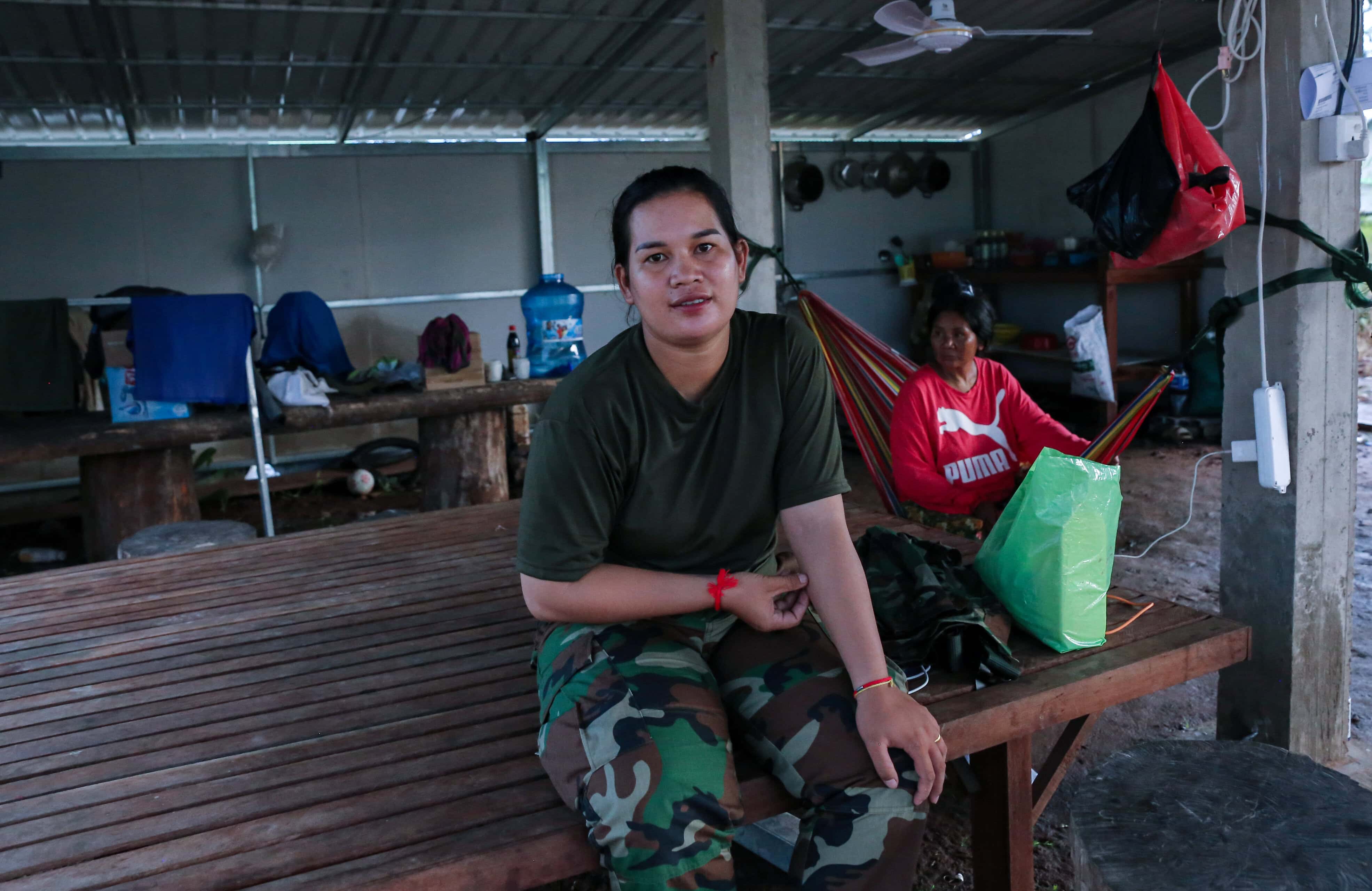
When her father was killed by artillery fire during the second round of fighting along the Cambodia-Thailand border in December 2025, San Sopheak was left devastated. She struggled to grasp how suddenly he had been taken from her, a man who had given his life defending his country.
Her grief was so overwhelming that it felt as though her entire world had gone dark.
Fully aware of the dangers that took her father’s life, Sopheak has chosen to follow in his footsteps. She is now training to wear a soldier’s uniform and serve the nation.
Speaking to The Post at Ta Keung Baitong, a resettlement village in Preah Vihear province for families displaced by the conflict, she recalled how she learned that her father had died on the front lines.
She said he was struck by artillery fire. She was told that he never heard the incoming shells and had no time to find cover.
The family first heard of his death from one of his close friends. His body was then brought back to the province.
A Painful Reality
At first, the family refused to believe it and clung to the hope that he might still be alive. Seeing his body made the truth impossible to deny.
“I was totally stunned. I lost all sense of myself and just froze. I could not accept it, because everything happened so quickly. I simply could not come to terms with it,” Sopheak said.
“Everything felt as black as a moonless night, the kind older people often talk about. It was completely dark because of the loss,” she said.
Even so, she eventually realised she had to summon the strength to face what had happened.
“In that moment I was numb, but I knew I could not afford to be weak. He was already gone, and I had to accept the truth. I had to find the courage to face it,” she said.
Her father’s body was first taken to Kok Beng pagoda and later moved to Prasat Sambor district in Kampong Thom province, his hometown, where he was laid to rest.
Sopheak’s father was one of the Cambodian soldiers killed in the second round of border fighting. The clashes broke out on December 7, 2025, after an earlier ceasefire agreed in late July had collapsed.
Cambodia said Thai forces carried out repeated attacks on its territory using fighter jets, heavy artillery and other weapons. Thailand maintained that its military operations were responses to actions taken by Cambodia.
The Human Cost of War
The fighting left an unknown number of soldiers and civilians dead or wounded and forced hundreds of thousands of Cambodians to abandon their homes. A new ceasefire took effect on December 27.
For Sopheak’s family, the war took more than a loved one. It also destroyed the farming livelihood they had depended on for years.
Before joining the military, Sopheak lived in Dach O’Svay village, where she worked alongside her parents growing rice and other crops.
She left school after Grade 9. It was not for lack of ambition, but because she could not bear to watch her parents struggle to keep the family afloat.
She had dreamed of becoming a soldier since childhood, but her family’s financial situation pushed that goal aside and she focused on working the land instead.
“I have loved the military profession since I was young, ever since I was a little girl. But I saw how hard my parents were working, and I didn’t want them to suffer. So I stopped studying and went to work in the rice fields and on the farm with them in O’Svay,” she explained.
Her father’s death became a turning point.
Afterwards, Sopheak was offered a place in the armed forces under a government policy that allows children of fallen soldiers to continue their parents’ military service. She accepted, seeing it as a chance to pursue a childhood dream and a way to carry on her father’s dedication to defending the nation.
A Family Tradition of Service
“After my father was killed, the government offered me the chance to take over his military service. I decided to take his place and continue what he had started,” she said.
Sopheak is now in military training and preparing for a career in the armed forces.
Asked whether she would accept a posting to a military base or a front-line position once her training is complete, she said she would follow her commanders’ orders without hesitation.
“Yes, I would go. Once we put on this uniform, we cannot hesitate. We must move forward, not backward. Being a soldier means being brave, having a strong and determined spirit, and obeying our commanders’ orders,” she said firmly.
Her family supports her decision, she added. They respect her choice, just as she respects theirs, and they have not tried to talk her out of it.
“My family has no objection. They respect my decision, and we respect one another. They have not tried to stop me,” she said.
Although joining the military has given Sopheak a new sense of direction, money remains tight at home.
New Lives Far From Home
She explained that losing access to their farmland and being unable to work it had cut off the household’s main source of income.
Before the conflict, the family relied almost entirely on rice cultivation and other farm work to make ends meet.
“When we lost those things, we had no income. We depended entirely on our rice fields and farmland. Once we lost them, life became very difficult. We had no income and very little to fall back on,” she said.
Sopheak said the family has received government assistance that has eased some of the financial strain caused by her father’s death and their displacement.
She now lives in Ta Keung Baitong, a settlement for displaced civilians who are working to rebuild their lives after being uprooted from their homes, farmland and familiar surroundings.
For Sopheak, the military uniform represents far more than the start of a new career. It is also a personal pledge to continue the path of a father who lost his life serving his country.
She knows firsthand how devastating armed conflict can be. When asked whether she feared ending up on the same path that cost her father his life, she answered without hesitation.
“Not at all. I’m not afraid.”