How Sihanouk's Quest for a Legendary Buddhist Hall Led Him to a Temple in Quanzhou
Cambodia's late King Father Norodom Sihanouk traveled to Quanzhou in 1983 to find a legendary Buddhist hall he had read about, highlighting centuries-old cultural ties between coastal China and Southeast Asia.
In 1983, Cambodia's late King Father Norodom Sihanouk made a visit to the Kaiyuan Monastery in Quanzhou, a coastal city in China's Fujian province. His reason for going was surprisingly personal: he had long been fascinated by a legendary structure known as the "Hundred-Pillar Hall" and wanted to see it for himself.
According to Deyuan, a senior monk at the temple, Sihanouk had come across references to the hall in a book but didn't initially know its precise location within China. When he asked Chinese officials to help track it down, they were unable to provide an answer right away.
"The King had read about this temple and inquired with Chinese officials, but at the time, no one could tell him where it was," Deyuan recounted to a group of ASEAN journalists who toured the temple on September 21.
A Historian Solved the Mystery
It was the celebrated Chinese historian Guo Moruo — who had previously spent time in Quanzhou — who ultimately pinpointed the city as home to the famous hall. Chinese officials then arranged for Sihanouk to travel there.
The story sheds light on a lesser-known aspect of Sihanouk's life: his deep curiosity about Asian religious and cultural heritage. It also underscores the centuries-old ties between Quanzhou — once a vital hub on the Maritime Silk Road — and the nations of Southeast Asia.
Deyuan explained that the hall's fame had spread far beyond China's borders long ago. Merchants and travelers who departed from Quanzhou's bustling port carried stories of the city's religious landmarks to distant shores across Asia.
"The temple was especially well known throughout Southeast Asia because of the Hundred-Pillar Hall," he said. "Over time, people remembered that such a hall existed somewhere in China, even if they had forgotten it was in Quanzhou."
The monk also mentioned that a member of the Cambodian royal family — described as one of Sihanouk's sons — returned to the temple in 1993, a decade after the King Father's visit.
A Temple with Imperial Ambitions
Kaiyuan Temple was established during the Tang dynasty and remains one of Fujian's most significant Buddhist sites. In 2021, it was recognized as part of the UNESCO World Heritage inscription titled "Quanzhou: Emporium of the World in Song-Yuan China."
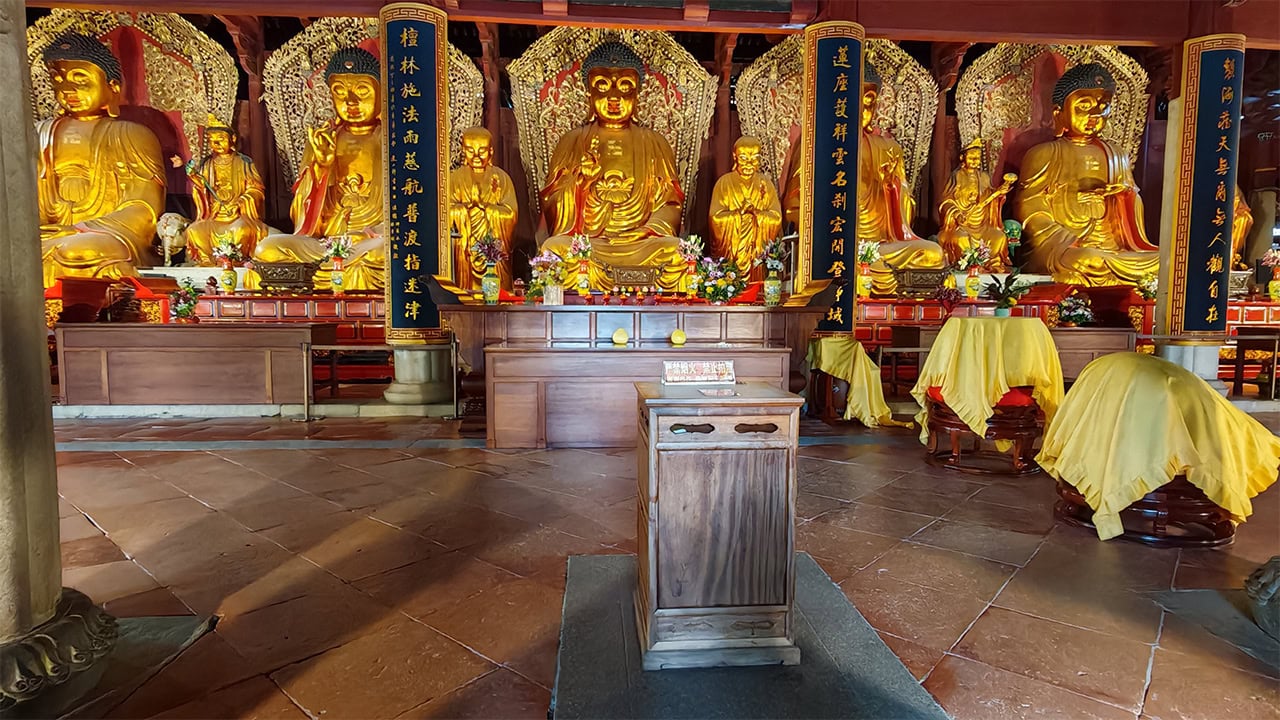
The temple's centerpiece is the Mahavira Hall, popularly nicknamed the Hundred-Pillar Hall — a name that is somewhat misleading, since the actual number of columns falls well short of one hundred. Deyuan noted that the current structure dates to 1637, when it was rebuilt following earthquake damage in 1604.
Its architectural grandeur is evident in its double-eaved roof and the use of nine bays and five steps, proportions traditionally reserved for structures associated with the Chinese emperor.
"Some temples in southern China have only a single-layer roof. This one has two, which reflects its exceptional status," Deyuan explained.
Unique Art and Ingenious Engineering
Inside, five large Buddha statues represent the cardinal directions and the center — an arrangement Deyuan described as unique among Chinese temples. High above, 24 carved celestial musicians are perched among the wooden beams, each holding a different instrument or cultural artifact. These figures symbolize China's 24 solar terms and the rhythm of day and night.
The hall's construction showcases remarkable timber engineering. Its wooden components interlock without reliance on nails, creating a structure that allows air to flow freely through the upper portions of the building.
Deyuan said this natural ventilation system prevents dust, cobwebs, and bird nests from collecting among the beams. During typhoons, the interlocking framework also disperses powerful winds in multiple directions, protecting the structure from damage.
"When wind enters, it creates an air current that is released in every direction through the wooden framework," he said. "It functions like natural air conditioning."
He compared the hall's double-layered beam system to the structural principles found in modern bridges, noting that heritage specialists have expressed admiration that builders applied such sophisticated engineering to a religious building more than four centuries ago.
A Living Link Between China and Southeast Asia
Beyond its architectural marvels, the story of Sihanouk's pilgrimage to Kaiyuan Temple serves as a reminder of the deep historical connections forged through the movement of religions, people, and ideas between coastal China and the communities of Southeast Asia.