 Mekong Monitor
Critical Mineral Mining Expands in Myanmar Amid Weak Oversight and Pollution Fears
Rare earth mining is spreading rapidly across Myanmar, often under the control of armed groups and with Chinese-linked firms involved. Rising pollution in neighboring rivers has raised alarm while major powers compete for access to the minerals.
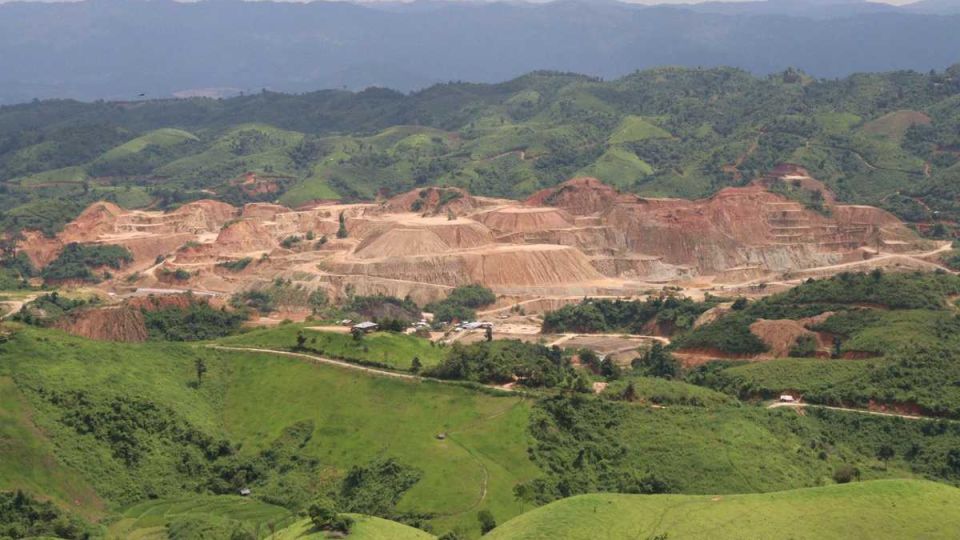
Myanmar’s critical mineral sector is growing quickly, and regulation is not keeping up. Chinese-linked companies are taking part, while ethnic armed groups and military-aligned forces use the revenue to fund their operations. As pollution concerns rise, governments around the world are also racing to secure supplies of these minerals.
Funding sources
On the Thai side of the border in Chiang Rai province, a reporter climbed a ridge along the frontier with Myanmar’s northeastern Shan State and looked down on a wide expanse of mining sites where the hillsides had been stripped bare. A senior Thai military officer traveling with the reporter said the area once yielded gold, but that mining for rare minerals had recently begun. He said Chinese operators holding licenses from the Myanmar military were running the projects. Various ethnic minority communities live in the region, but the Myanmar side is under military control.
Since the 2021 coup, ethnic minority and pro-democracy armed groups have held much of the mountainous terrain and continue to resist the military. With central government control broken down by the civil war, both the armed groups and the military rely on these natural resources to fund themselves.
Exports to China
The main rare earth mines are in Kachin State, in the north, which borders China. The region produces dysprosium and terbium, elements used in electric vehicle motors. According to the research group ISP-Myanmar, the number of mining sites in Kachin has tripled since the coup.
From 2017 to 2024, Myanmar’s rare earth exports to China were worth more than $4 billion, roughly 630 billion yen. About 84% of that value was shipped after the coup. Over the eight years through 2024, around two-thirds of the rare earths China imported came from Myanmar. China handles roughly 90% of the world’s rare earth refining, and that work depends heavily on Myanmar’s supply.
Military-affiliated forces had long controlled the Kachin mines. In 2024, however, the Kachin Independence Army seized control, and the military lost a major source of income. Mining then spread into northeastern Shan State.
In 2025, the Shan Human Rights Foundation reported that mining had begun near the Thai border in southern Shan State, an area held by the United Wa State Army. The UWSA has close ties to China, and Chinese-linked companies are reportedly involved. Operations were soon uncovered in areas held by the Ta’ang National Liberation Army in northern Shan State and the National Democratic Alliance Army in the east. According to the United Nations, the number of mining sites in Shan State has jumped from 12 before the coup to 85.
A diplomatic bargaining chip
Several countries are moving to get involved. In August 2025, Indian Prime Minister Narendra Modi met Min Aung Hlaing, who was then the military’s commander-in-chief, and the two agreed to cooperate on rare earth development. In July of this year, the Indian government hosted a mining forum in Myanmar. India has also reportedly been in separate contact with the KIA.
Russia is expanding its reach as well. In June, the Shan Human Rights Foundation said a Russian company planned to mine tungsten, a rare metal, in southern Shan State, and Myanmar’s government is reported to have granted it a mining permit. In October, an executive from a Russian mining company met with Min Aung Hlaing, who became Myanmar’s president in April.
The United States has drawn particular attention. In July 2025 and again in October, Washington lifted sanctions on some Myanmar companies and individuals linked to the military. A recently released US government document states that backing peace talks in the country would open the way to Myanmar’s abundant rare earth deposits.
For the military-backed administration, which is seeking international recognition, minerals such as rare earths could be a powerful diplomatic card. Most of the mines lie in areas held by ethnic minority groups, but the government is courting foreign partners and inviting them to cooperate on future projects.
Serious environmental concerns
Fears of severe pollution are mounting as unregulated mining spreads.
A fisherman in his sixties in Chiang Khong, a town on the Mekong River in northern Chiang Rai, described a sharp decline. Five or six years ago he could catch 40 to 50 fish in a single night. Now he is lucky to catch two or three. The water stays murky, and many villagers have given up fishing, leaving only about five boats. He has been fishing since he was a teenager.
The Mekong flows along the Laos–Myanmar border, where mining is expanding, and it also receives murky runoff from tributaries such as the Kok River, which begins in Shan State. Since last year, Thai authorities have tested several rivers and found arsenic, lead and other substances above safety limits at various points. They have urged people not to eat fish, which tend to accumulate heavy metals, or shrimp that live near riverbed sediment.
A direct link between mining and river pollution has not been fully proven. However, the in-situ leaching method used for rare earth mining in Myanmar, which involves drilling into hillsides and injecting chemicals, has been blamed for groundwater contamination and wastewater flowing into rivers.
Niwat Roykaew, who has worked on Mekong conservation for about 30 years, warned that health effects take time to appear. Because the river crosses several countries, he said, the situation could eventually become extremely serious.
A central problem is that the mines lie in areas run by ethnic armed groups, beyond the reach of Myanmar’s government.
Suebsakun Kidnukorn, a lecturer at Mae Fah Luang University in Thailand, called for China to be more transparent about where its minerals come from and how it accounts for environmental impacts. Critical mineral supply chains are a global issue, he said, and more countries need to take part.