 Mekong Monitor
China Has Named Its Red Lines. What Are Washington's?
As Xi Jinping visits the White House for the first time in over a decade, China has restated its four red lines while analysts struggle to pin down what the Trump administration considers non-negotiable.
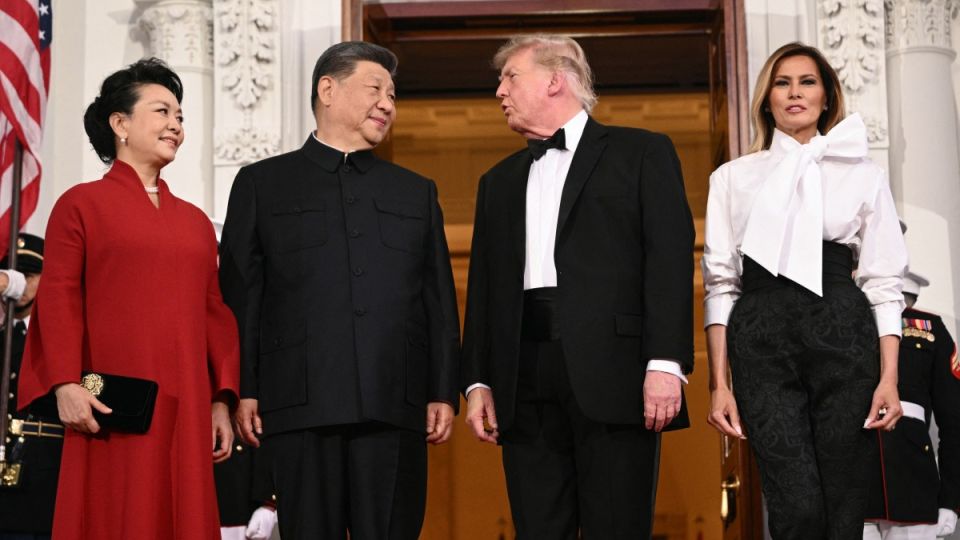
As President Donald Trump prepares to welcome Chinese President Xi Jinping to the White House for the first time in over ten years, American analysts are left wondering where the United States intends to draw its own line in the sand.
The visit, scheduled for September 24, is set to open with a lavish arrival ceremony featuring military bands and fighter jet flyovers, followed by bilateral talks between the two leaders. Meanwhile, Melania Trump plans to accompany Xi's wife, Peng Liyuan, to the Smithsonian National Museum of Asian Art. A formal state dinner will cap off the day.
Beijing's Four Red Lines
A day before Xi's arrival in Washington, China's ambassador to the US, Xie Feng, restated Beijing's position on what it considers non-negotiable. Writing in a September 23 op-ed for the official People's Daily, he stressed that China's sovereignty, security and development interests must not be violated, and that four red lines cannot be challenged: the Taiwan question, democracy and human rights, China's chosen development path and system, and its right to develop.
These are familiar talking points that Beijing routinely repeats around visits by senior US officials. Xi himself laid them out when he met then-President Joe Biden in Lima in November 2024.
What Does Washington Want?
If Beijing's boundaries are clear, the harder question is what the US is demanding that China stop. "The United States has not as clearly stated its own red lines; we could try to infer them," said Kelly Grieco, a US foreign policy expert at the Stimson Center.
At the top of that inferred list is the war involving Iran. China purchases Iranian oil and has reportedly backed Iran's war effort. Observers are watching to see whether Beijing might step in as a mediator and what it would expect from Washington in exchange.
A second concern is China's grip on rare earth exports, the elements critical to producing everything from smartphones to missiles. Although Beijing has officially lifted its strict controls on these materials, it has continued to squeeze supplies reaching American firms.
A Shift in Priorities
According to Scott Kennedy, a China specialist at the Center for Strategic and International Studies in Washington, American red lines have traditionally centered on China's industrial policy, its ambitions toward Taiwan, disputes in the South China Sea, and human rights.
Those priorities, he noted, are difficult to spot in the current Trump administration's stance. "Instead, they want an avoidance of war. They want to keep markets up, and anything that makes President Trump look good. Very different kinds of red lines that the US now has than in the past," he said.
Grieco, however, cautioned against reading too much into shifting tone. She argued there has been no dramatic abandonment of long-standing US positions, noting that the administration has pushed back against Chinese pressure in the South China Sea by reaffirming defense commitments to the Philippines, keeping up joint maritime patrols, and carrying out military exercises.
"On maritime disputes and China's support for Iran, I'd look more closely at actual policy decisions rather than changes in rhetoric," she said, adding that some observers are mistaking an effort to dial back provocative language for an actual retreat from commitments. "Those are two very different things."
Ultimately, she suggested, greater openness on both sides about their respective boundaries could benefit the relationship. "Clarifying the two sides' red lines could be helpful to stabilise relations, particularly to avoid misperceptions and the dangers of accidental or inadvertent escalation," she said.