 Mekong Monitor
Cambodia's UN envoy rejects Thai claims and submits maps to the General Assembly
Cambodia's UN envoy has rebutted claims made by Thailand's ambassador at the General Assembly and submitted maps detailing alleged Thai military operations during the July and December clashes. The exchange deepens a long-running border dispute.
Cambodia's ambassador to the United Nations has rejected statements made by his Thai counterpart, accusing him in a detailed response of presenting a “political narrative that distorts the historical record.”
Thai ambassador and permanent representative Cherdchai Chaivaivid addressed the General Debate of the 81st session of the UN General Assembly on September 28. He repeated several of Thailand's positions, including the claim that Cambodian citizens had settled on Thai territory and that Cambodia had chosen to start the UNCLOS conciliation process instead of accepting Thailand's offers of bilateral talks. He said Thailand was observing the current ceasefire and urged Cambodia to stop raising accusations in international forums. He also accused Cambodia of planting new landmines near the border.
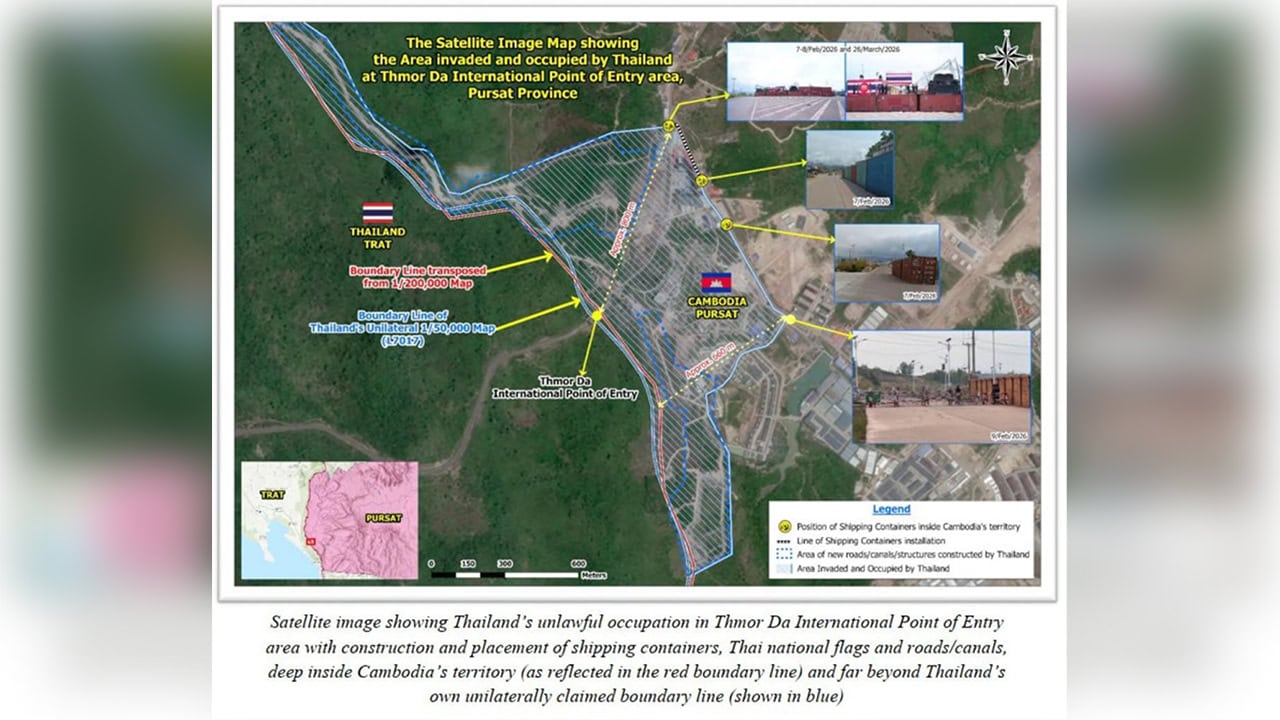
Cambodia's permanent representative, Chhea Keo, responded in a September 29 statement sent to the UN Secretary-General, which included several maps. The statement details Thai military operations during the clashes in July and December of last year, including the use of tanks, heavy artillery, F-16 and Gripen fighter jets, drones and cluster munitions in several Cambodian provinces.
The statement also disputes Thailand's claim that it is abiding by the terms of the December 27 ceasefire. It notes that the agreement requires both sides to halt all activity, but says Thai forces have kept building fortifications, including razor wire and shipping-container barricades, and have continued to push the frontier further into Cambodian territory.
Chhea called the claim about Cambodian civilians living on Thai land “regrettable.” He also criticised Thailand for citing events from past decades to justify current military incursions and what he described as the continued unlawful occupation of Cambodian territory. He pointed out that Thailand has not accepted Cambodia's repeated requests to resume survey and demarcation work under the Cambodia-Thailand Joint Boundary Commission.
Chhea also referred to comments by Thomas H. Andrews, the UN Special Rapporteur on human rights in Cambodia, who said the roughly 20,000 people displaced from the border “need, and deserve, to go home.”
On Thailand's accusation that Cambodia is trying to internationalise the dispute, Chhea disagreed firmly. He argued that using mechanisms set out in the UN Charter and in treaties both countries have freely accepted is not an improper internationalisation, but a legitimate peaceful means of settling disputes under international law. He described the UNCLOS compulsory conciliation for the maritime dispute, which Cambodia initiated, as a chance to narrow differences, rebuild trust and build a stronger basis for peaceful relations.
Regarding the claims of new Cambodian landmines, Chhea said Cambodia remains committed to the Anti-Personnel Mine Ban Convention, both as a treaty obligation and because of its own experience. He noted that Cambodia has spent decades dealing with the devastating humanitarian toll of anti-personnel mines.
Chhea also responded to Thai Prime Minister Anutin Chanvirakul's address to the General Assembly, in which Anutin said Thailand would make no concessions unless Cambodia moved first, adding, “Thailand's conditions only.” Chhea said rebuilding trust requires concrete steps. Thailand, he said, must stop all unlawful activity, refrain from further unilateral moves and work to ease tensions, so that mutual trust, peace and good neighbourly ties can be preserved along the border.
He concluded that Cambodia remains committed to resolving all outstanding issues peacefully, in line with the UN Charter, international law and existing bilateral agreements. He asked that the UN circulate his statement to member states.