 Mekong Monitor
Cambodia Responds to Thailand's UN Address: Peace Demands Adherence to International Law
A Cambodian perspective argues that Thailand's call for peace at the UN General Assembly must be backed by respect for sovereignty, independent verification of facts, and equal application of international law to both nations.
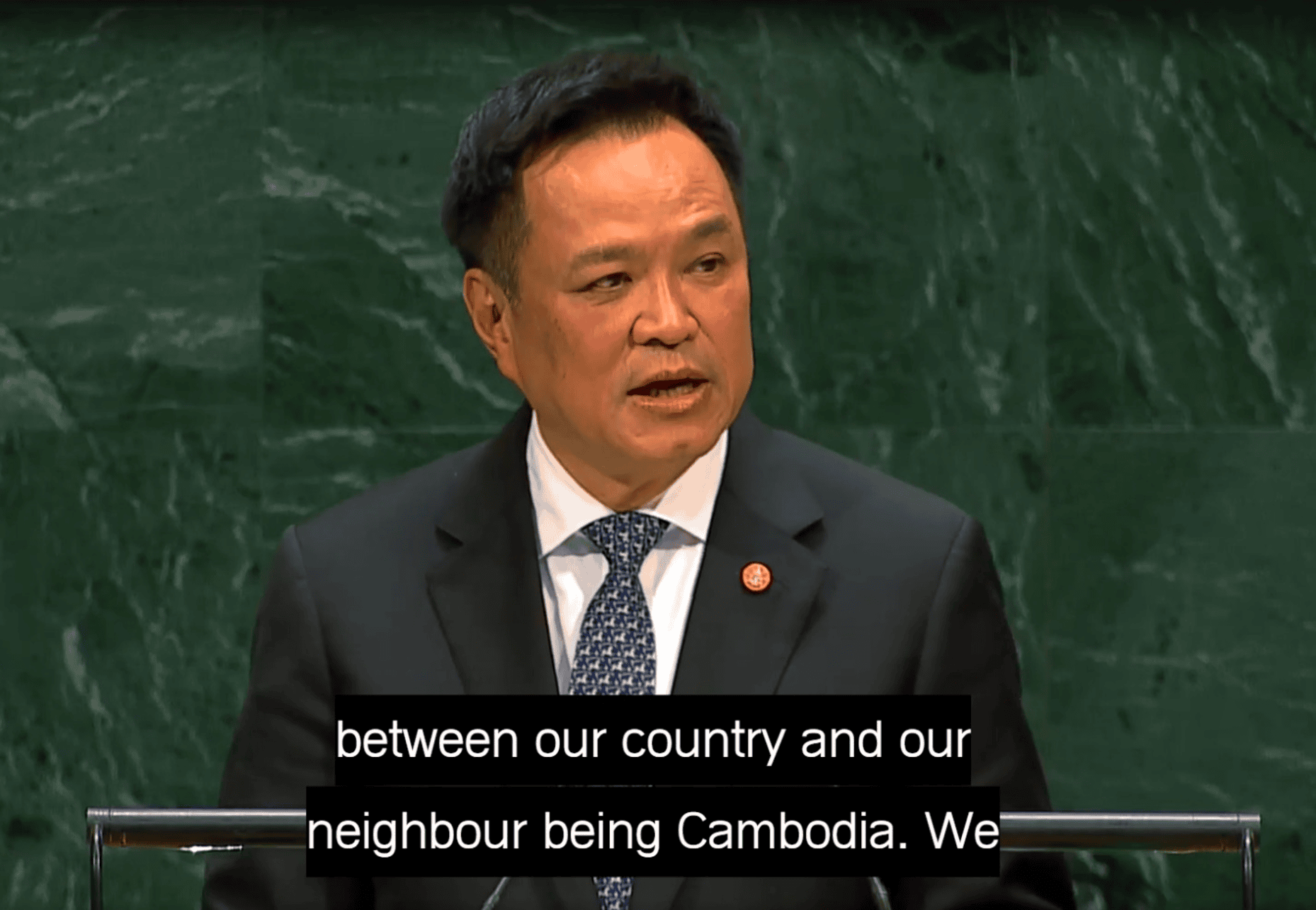
When Thai Prime Minister Anutin Charnvirakul addressed the 81st UN General Assembly on September 24, he declared that Thailand has never pursued conflict and urged Cambodia to make sincere efforts toward peace.
From a Cambodian perspective, any authentic appeal for peace deserves a warm reception. Cambodia has no desire for war. But durable peace demands far more than carefully worded speeches at international forums — it requires genuine respect for national sovereignty, adherence to international legal standards, honoring of existing agreements, reliance on credible evidence, and recognition that all nations possess equal rights.
Should Thailand truly desire peace, both nations need to resolve their differences through open dialogue, independent fact-finding, and lawful dispute-resolution processes — rather than through political leverage, military posturing, or dueling public narratives.
Online Crime and Sovereignty Must Not Be Conflated
Thailand has every right to bring the urgent problem of online scams and cross-border crime before the international community. Cambodia, for its part, should actively cooperate in dismantling criminal networks, safeguarding victims, and bolstering joint law enforcement efforts.
That said, transnational cybercrime and territorial sovereignty are fundamentally distinct matters. The former deals with criminal activity spanning national borders, while the latter involves questions of frontiers, historical treaties, cartographic evidence, and international legal principles.
Neither issue should be leveraged to distract from or supplant the other.
It would be irresponsible to allege — without proof — that Thailand deliberately seeks to redirect global attention away from territorial concerns. Intentions should be evaluated on the basis of evidence, not speculation. Even so, the international community bears a duty to consider both issues on their own merits and with equal rigor.
If Thailand expects global institutions to take its concerns about cybercrime seriously, Cambodia deserves the same platform to raise questions about its sovereignty and territorial integrity. This is not an antagonistic stance — it is simply a call for fairness under international law.
Evidence and Independent Scrutiny Are Essential
Many countries are geographically far removed from the Cambodia-Thailand border region and may lack a nuanced understanding of conditions on the ground. Their impressions may be shaped largely by official government statements, media coverage, historical documents, and maps supplied by the disputing parties.
For precisely this reason, international bodies should scrutinize relevant treaties, prior legal rulings, independently verified data, and firsthand accounts from border communities before drawing conclusions.
No government — including Cambodia's — should expect its version of events to go unquestioned. Both sides must be willing to submit their claims and conduct to impartial examination. International justice requires that all pertinent evidence be weighed, regardless of its source.
Building Peace Together
Prime Minister Anutin's public commitment to peace opens a door for both nations to reinforce constructive mechanisms. Meaningful steps should include:
- Upholding international law and honoring existing bilateral agreements.
- Engaging in substantive dialogue while exercising restraint.
- Submitting disputed facts to independent verification.
- Ensuring the safety and well-being of civilian populations along the shared border.
- Making use of established bilateral and multilateral dispute-resolution frameworks.
Peace should never hinge on which side wields greater military force, economic clout, or diplomatic influence. It should rest on mutually respected rules and norms.
If Thailand has truly never sought conflict, as its leader proclaimed, that commitment must be reflected in concrete actions that de-escalate tensions and advance peaceful outcomes.
The People of Both Nations Deserve Better
Neither the Cambodian nor the Thai people need another armed confrontation. Communities straddling the border on both sides are entitled to security, dignity, economic opportunity, and freedom from the threat of violence.
Governments may spar over historical interpretations, boundary lines, and legal arguments, but ordinary citizens of both countries should never be turned into adversaries because of unresolved governmental disputes.
Cambodia and Thailand are fully capable of working together against online crime while simultaneously pursuing territorial questions through proper legal and diplomatic channels. These objectives are not in competition with one another.
The United Nations should hear both sides, weigh the evidence impartially, and ensure that international law is applied uniformly — to strong and less powerful states alike.
A Call for Justice, Not Confrontation
From the Cambodian standpoint, the goal is not to provoke Thailand but to insist on truth, accountability, transparent dialogue, and equal application of international law.
Respect for the Thai people is a given — and the same respect should flow in the other direction. Sustainable peace cannot be constructed by sidestepping hard questions or allowing one concern to eclipse another.
If Thailand's peace overture is genuine, Cambodia should embrace it wholeheartedly. But peace must be proven through deeds, not rhetoric alone.
Both countries should strengthen peaceful channels for resolving disputes. Contested claims should be subjected to independent review. Sovereignty must be honored, and international law must apply to everyone equally.
Peace should never be confused with silence. True peace requires justice — and justice begins when international law is respected without exception.