 Mekong Monitor
Cambodia Protests Thai Road Building on Disputed Land
Cambodia has formally protested against Thai road construction and preparatory work on land it says is Cambodian, in Oddar Meanchey province. The government says the activity violates existing border agreements and the December 2025 de-escalation commitments.
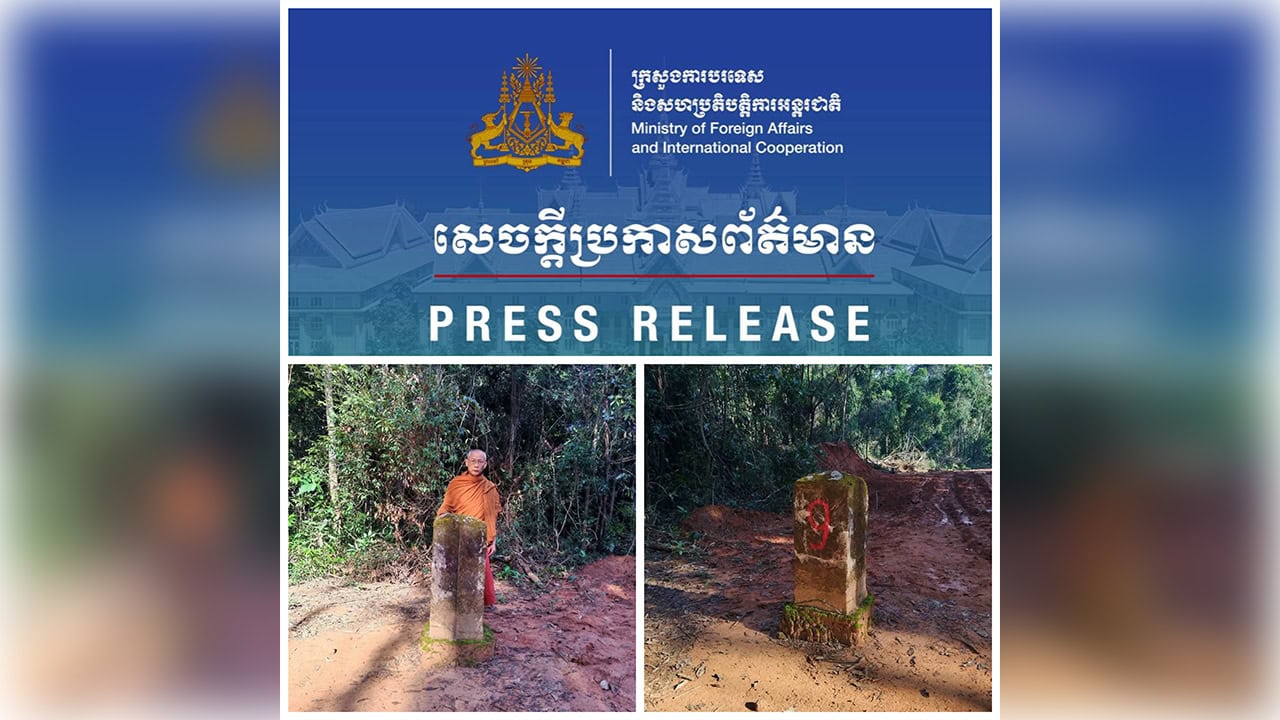
Cambodia has lodged a formal diplomatic protest with Thailand over road building and preparatory work carried out by Thai forces on land that Phnom Penh says is Cambodian territory in Oddar Meanchey province, where Thai troops remain in place.
In a statement issued on October 23, the Ministry of Foreign Affairs and International Cooperation said the actions breached Cambodia's sovereignty and territorial integrity, as well as existing border agreements and de-escalation commitments.
What Cambodia says happened
According to the ministry, Thai personnel used heavy machinery to build a road in the Ta Tum area of Anlong Veng district, between boundary pillars 9, 10 and 11, on October 15. Two days later, Thai forces reportedly painted red markings on trees between pillars 10 and 11, which Cambodia views as groundwork for further construction.
The legal basis for the protest
Cambodia maintains that its international boundary was set by the 1:200,000-scale maps drawn up by the Commissions for the Delimitation of the Boundary between Indo-China and Siam, under the Franco-Siamese Convention of 1904 and the 1907 Treaty. The ministry also argues the activities violated Article 5 of the 2000 Memorandum of Understanding on the survey and demarcation of the land boundary, signed on June 14, 2000.
It further accuses Thailand of breaking the de-escalation measures in the first item of the joint statement issued at the third special meeting of the General Border Committee on December 27, 2025. That agreement followed renewed armed clashes and was meant to halt fighting, ease military tensions and restore stability along the border, after hostilities forced hundreds of thousands of civilians from their homes.
Cambodia's demands
The government said it does not recognise any boundary line or territorial claim that Thailand asserts unilaterally, and that such actions cannot affect Cambodia's legal rights or its position on the border. Its stance rests on historical treaties, widely accepted legal principles and existing bilateral agreements, rather than on changes made on the ground.
“The Royal Government of Cambodia demands that Thailand stop all such unlawful activities, refrain from further unilateral moves, and work to ease tensions, build mutual trust and preserve peace and good neighbourly relations along the border,” the ministry said.
A fragile situation
The two countries still have unresolved boundary disputes after two rounds of armed conflict in 2025, even though they have agreed to end hostilities and adopt measures to prevent another flare-up. Cambodia has repeatedly urged that land boundary issues be handled through the Joint Boundary Commission, using legal and technical procedures grounded in historical documents, relevant treaties and bilateral agreements. Prime Minister Hun Manet has likewise said talks must rest on legal and technical evidence, with the commission as the proper forum.
Phnom Penh warns that construction in contested areas could complicate demarcation and weaken the confidence-building measures agreed after the December 2025 ceasefire.
The statement did not say how long the road is or how far it extends, nor whether the work has been finished or is still going on.
Cambodia said it remains committed to settling all its border disputes with Thailand, as with its other neighbours, only through peaceful means and in line with international law. It stressed that national borders must not be changed by force.