 Mekong Monitor
Beyond Thailand's Refugee Story: Who Funded the Camps, Who Gained, and What Followed
Thailand's role in sheltering Cambodians fleeing the late-1970s conflict deserves credit, but the full record shows that international donors funded most of the relief effort and that Thailand's economy also benefited. The story of who paid, who gained, and what followed the camps' closure matters for today's border debate.
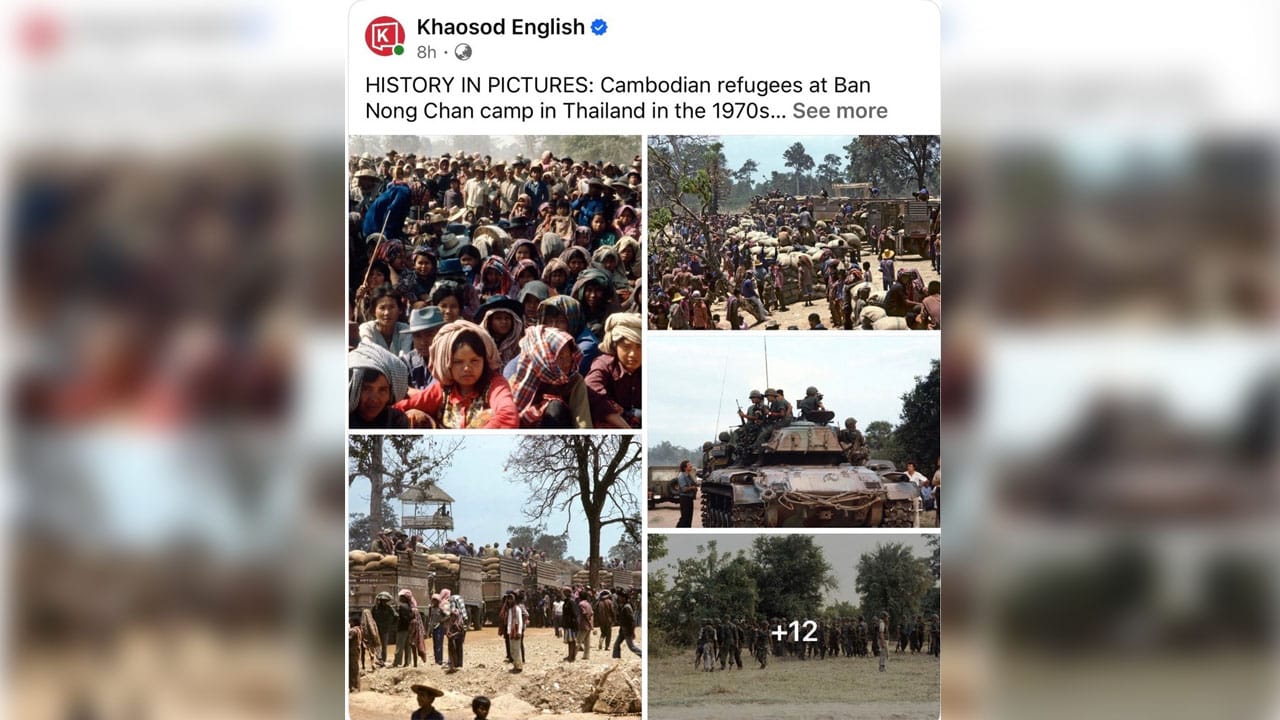
Thailand's Ministry of Foreign Affairs has recently returned to the story of Cambodians who fled fighting in the late 1970s. In a November 16 report, Khaosod English relayed Bangkok's position: Thailand offered temporary humanitarian shelter, but some Cambodians stayed in border areas despite repeated Thai objections.
Thailand's humanitarian role during that crisis deserves recognition. It allowed international agencies to work on Thai soil, offering a lifeline to thousands escaping war and famine.
Yet casting Thailand as the sole benefactor leaves out two crucial points: the large sums contributed by the international community, and the economic gains Thailand received from the relief effort. The real historical question is broader than whether Thailand offered help. It asks who paid for the operation, who profited from it, and what happened once the camps closed.
Who Footed the Bill?
A November 1993 study by the Overseas Development Institute (ODI) estimated that multilateral donors provided roughly $1.118 billion, in 1992 prices, for Cambodian refugees along the Thai border between October 1979 and 1990. A separate January 1991 report from the US General Accounting Office (GAO) recorded more than $331 million in international contributions to the UN Border Relief Operation (UNBRO) between 1982 and 1989.
The two figures overlap, and the money went to refugee programs rather than directly into the Thai treasury. Even so, their scale shows that the operation was carried overwhelmingly by the international community, not by Thailand alone.
Who Gained Economically?
Historical assessments indicate that international agencies spent about $100 million inside Thailand during the first six months of the operation, from October 1979 to March 1980. Another $140 million to $180 million was projected for the rest of 1980. One estimate found that 90 percent of UNBRO's $36 million annual budget was spent locally.
That spending paid for food, water, building materials, fuel, transport and warehousing. It generated significant business for Thai contractors, landlords and border towns such as Aranyaprathet. In effect, Thailand supplied land and cooperation, while donors bore the financial load and stimulated the local economy. Both sides of that arrangement belong in the historical record.
What Happened When the Camps Closed?
In November 1991, UNBRO handed its responsibilities to the UN High Commissioner for Refugees (UNHCR). The transfer followed a tripartite agreement among Thailand, Cambodia's Supreme National Council and UNHCR, aimed at ensuring voluntary repatriation with no residual caseload.
Between March 1992 and April 1993, UNHCR repatriated 362,209 Cambodians, and nearly 23,000 others returned independently or under Thai arrangements. UNHCR formally closed Site 2, the last and largest of the nine border camps, on March 30, 1993.
These records show that the camps did not end without oversight. Still, aggregate figures cannot establish the status of every individual who may have remained in border areas.
Why Documentation Matters
If some people did stay after the camps closed, their circumstances matter. Were they unregistered arrivals, former camp residents who settled elsewhere, or later migrants? Answering that requires UNHCR registration files, UNBRO administrative records, camp-closure reports and national archives. Treating these very different histories as a single category obscures the picture.
Humanitarian History and Territorial Sovereignty
This history has resurfaced amid renewed tensions along the Cambodia-Thailand border. Both countries have the right to defend their territorial claims, but humanitarian history must not be confused with legal sovereignty.
Hosting refugees does not establish ownership of disputed land, and having lived in a border camp does not automatically determine present-day land rights. Sovereignty must be settled through treaties, maps and international law, not political rhetoric.
Opening the Archives
If Thailand cites refugee history to support its border claims, it should open its archives to independent review, and Cambodia should do the same. Both governments, alongside the UN, should examine original maps, boundary agreements and repatriation records rather than quoting history selectively.
The Cambodians who fled in the 1970s were victims of war, not a monolithic group plotting territorial expansion. Their story deserves gratitude and honesty, and territorial disputes deserve resolution through evidence and diplomacy. Thailand should not count only what it gave while overlooking what it received, and Cambodia should not rely solely on historical suffering without documentary proof. The real test is not who makes the loudest historical claim, but who is willing to open the records, weigh the evidence and respect the law.