 Mekong Monitor
Bangladesh's January Wage Hike Pledge Fails to Calm Garment Unrest
Garment workers' pay protests entered their fifth day even as a new minimum wage board said higher wages would begin in January. Clashes with police and factory shutdowns continued across industrial areas near Dhaka.
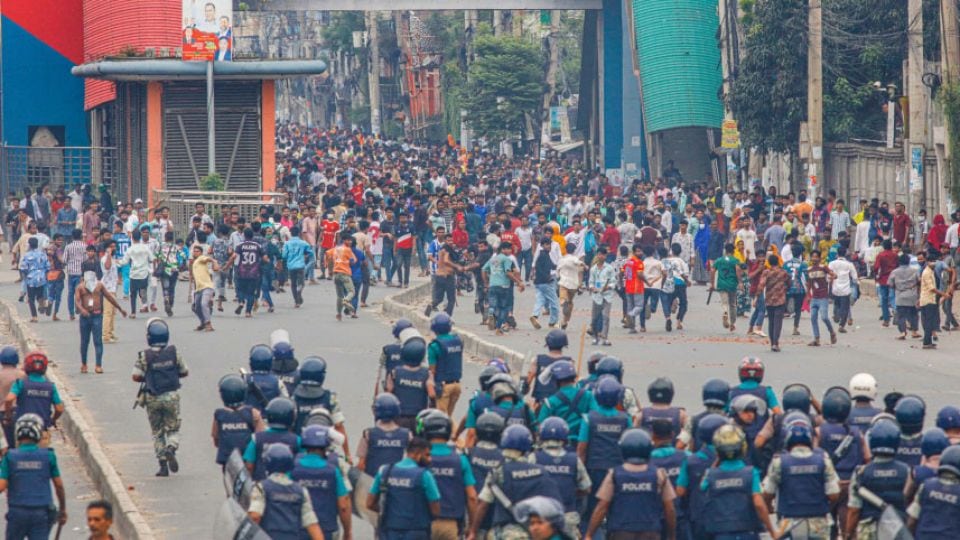
Garment workers in Bangladesh will start receiving wages under a revised pay structure in January, the newly formed minimum wage board announced after its first meeting in the capital. The announcement came as protests demanding higher pay entered their fifth consecutive day, with fresh clashes between workers and police reported in Gazipur, Narayanganj and Savar.
In Savar, protesters set fire to a police vehicle and blocked major roads, forcing more than 100 factories to suspend operations. Officials also declared holidays in Gazipur and Savar.
Wage board and pay timeline
Syed Azad Subhani, a district and sessions judge who chairs the minimum wage board for readymade garment workers, said the new pay increase would take effect in December, meaning workers would receive the higher wages in January. He spoke to reporters after the board's first meeting at its office in Segunbagicha. The board, which the government formed on November 1, will next consider wage proposals from workers, factory owners and other organisations.
Babul Akhter, the workers' representative on the board, urged employees to return to their workplaces. He said many had already gone back as the demonstrations gradually lost intensity.
Workers currently earn a minimum monthly wage of Tk 12,500 and are demanding Tk 30,000. They say years of persistent inflation have eroded their purchasing power.
Home Minister Salahuddin Ahmed said after an inter-ministerial meeting at the Secretariat that ordinary workers were being used in a political conspiracy and anti-state activities. He said law enforcers had been instructed not to use excessive force, even though several police personnel were injured. He warned that criminal groups would not be spared and urged workers to ignore rumours and return to their jobs.
Gazipur
In Gazipur, workers began demonstrating around 9:00 am at several locations, including Signboard, Bhogra Bypass, Chandana Chowrasta, Konabari and Banglabazar, according to police. Protesters blocked the Dhaka-Mymensingh highway at Bhogra Bypass, and police and Border Guard Bangladesh (BGB) members fired tear gas and sound grenades to disperse them. Traffic returned to normal around 12:30 pm.
More than 100 workers gathered near Basan Police Station on the Chandana Chowrasta-Shibbari road, and police fired at least 10 sound grenades to drive them away. In Gacha, demonstrators took to the streets around 9:30 am, triggering repeated chases between protesters and police.
Later, police broke up a gathering at Chandana Chowrasta. The crowd had come for a gayebana janaza, or funeral prayer held without the body, for garment worker Toufiq Hossain, 35, who died from injuries sustained during the unrest. Toufiq, from Gaibandha, worked at Laila Styles Ltd in Gazipur and died on Tuesday while being treated at a hospital in Uttara.
Leaders and activists of the National Citizen Party and Sramik Shakti had joined the event, which was organised under the banner of Workers-Students-People. Police asked the organisers to clear the road before the prayers began. When they asked for time to finish, an argument turned into a scuffle and police fired sound grenades. NCP leader Ali Naser Khan alleged that police used truncheons and sound grenades, injuring at least 20 people. Basan Police Station Officer-in-Charge Mohammad Harun Rashid said he was unaware of the incident. Executive Magistrate Arif Hossain said the administration was discouraging gatherings given the overall situation.
Speaking to reporters after a Secretariat meeting, Labour and Employment Minister Ariful Haque Choudhury said those responsible for Toufiq's death would be brought to justice as soon as possible.
Savar
In Savar, clashes broke out at Padmar Mor in Hemayetpur when police tried to remove protesters from the Hemayetpur-Singair road. Witnesses said workers hurled brick fragments and police responded with tear gas. Protesters then set a police vehicle ablaze.
Alia Akter, who works at a garment factory in Ashulia, said a wage board had been formed but workers needed clear information about how much their pay would rise. She said the protest would continue until that was provided.
Dhaka District Police Superintendent Shamima Parvin said 30,000 to 40,000 workers had gathered there. She alleged that protesters set fire to the vehicle of Savar Model Police Station OC Saiful Islam, seriously injuring him.
Three journalists were assaulted while covering the clashes: Ahmed Sohan Siraji, correspondent for Star News; Raiyan Bin Amin, correspondent for Ekattor Television; and Md Uzzal Hossain, a cameraperson. Sohan said a group of protesters wielding sticks attacked them while they were filming, after they noticed the Ekattor Television camera and logo.
Narayanganj
In Narayanganj, several factory workers demonstrated in the Katherpool area of Sadar upazila and tried to block the Hajiganj-Post Office road by setting fires. Police responded with tear gas and stun grenades. Some protesters tried to pull workers out of neighbouring factories, and chases followed after police stopped them from marching toward Shibu Market on the Dhaka-Narayanganj Link Road.
Additional Superintendent of Police Tarek Al Mehedi said six people were arrested after efforts to persuade the demonstrators to leave failed.
Police also filed a case under the Anti-Terrorism Act naming 21 people, including leaders and activists of the Awami League, Jubo League and Chhatra League, along with 1,000 to 1,500 unidentified individuals. Mohammad Mahbub Alam, OC of Fatullah Model Police Station, said the case was filed early the previous day. The six detainees were produced in court, and police requested a seven-day remand.
Mirpur and security deployment
In Mirpur, workers tried to take to the streets for a fifth day but were stopped by police. Closure notices were posted at no fewer than 15 garment factories, and police remained deployed at key locations. DMP Joint Commissioner Md Mahidul Islam said several people had been arrested and cases filed over road blockades, vandalism and damage to public property.
BGB Public Relations Officer Md Shariful Islam said 24 BGB platoons had been deployed in industrial areas: five in Savar-Ashulia, 13 in Gazipur and six in Narayanganj, including Chashara, the BSCIC industrial area and Kanchpur Bridge.