 Mekong Monitor
Bangkok Suffers Heaviest Losses as Thai Floods Hit Economy
Bangkok faces the largest share of economic losses from widespread flooding across 48 Thai provinces, with estimates ranging up to 25.3 billion baht. Economists and business leaders warn of supply chain disruption, weakened consumer confidence, and calls for structural flood investment over cash handouts.
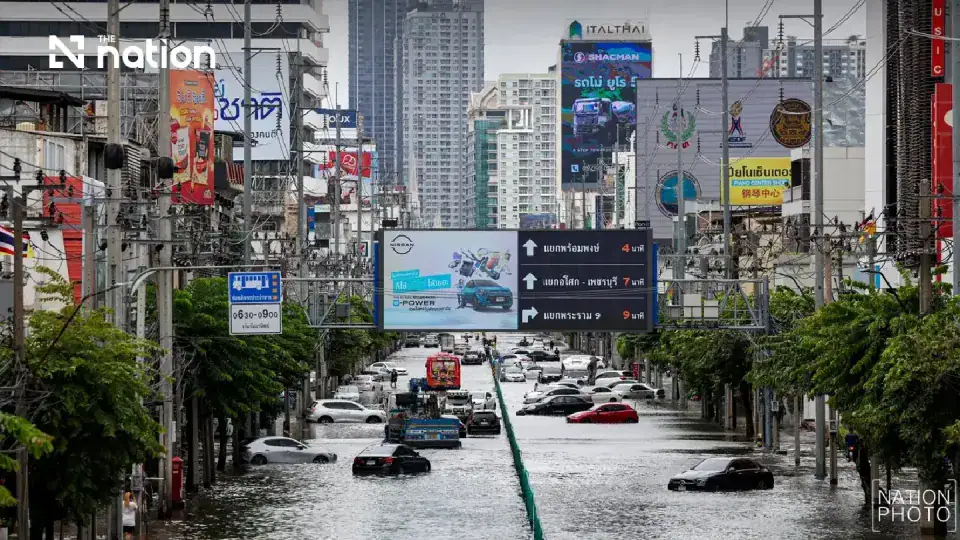
Flooding across 48 Thai provinces from September 24 to 27, 2026, could inflict economic losses of up to 25.3 billion baht (about US$754 million) under a moderate-damage scenario, according to Associate Professor Aat Pisanwanich of Rangsit University. Bangkok alone accounts for 10.6 billion baht of that total as inundation disrupts commerce, services, and travel. Business leaders warn many firms were unprepared for the severity and duration of the flooding, which overwhelmed the capital's drainage systems after slow-moving rain clouds dumped persistent downpours.
Economists offer differing loss estimates
Aat's analysis models low, moderate, and high-damage scenarios over four days. Nationwide losses range from 16.9 billion to 33.8 billion baht, translating to a third-quarter GDP impact of 0.36% to 0.73%, with the moderate scenario at 0.55%. In that scenario, Bangkok's 10.6 billion baht loss exceeds the East (5.5 billion) and Central (4.4 billion) regions. The capital's GDP impact is estimated at 0.23%, followed by the East at 0.12% and Central at 0.10%.
Wholesale and retail trade account for 23.4% of Bangkok's estimated losses, followed by finance and insurance at 14.9% and public administration at 10.3%, indicating disruption extends well beyond manufacturing into urban services and administrative activity.
Thanavath Phonvichai, president of the University of the Thai Chamber of Commerce, offered a separate assessment covering a shorter three-day window (September 25–27) across 21 provinces. He projects nationwide losses of 10 billion baht and a GDP impact of just 0.05%, assuming flooding in Bangkok and surrounding areas subsides within three days, though other areas could remain affected for up to a week. The two estimates cover different periods and geographies and do not represent a single agreed figure.
CIMB Thai flags consumption, tourism, and confidence risks
Dr. Amonthep Chawla, head of research at CIMB Thai Bank, said the overall impact should stay limited if floodwaters recede within two or three days. However, he stressed the need to monitor consumption, tourism, construction, and consumer confidence. Households are likely to delay major purchases and shift spending toward food and necessities. While post-flood repairs could spur some spending, weaker purchasing power and confidence may curb the recovery, and disrupted logistics could hinder deliveries even where demand exists.
Tourism may not see outright cancellations, but visitors could switch from Bangkok to destinations like Chiang Mai or Phuket, hurting hotels, restaurants, and retailers in flooded areas. The property market faces added pressure: flood exposure may deter purchases of detached homes outside the city center, while central Bangkok condominiums may see little additional impact. Some households may opt to rent city-center units instead.
Amonthep argued that cash handouts of 1,000 baht over two months would not fully offset losses, and extending such aid would not resolve Thailand's structural low growth and weak purchasing power. He called for clearly allocated investment in flood prevention, practical water-retention infrastructure, and jobs involving local residents rather than relying solely on cash transfers. Foreign direct investment and exports should remain largely unaffected, though agricultural flood damage could reduce output, raise prices, and weaken competitiveness. Crucially, he warned that damaged confidence in the government's flood management could force households and firms to bear higher self-reliance costs over the long term.
Industry federation says businesses were unprepared
Pimjai Leeissaranukul, chair of the Federation of Thai Industries (FTI), said weather warnings had not translated into adequate preparation. Even retailers did not anticipate floodwater accumulating on such a scale. She warned that industrial disruption could cascade through supply chains — from raw material procurement and worker commutes to transport and deliveries — with machinery, electrical systems, warehouses, and inventories all exposed. The FTI urged companies to urgently assess risks, review business-continuity plans, verify raw material availability and transport routes, and secure alternative routes and service providers.
Brokerages split on market and growth outlook
- CGS International Securities expects flood concerns to shave 10–15 points off the SET Index on September 28. Property shares face the strongest selling pressure as flooding influences home-buying decisions, while retail shares could see volatility as consumers curb spending. Foreign investors are closely watching tourism and restaurant implications. The firm maintains its 2026 GDP growth forecast of 2.5%.
- Kasikorn Securities sees a potential 0.1–0.2 percentage point downside to its roughly 2% growth forecast. The extension of the Thais Help Thais Plus stimulus programme is a positive factor, but a month-long flood could cause losses of 20–40 billion baht (0.15–0.25% of GDP). Sorrabhol Virameteekul noted the damage remains far below the 2011 disaster, which affected nearly 4.8 million hectares.
- UOB Kay Hian Securities takes a less pessimistic view. Kitpon Praipaisarnkit expects the economy to retain growth momentum and the SET Index to trade between 1,580 and 1,620 points. He does not expect flood damage severe enough to undermine fundamentals, noting conditions differ substantially from 2011 because water levels in the four main dams remain manageable.