 Mekong Monitor
As Rain Returns, Nepal Flood Survivors Face Cold and Leaking Tents
Renewed rain is soaking tents and bedding for flood-displaced families in Nepal’s Rasuwa and Nuwakot districts. Survivors are seeking dry supplies, medical care and permanent shelter as authorities consider resettlement options.
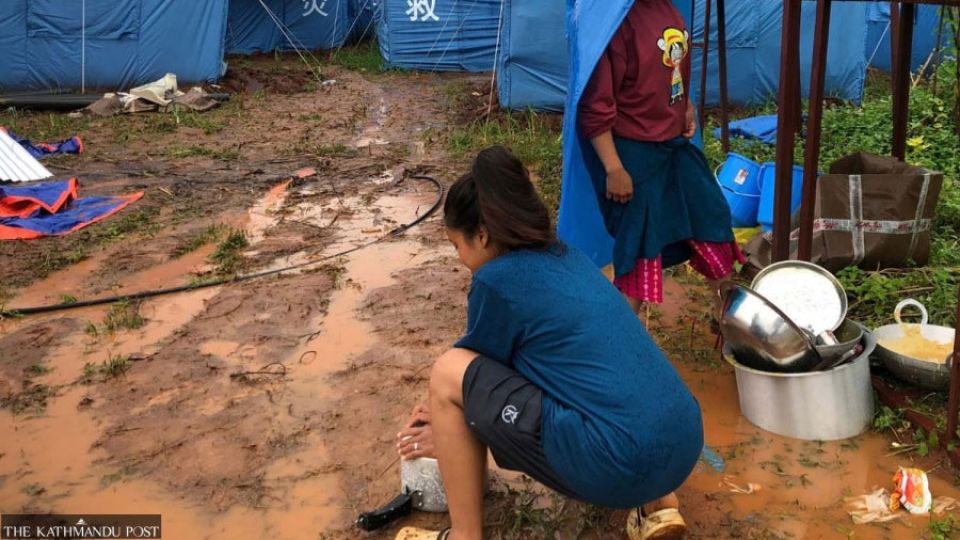
Fresh rain has brought new hardship to families displaced by the late-August flash floods in Nepal’s Rasuwa and Nuwakot districts. In many temporary camps, tarpaulin shelters are leaking, bedding is soaked and the ground has turned to mud.
At a camp below Shree Karma Dhechenling Monastery in Bandre, Nuwakot, Juthe Tamang said rainwater recently entered his tent and drenched the blankets and bedding. He added another tarpaulin for protection, but the shelter remains crowded. Three members of his family are staying there, while his 77-year-old mother-in-law had to spend the night with relatives because there was not enough room.
Rain has continued across Nepal since Thursday as a low-pressure system developed over the Bay of Bengal. Across Pipaltar, Dhunge, Gerkhu, Bhaise and areas around Trishuli Bazar, displaced families have pitched shelters in open fields and on higher ground, but many have been unable to keep the water out. Some residents say they stay awake at night to protect their belongings, while others have added a second tarpaulin. Persistent rainfall has left the soil beneath the tents wet and thick with sludge.
“During the day, you can find somewhere to shelter, but where do you go or sleep when it rains at night?” said Temba Tamang, who was displaced from Khalte in Rasuwa’s Uttargaya Rural Municipality and is living at the Pipaltar holding centre.
Temba said his family of three received a bed, though it is large enough for only one person. He gives it to his children and sleeps on the floor. His wife was swept up in the floods while he was working, and the children survived because they had gone to tuition classes. He found them four days after the disaster: his daughter had been rescued in Bidur and his son taken to Tamang Plaza Agro Resort before the family reunited at the holding centre.
At the Lito holding centre in Pipaltar, residents are worried about the health effects of wet clothes and bedding, particularly for children, new mothers and older people. Families with infants are running short of dry clothing, while the damp conditions prevent their belongings from drying. Many lost nearly everything and now rely on donated clothes.
Cooking has also become difficult. Families without proper facilities must burn firewood outdoors or cook inside tents filled with smoke and moisture. Binita Tamang, who is staying near the monastery in Bandre, said the wood had become too wet to burn. Although some centres have distributed induction cookers, individual tents generally lack electricity, leaving residents dependent on communal kitchens.
Norsang Tamang, who was displaced from Khalte, said she would work breaking stones to support her family if they had a permanent roof. Her husband has been missing since the floods, and she is living with their one-and-a-half-year-old son, three-year-old daughter, blind mother-in-law and elderly mother, who has asthma.
Days of rain have also increased fears of landslides and rising rivers near camps on hillsides and along riverbanks. Bhimsen Thapa, a retired soldier from Bogati village, said residents have grown increasingly anxious as the rivers swell.
Muddy, slippery roads are making it harder for survivors to reach government and ward offices to collect relief supplies or obtain official recommendations. Elderly and sick people in particular have struggled to leave the camps.
Authorities plan permanent settlements
For people who lost their homes, the most urgent need is a safe and lasting place to live. Many still lack warm clothing, umbrellas and raincoats, and some are clearing mud around their tents while wrapped in relief blankets. Survivors are asking for secure shelter, food, tarpaulins, mattresses and medical assistance.
Krishna Prasad Humagain, Nuwakot’s assistant chief district officer, has asked displaced residents to remain at designated holding centres until other arrangements are available.
Rasuwa has five holding centres, according to assistant chief district officer Dhruba Prasad Adhikari, who said the rain had not created major problems at those locations. A district committee has identified possible land for resettlement and submitted its recommendations to the central government. Adhikari said the process would begin after the central committee reaches a decision.
Dharam Raj Uprety, chief executive of the National Disaster Risk Reduction and Management Authority, said preparations were underway to create permanent settlements in Rasuwa and Nuwakot according to displaced families’ needs and preferences. Officials have gathered information on public and private land from Syaphrubesi and Timure in Rasuwa to Bidur in Nuwakot.
Uprety said survivors would be offered safe locations, including sites on forest or private land, and that legal changes could be considered if necessary.
For many families, however, a stable roof cannot come soon enough. Some are searching for rented rooms despite having little or no money to pay. Pemba Dechen Tamang, who is seven months pregnant and was displaced from Khalte, has been looking for accommodation since reaching the holding centre but has found nothing. Thirteen members of her family, including her husband, remain missing. “Everywhere I go, they say all the rooms are occupied,” she said.