 Mekong Monitor
Archived Royal Barge Article Misused in Thai Cultural Claims, Newspaper Says
The newspaper’s editorial board has rejected claims that a 2019 syndicated feature on Thai royal barges endorses an exclusive Thai cultural claim. It says the article is being shared out of context.
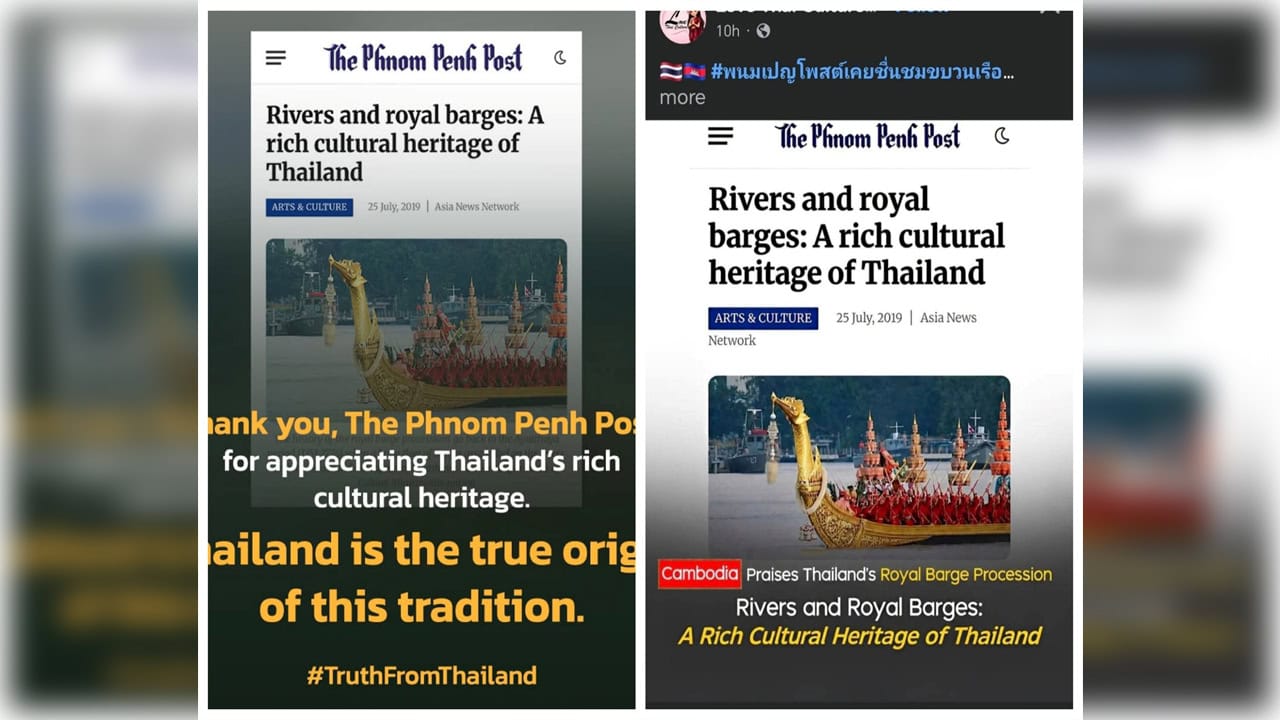
The newspaper’s editorial board has firmly rejected claims that a 2019 syndicated feature on Thailand’s royal barges represents the paper backing an exclusive Thai claim to a cultural tradition. The board says the article is being circulated outside its original context.
A screenshot of the piece, titled “Rivers and royal barges: A rich cultural heritage of Thailand” and dated July 25, 2019, recently spread on Facebook. It was posted by a group called Love Thai Culture, with the caption “Cambodia Praises Thailand’s Royal Barge Procession.” The image keeps the original date and a regional news-sharing credit, but the caption wrongly suggests the praise came from Cambodia.
The article itself states that these processions began during the Ayutthaya period (1351–1776), several centuries after similar scenes were carved into the walls of Angkor Wat.
A separate post, attributed to an account named “Royal Thai Army: Update,” thanked the newspaper for valuing Thai heritage and claimed that “Thailand is the true origin of this tradition.” The board says this shows the account had not actually read the article.
The feature was part of a routine content-sharing arrangement. The newspaper has been a member of a regional network of news organisations since July 2017, and these outlets exchange and republish cultural, economic and other coverage. The piece was originally produced by a fellow member and was meant to showcase regional heritage, not to establish where any tradition began or who owns it.
The board stresses that the article was never intended to deny or downplay the well-known traditions of Cambodia, including the Kingdom’s historic Water Festival (Bon Om Touk).
The newspaper also notes that boat processions with ceremonial vessels are a shared legacy across mainland Southeast Asia, with each country keeping its own distinctive customs. The board warns that stirring up “culture wars” does nothing to resolve the current border dispute, and encourages readers to view the piece as ordinary syndicated content rather than a statement in the middle of present-day political tensions.