 Mekong Monitor
Ancient Bridges in China and Cambodia Reveal Two Paths in 12th-Century Engineering
China’s Anping Bridge and Cambodia’s Kampong Kdei Bridge show how 12th-century engineers solved different challenges with distinct materials, methods and cultural designs.
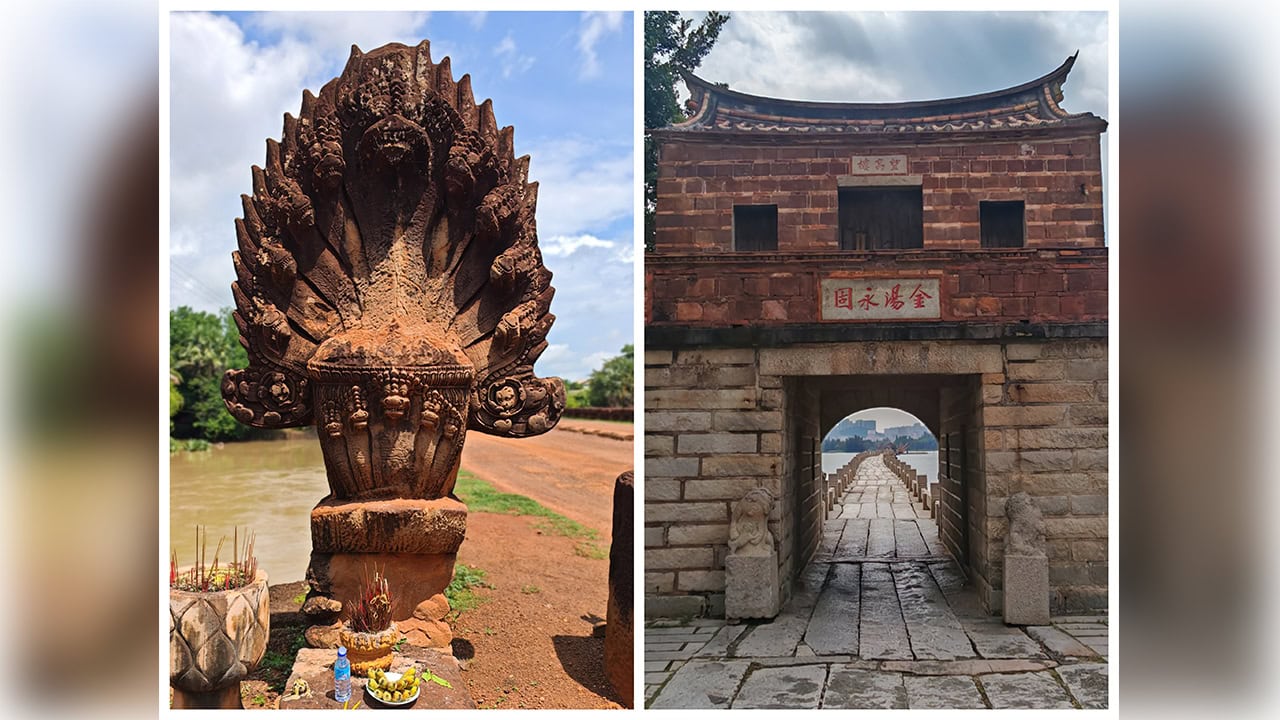
Almost 900 years ago, builders in China were placing huge granite slabs across a tidal estuary in Fujian province, while Khmer engineers were raising stone bridges along the road system of the Angkorian Empire.
Although they were created for different landscapes and needs, China’s Anping Bridge and Cambodia’s Spean Praptos, also known as Kampong Kdei Bridge, remain notable examples of 12th-century engineering skill.
A group of ASEAN journalists visited Anping Bridge in Anhai town, Jinjiang, on September 22. A local guide described how its builders dealt with soft seabed, tidal flows and the challenge of moving stone blocks weighing several tonnes.
Anping Bridge and maritime China
Anping Bridge links Anhai town in Jinjiang with Shuitou town in Nan’an. Both are county-level cities under Quanzhou in Fujian province.
Construction started in 1138 during the Southern Song dynasty and was finished in 1152. That means work began 888 years ago, while the completed bridge has endured for about 874 years.
The bridge is about 2.25km long and ranges from 2.9m to 4m in width. It is also called Wuli Bridge, or Five-Li Bridge, because its length was roughly equal to five traditional Chinese li.
The guide said the longest stone slab measures around 11m, while the heaviest weighs about 25 tonnes. Without modern lifting machinery, workers moved granite by boat and used the rise and fall of the tide to help set the slabs onto the piers.
Some local accounts say part of the stone may have come from Kinmen and nearby islands, though the full origin of all the granite has not been confirmed.
Anping Bridge also used a sleeper-log foundation method. Builders placed wooden logs over soft mud, then laid heavy stones on top, gradually pressing the structure down toward a firmer load-bearing layer.
Oysters around submerged sections also helped protect the bridge. Rather than producing an adhesive substance, their shells built up around the masonry and reinforced the outer surface against waves and erosion.
The bridge’s builders used three types of piers to suit different water currents: rectangular piers, single-pointed or half-boat-shaped piers, and double-pointed boat-shaped piers.
Official descriptions usually list 360 piers, including 290 rectangular, 44 single-pointed and 26 double-pointed piers, though some accounts give the number as 361. The bridge has 362 water openings.
Anping Bridge supported commerce and travel between Quanzhou and areas to the south. Its scale reflects the wealth generated by maritime trade during the Song and Yuan periods.
In 2021, the bridge became one of 22 component sites included in the UNESCO World Heritage listing for “Quanzhou: Emporium of the World in Song–Yuan China”.
Kampong Kdei and the Angkorian road network
Cambodia’s Kampong Kdei Bridge offers a comparison from roughly the same era.
Located in Kampong Kdei, Chi Kreng district, Siem Reap province, the bridge is about 87m long. It is associated with the reign of King Jayavarman VII and the road network that linked Angkor with other parts of the Khmer Empire.
Unlike Anping Bridge, which relies on long granite beams set across hundreds of piers, Kampong Kdei was built from laterite blocks and features more than 20 corbelled arches.
Its nine-headed naga balustrades show how Khmer builders combined practical engineering with religious symbolism and artistic identity.
Different answers to similar problems
The two bridges show contrasting solutions to the challenge of crossing water.
Anping Bridge served a maritime trading world, using tides, timber foundations and pier shapes designed for different currents. Kampong Kdei carried travellers across a river as part of the Angkorian land transport network.
Their continued survival shows that ancient bridges were more than routes for movement. They were lasting statements of economic strength, technical knowledge and cultural identity.