 Mekong Monitor
Amazing Nature of Cambodia Aims to Bring Wildlife Closer to City Youth
Cambodia’s forests, wildlife and wetlands take centre stage at a two-day public event in Phnom Penh aimed at city residents, especially young people. The programme encourages greater public participation in wildlife protection and conservation.
Cambodia’s forests, wildlife, rivers and wetlands will be the focus of a public awareness event in Phnom Penh over the weekend of October 24–25. The organisers want city residents, especially young people who rarely get to experience natural ecosystems first-hand, to see the country’s natural heritage up close and to take a more active part in wildlife protection and conservation.
The inaugural “Amazing Nature of Cambodia” runs from 11am to 8pm each day at Aeon Hall, on the third floor of AEON Mall Sen Sok City. Its theme is “Appreciating the Value of Nature.”
A two-day showcase
The event will bring together government bodies, conservation groups, private companies, local communities, schools and universities, and youth organisations. Together they aim to deepen public understanding of Cambodia’s natural resources and explain why protecting them matters for future generations.
According to a press release issued on October 23, the programme will highlight the country’s forests, rivers, wetlands and coastal ecosystems. It will also show how these areas provide clean water, food, livelihoods and cultural identity, while supporting tourism and the wider economy.
Beyond celebrating Cambodia’s biodiversity, the initiative is designed to raise awareness of wildlife protection, endangered species, the prevention of wildlife crime, and the responsible use of media and social platforms in support of conservation.
Making conservation science accessible
Oum Sony, country director of Conservation International Cambodia and a member of the organising committee, said the event would give conservation groups and communities a shared platform to present their experiences, scientific findings and practical methods for protecting nature.
He said the event was especially aimed at helping young people see how nature connects to their daily lives and recognise the part they can play in conservation. As a science-based organisation, he added, conservation groups have a duty to explain their findings in clear, accessible language, act as a bridge between partners, mobilise resources and encourage cooperation so that people and nature can thrive together. He stressed that making scientific knowledge easier to understand is key to drawing more people into efforts to protect the country’s natural heritage.
Why young city residents are part of the picture
For young people in urban areas, the event offers more than a chance to discover Cambodia’s biodiversity. Visitors can speak with conservation experts, learn about the environmental challenges facing the country, and find out what practical steps they can take themselves.
Hak Socheata, a youth volunteer helping to organise the event, argued that climate change and environmental decline should not be seen as distant problems just because many young people live far from forests and wildlife habitats. She said that nature supports people every day, and that everyone has a responsibility to give something back. Volunteering, she explained, had given her the chance to learn from conservationists and to understand how healthy ecosystems are tied to human wellbeing.
She hopes more young Cambodians will get involved, beginning with small, practical actions in their own communities. “We can start with what is within our reach,” she said, “because every action, large or small, can contribute to positive change.”
Conservation and local livelihoods
The event will also look at how protecting natural resources can go hand in hand with sustainable economic activity. Visitors will be able to meet community representatives and see locally made products, with a focus on how responsible production and consumption can protect nature while supporting rural families.
Ung Samath, secretary of state at the Ministry of Agriculture, Forestry and Fisheries, pointed out that farmers and fishers depend heavily on land, water and other natural resources, both for their incomes and for the food eaten across the country. He said efforts to raise farm output and household incomes must go hand in hand with the sustainable management of those resources. Samath linked the initiative to the National Policy on Agricultural Development 2022–2030, which puts competitiveness, inclusion, climate resilience and sustainability at its core.
Government backing for behaviour change
Khvay Atitya, spokesperson for the Ministry of Environment, said that changing public habits and getting every sector of society involved were essential to meeting Cambodia’s environmental goals. He noted that the government’s Circular Strategy on Environment 2023–2028 places public communication and behaviour change at the heart of efforts to promote cleanliness, greenery and sustainable development.
Current initiatives include campaigns to cut plastic use, partnerships with the Ministry of Education, Youth and Sport to promote “clean habits and a clean culture,” and the Green Sprouts campaign, which aims to grow, distribute and plant at least one million trees each year. Atitya said the event fits within this strategy and offers another opportunity to share knowledge and build wider public appreciation of nature.
The role of responsible reporting
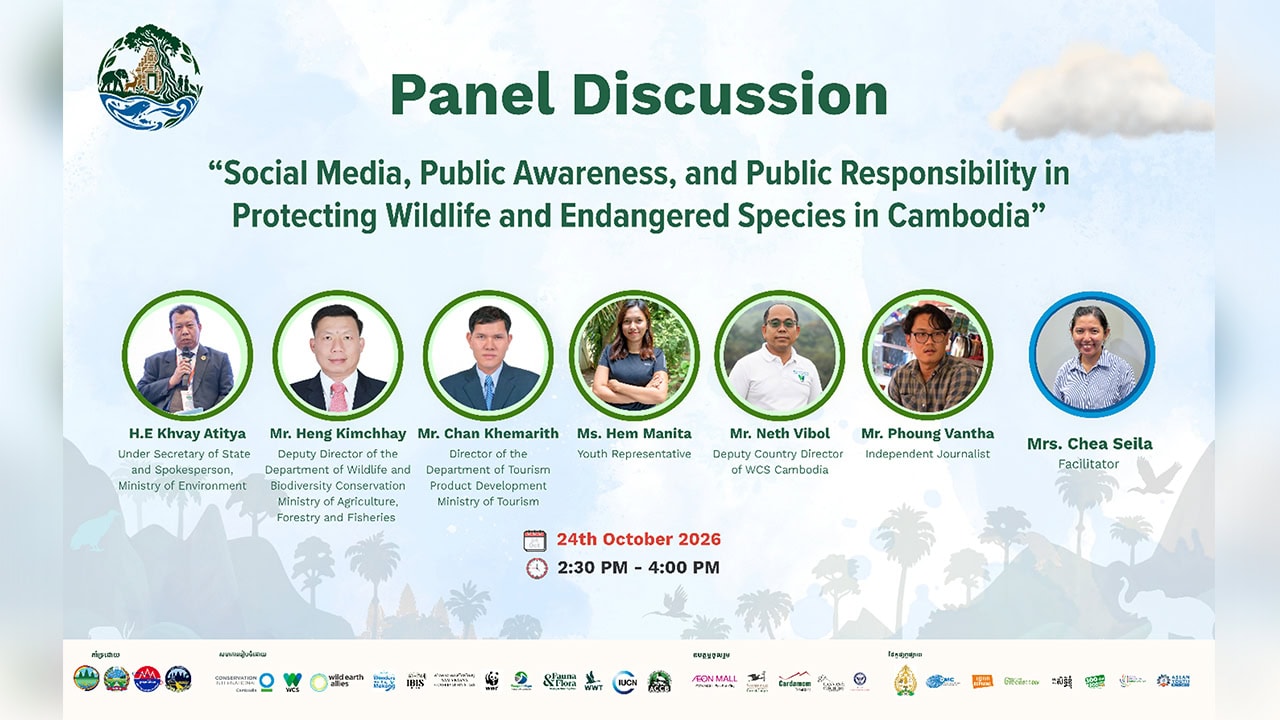
The first day will include a panel discussion with government officials, conservation groups, journalists and youth representatives. They will examine how responsible communication, social media and public engagement can help protect wildlife and endangered species. Participants will discuss practical challenges and consider how institutions and individuals can work more effectively to prevent wildlife crime and safeguard the country’s natural heritage.
Tep Asnarith, spokesperson for the Ministry of Information, stressed that accurate, ethical and evidence-based reporting is vital to raising public awareness of environmental protection. He said journalists, media outlets, content creators, conservationists and community members all have a role in sharing reliable stories about Cambodia’s natural resources, both at home and abroad. Clear sources and verified facts, he argued, build trust, support conservation, tourism and community development, and strengthen the country’s international reputation.
Partners and supporters
The event is backed by the Ministries of Environment, Agriculture, Forestry and Fisheries, Information, and Tourism. It is co-organised by Conservation International Cambodia, the Wildlife Conservation Society (WCS), Wild Earth Allies, Wonders of the Mekong, IBIS Rice, Sam Veasna Conservation Stays, WWF, NatureLife Cambodia, Fauna & Flora, the Wildfowl & Wetlands Trust (WWT) and the International Union for Conservation of Nature (IUCN).
Private-sector partners, including AEON Mall Sen Sok City, Siempang Forest Lodge, Cardamom Tented Camp and Canvas & Orchids Retreat, are also supporting the event. Educational institutions, media partners, youth groups and local communities are taking part as well.